Yoon Led Improvement in Relations by Yielding to Japan
But Impeachment Verdict Could Reverse Korea-Japan Policy
Past Issues May Hinder Again... Concerns Over Trump Response
Although it is the 60th anniversary of the normalization of diplomatic relations between Korea and Japan, concerns are emerging that the momentum for cooperation may instead be lost. If South Korea's policy toward Japan is overturned depending on the impeachment trial results of President Yoon Suk-yeol, it is uncertain whether solutions such as the 'forced labor compensation' will remain valid. Historical issues could once again become a source of conflict.
According to diplomatic circles on the 2nd, Japan had been considering inviting Prime Minister Ishiba Shigeru to visit Korea this month and then extending a state visit invitation to President Yoon Suk-yeol, but the plan was canceled. Korea and Japan began preliminary negotiations in January 1951 during the height of the Korean War, and after 14 years of marathon talks, the Korea-Japan Agreement was signed in 1965.
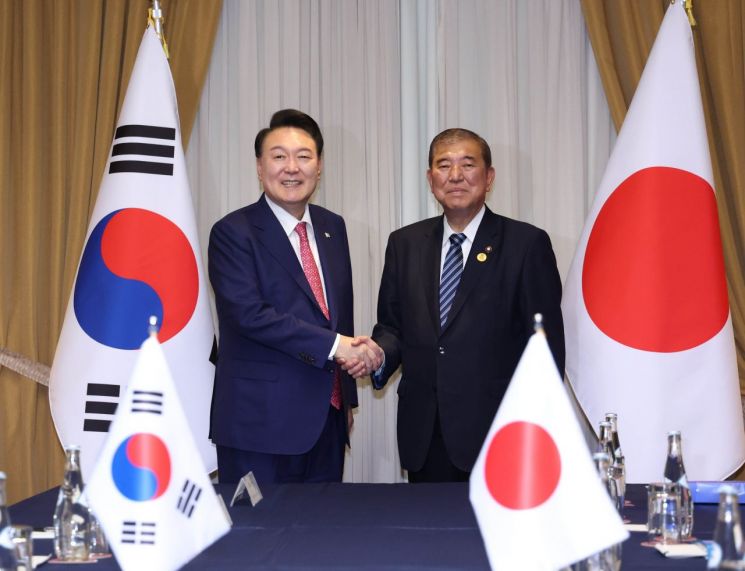 President Yoon Suk-yeol shakes hands with Japanese Prime Minister Ishiba Shigeru before a summit meeting at a hotel in Lima, Peru, in November last year. Photo by Yonhap News
The Yoon Suk-yeol administration showed the strongest will to improve Korea-Japan relations among all previous governments up to the 60th anniversary of diplomatic ties. They took the first step toward normalization by proposing a 'third-party compensation' solution to the forced labor compensation issue. President Yoon and former Prime Minister Kishida Fumio held as many as 12 summit meetings, demonstrating close cooperation. However, there is criticism that Korea only conceded unilaterally to Japan without gaining much in return.
Korea-Japan relations contain both crisis and opportunity factors. The 60th anniversary of diplomatic relations was significant in terms of continuing a cooperative phase. However, with the leaders of both countries facing political crises, they are confronted with a situation different from expectations. Japan faced a minority government after the Liberal Democratic Party's defeat in the House of Representatives election held in October last year. Prime Minister Ishiba is suffering from a triple burden due to a weak party base and declining approval ratings.
In this context, the greatest concern is the '80th anniversary of defeat' prime ministerial statement expected in August. In the 70th anniversary statement in 2016, then-Prime Minister Abe Shinz? said, "We can no longer pass on apologies to future generations." Although Prime Minister Ishiba is evaluated to have a different stance on historical recognition, considering the confusing political situations on both sides, it seems unlikely that Korea will receive the 'sincere response' it has persistently demanded.
Even during the period when President Yoon was strengthening Korea-Japan relations, historical issues remained a factor preventing the relationship from entering a stable phase. Japan's provocative remarks about Dokdo and distortion of history textbooks continued annually, and the 'Line Yahoo' incident triggered by the involvement of the Ministry of Internal Affairs and Communications also erupted. The process of registering Sado Mine, a forced labor site during the Japanese colonial period, as a UNESCO World Cultural Heritage site, where Japan blindsided Korea, is considered the greatest crisis.
An immediate crisis is expected to become apparent with the launch of the 'Trump 2nd term.' The Donald Trump administration is passive toward multilateral cooperation. For Japan, there are sufficient reasons to continue cooperation with Korea in economic and security fields. The intensifying US-China competition and the precarious international situation such as illegal military cooperation between North Korea and Russia are in the same context. In this case, analyses suggest that Korea, where summit diplomacy is virtually impossible, will be placed in a diplomatically disadvantageous position.
© The Asia Business Daily(www.asiae.co.kr). All rights reserved.

















