"There Were Countless Warnings and Signs"
"Cannot Be Solved by Hatred or Expulsion"
"Urgent Call for Unnecessary Airport Full Review"
As bird strikes are cited as one of the causes of the Jeju Air passenger plane disaster at Muan International Airport, an animal protection organization has expressed concerns about the perception of migratory birds and others as targets for expulsion.
Animal Liberation Wave issued a statement related to the disaster on their official social media (SNS) account on the 30th of last month. They said, "We express our deepest condolences to all humans and animals who lost their lives in the Jeju Air disaster at Muan Airport," and opened by stating, "The cause and responsibility of the accident must be clarified as soon as possible, and fundamental measures should be established to prevent such tragedies from recurring." They added, "Currently, engine damage caused by bird strikes is pointed out as one of the causes of the accident, but we are seriously concerned about simplifying this disaster as a problem of a specific region or aircraft type, as well as targeting animals such as migratory birds for expulsion."
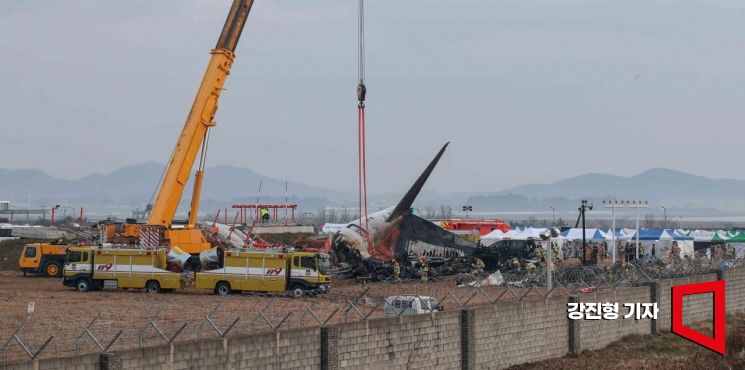 Firefighters are searching for belongings at the site of the Jeju Air passenger plane collision and explosion accident that occurred last month on the 30th at Muan International Airport in Jeollanam-do. Photo by Kang Jin-hyung
Animal Liberation Wave explained, "There were countless warnings and signs before this disaster. According to Korea Airports Corporation, from 2019 to the first half of 2024, there have been 623 bird strikes at domestic airports," adding, "In the United States, about 13,000 bird strikes are reported annually, and in Europe, airlines are implementing bird detection technology and habitat management strategies using radar and sound systems, but the focus is generally on driving birds away from their habitats." They continued, "In Korea, concerns about bird strikes have been consistently raised through environmental impact assessments and private ecological surveys at locations including Muan International Airport, Saemangeum International Airport, Gadukdo New Airport, and Jeju Second Airport," and further explained, "Instead of year-round continuous investigations recommended by the International Civil Aviation Organization (ICAO), short-term surveys have been conducted or sometimes skipped altogether, resulting in the production of perfunctory and makeshift policies without a proper understanding of bird ecology."
They also stated, "Increasing the number of bird strike prevention personnel, installing detectors, or scaring birds away with sound waves and shotgun blasts will not solve the problem. These airports are located near tidal flats and lakes, which are migratory bird habitats," adding, "Originally, the airports are situated in vast grasslands where feeding is easy and there are few people, attracting birds. Recently, due to abnormal climate effects, migratory birds have become territorial and often stay around the airports permanently, increasing the risk." Furthermore, they emphasized, "The bird strike issue cannot be resolved through hatred or expulsion of animals," and urged, "We call for stopping the construction and operation of unnecessary airports driven by construction capitalism that simply targets, expels, or sacrifices birds, and for a comprehensive review to preserve ecological value and life." They concluded, "We deeply mourn all victims of this disaster and will continue to strive to create safe and peaceful habitats for both animals and humans."
Meanwhile, the area around Muan Airport is a migratory bird habitat where 88 species appear, with six species including mallards classified as 'Level 3 risk' birds based on bird strike risk analysis. A recent survey conducted by the National Institute of Ecology last month observed 1,792 migratory birds at Muan Reservoir, 4,315 at the Muan-Mokpo coast, and 12,779 in Hyeonggyeong-myeon and Unnam-myeon. On the day after the accident, Joo Jong-wan, Director of the Aviation Policy Office at the Ministry of Land, Infrastructure and Transport, stated, "The pilot declared a 'Mayday' (distress call) due to a bird strike at 8:59, which was the first and only such declaration, and then attempted to return," adding, "At some point during this process, communication with the air traffic controller became difficult, and the accident occurred while attempting to land again."
© The Asia Business Daily(www.asiae.co.kr). All rights reserved.

















