Acting Chief Justice Choi Sang-mok's Appointment as Constitutional Court Justice an Inevitable Decision Considering Economic Conditions
Political and Economic Uncertainty Growing Unprecedentedly, Interest Rate Cut Pace to Be Decided Flexibly
Lee Chang-yong, Bank of Korea Governor, 2025 New Year's Address
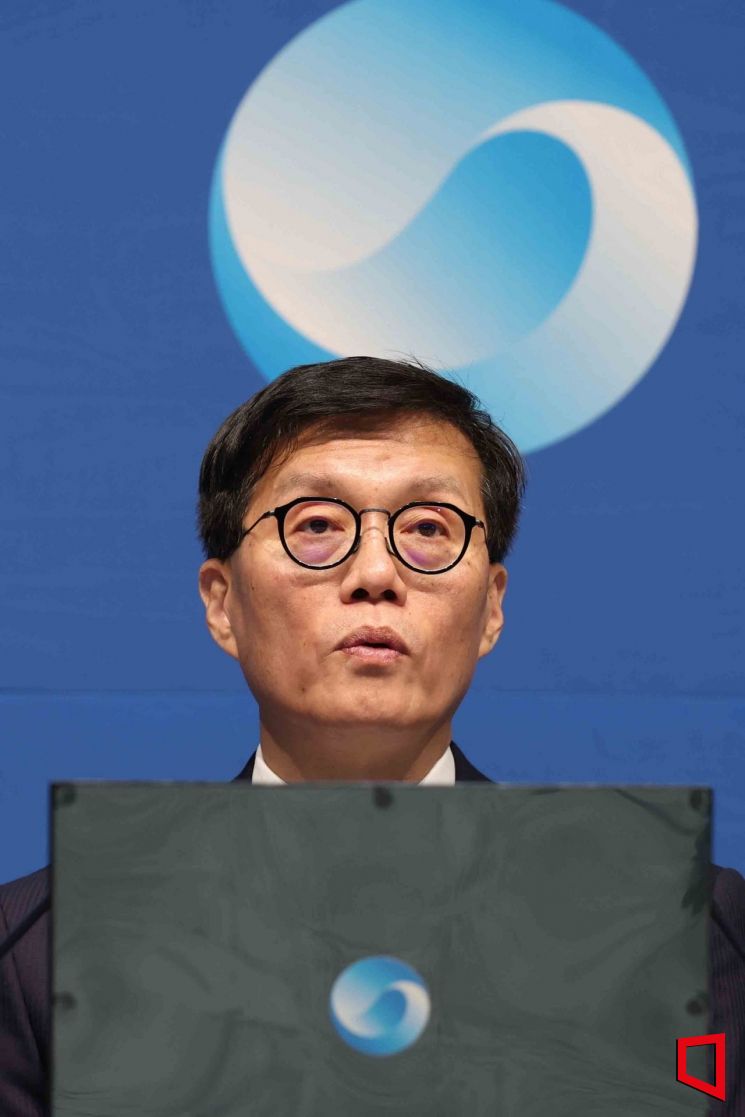
Lee Chang-yong, Governor of the Bank of Korea, evaluated the appointment of Choi Sang-mok, Acting Prime Minister and Minister of Strategy and Finance, as a Constitutional Court Justice as an inevitable decision made with economic considerations rather than political ones. Regarding the future base interest rate, he stated that due to unprecedented political and economic uncertainties, the pace of rate cuts will be flexibly determined according to changing circumstances.
In his 2025 New Year's address released on the 2nd, Governor Lee said, "This year, political and economic uncertainties are greater than ever, so monetary policy needs to be operated flexibly and nimbly in response to changing situations," adding, "As conflicts among policy variables such as inflation, growth, exchange rates, and household debt are expected to expand, we will flexibly determine the pace of rate cuts based on the data obtained."
Appointment of Choi Sang-mok as Constitutional Court Justice an Inevitable Decision for the Economy
He emphasized that it is difficult to stabilize the Korean economy with monetary policy alone under the current circumstances and that politics must quickly find stability. "If the political conflict and resulting government vacuum persist, it will negatively affect external credibility and add direct and indirect shocks to the overall economy, so it is of utmost importance that the government command center remains stable," he stressed.
He further stated, "Acting Prime Minister Choi made a difficult but inevitable decision prioritizing the economy over politics to prevent a decline in external credibility and a government vacuum," adding, "This will serve as a starting point to signal domestically and internationally that our economic system will operate normally and independently from the political process going forward."
Governor Lee has been conducting the macroeconomic and financial issues meeting (known as the F4 meeting) with Acting Prime Minister Choi, Financial Services Commission Chairman Kim Byung-hwan, and Financial Supervisory Service Governor Lee Bok-hyun to review and respond to domestic economic issues. He said, "Now is the time for the ruling and opposition parties to cooperate to stabilize the government command center," adding, "In this process, the Bank of Korea will play the role of a breakwater, maintaining its balance amid the storm and advising government policies to protect external credibility."
He diagnosed that the conditions surrounding the Korean economy this year will be more difficult than ever. Externally, he judged that if the new U.S. administration's protectionist policies become full-fledged, global trade will shrink, making exports difficult. He also suggested that due to the sustained U.S. economic boom, the pace of U.S. interest rate cuts may be slower than expected, potentially causing exchange rate volatility to persist for a considerable period.
Domestically, he pointed out that if interest rate cuts continue, it could develop into instability factors such as household debt, and if political uncertainties persist, overlapping with worsening external conditions, the negative impact on the economy could increase.
Focus on the Birth of Innovative Companies to Revitalize the Economy
He emphasized that the birth of innovative companies is essential for the Korean economy to regain vitality. Governor Lee explained, "Our export structure has not diversified and has become fixed around a few key products such as semiconductors and automobiles, raising concerns about export slowdown," adding, "As the entire export fluctuates according to the cycle of specific industries, China, a latecomer, is catching up with us in key industries."
He pointed out, "New industries that should lead future exports have not been developed over the past decade," stating, "Comparing the top 15 companies by sales in Korea and the U.S. ten years ago, seven new companies entered the U.S. list, whereas in Korea, only one company has entered as a new growth business, meaning there has been almost no new entry."
He added, "The lack of new growth companies or industries in our economy may be because we have avoided managing the social conflicts that accompany the 'creative destruction' process emphasized by Schumpeter, seeking stability instead," urging reflection on this point.
He also voiced concerns regarding household debt. Governor Lee said, "As concerns about economic slowdown grow this year, voices calling for postponing household debt management and focusing more on economic stimulus are increasing," warning, "However, doing so risks repeating past mistakes of ignoring future risks to alleviate immediate economic slowdown pain."
While acknowledging that "microscopic adjustments to non-real estate household debt and non-capital region real estate loans can be considered in light of the economy," he insisted, "The macroprudential policy stance of managing household debt growth within nominal economic growth must be maintained unwaveringly from a macro perspective."
© The Asia Business Daily(www.asiae.co.kr). All rights reserved.
![Clutching a Stolen Dior Bag, Saying "I Hate Being Poor but Real"... The Grotesque Con of a "Human Knockoff" [Slate]](https://cwcontent.asiae.co.kr/asiaresize/183/2026021902243444107_1771435474.jpg)











