BoA, Deutsche Bank Forecasts
Tax Cuts to Drive Economy
US Stock Market Expected to Remain Strong
S&P 500 Average Target 6508
Inflation Reignition a Possible Variable
This year, due to the pro-business policies of the second term of the Donald Trump administration, such as deregulation and tax cuts, as well as the Red Sweep (Republicans controlling both the executive and legislative branches), the U.S. economy is expected to achieve a solid growth rate exceeding 2%. As a result, the prevailing outlook is that the U.S. stock market boom and strong dollar trend will continue this year. However, the possibility of inflation intensification due to Donald Trump's threats of imposing tariffs and deporting illegal immigrants is identified as a variable for U.S. economic growth.
Strong U.S. Growth Expected This Year
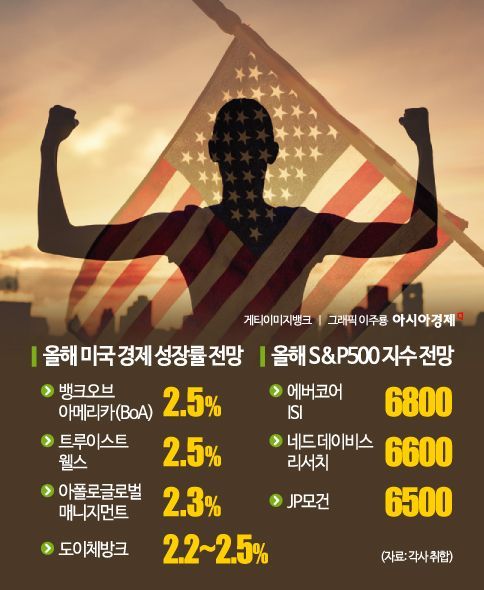
On the 2nd, after compiling this year's U.S. Gross Domestic Product (GDP) growth forecasts from various institutions, Bank of America (BoA) and Truist Wealth projected 2.5%, Apollo Global Management 2.3%, and Deutsche Bank 2.2?2.5%. Although this is a slowdown compared to the International Monetary Fund (IMF)'s last year's GDP growth forecast (2.8%), it remains much higher than the major Group of Seven (G7) countries such as Japan and France (1.1%), and the United Kingdom (1.5%).
Trump's America First policy, tax cuts, and encouragement of mergers and acquisitions (M&A) are expected to drive the U.S. economy. In particular, with the Republican Party controlling the White House and both houses of Congress, the likelihood of extending the Tax Cuts and Jobs Act (TCJA), which is set to expire this year, has increased, which is expected to greatly aid corporate growth. The TCJA, passed during Trump's first administration in 2017, primarily lowered the corporate tax rate from 35% to 21%, and Trump pledged during his presidential campaign to extend this law and further reduce the rate to 15%.
Comerica, a mid-sized U.S. bank, stated, “Such tax cut policies will increase household disposable income and corporate profits,” adding, “This will lead to a virtuous cycle of consumer spending and employment.”
Stock Market Booming... Inflation as a Variable
Accordingly, the dominant view is that the U.S. stock market will continue its boom this year. The average year-end target for the S&P 500 index from 26 financial institutions is 6508, indicating a potential increase of 10.65% compared to last year's closing price. The most bullish forecast came from Oppenheimer at 7100, followed by Evercore ISI at 6800. Goldman Sachs, Morgan Stanley, Citigroup, and JP Morgan all projected 6500. Evercore ISI expects the AI boom, which was the growth driver of last year's U.S. stock market, to continue this year and lead the upward trend.
However, the possibility of inflation reigniting due to policy uncertainties such as illegal immigrant deportations and tariffs is considered a variable for economic growth. Vanguard predicts that the U.S. core Consumer Price Index (CPI) will remain above 2.5% throughout this year, while Ned Davis Research forecasts a range of 2.75?3.25%. National West recently raised its forecast for the Personal Consumption Expenditures (PCE) price index to 2.4%?3.2% this year.
TD Securities expressed concern, stating, “Tariffs and immigration policies in the U.S. could raise inflation by nearly 1 percentage point through early 2026, ultimately burdening growth and significantly impacting monetary policy.” Bel Air Investment noted, “The combination of tariffs, stricter immigration regulations, and onshoring could lead to higher inflation in the future.” However, UBS offered a different view, saying, “U.S. growth will offset the tariff impact on Chinese and European imports thanks to deregulation and improved corporate confidence.”
BNP Paribas: “Possibility of Holding Interest Rates Steady Throughout the Year”
Some believe the Fed may slow the pace of interest rate cuts. The Fed projected a year-end interest rate of 3.9% in its dot plot updated on the 18th of last month. While many investment banks generally expect rates to remain at this level, BNP Paribas warned, “Due to increased uncertainty and inflationary pressures this year, the Fed may hold interest rates steady throughout 2025.”
As a result, the U.S. Treasury market, which experienced a boom last year, is likely to face a downturn this year. Regarding the year-end forecast for the 10-year U.S. Treasury yield, Comerica projected an average of 4.25?4.75%, and Wells Fargo forecast 4.5?5%. Considering the current 10-year yield is around 4.573%, this suggests room for upward movement. When bond yields rise, bond prices fall.
However, Jefferies assessed that concerns over Trump's tariff threats are overly exaggerated. Trump pledged to impose a universal 10% tariff on all imports, but this is expected to be used more as a measure to reduce the U.S. trade deficit rather than being fully implemented.
Trump's protectionist trade policies are expected to sustain the strong dollar for the time being. Bloomberg reported, “Several institutions have predicted that the euro could fall to parity (1 euro = 1 dollar), meaning a decline in the euro's value and a rise in the dollar.” The euro has only broken parity twice, in 2002 and 2022.
© The Asia Business Daily(www.asiae.co.kr). All rights reserved.

![Clutching a Stolen Dior Bag, Saying "I Hate Being Poor but Real"... The Grotesque Con of a "Human Knockoff" [Slate]](https://cwcontent.asiae.co.kr/asiaresize/183/2026021902243444107_1771435474.jpg)














