Opening of Sejong-Pocheon Expressway... Acceleration of Gyeongbu Expressway Underground Project
452.1 Billion KRW Invested in Road and Rail to Expand Transportation Infrastructure
In the year of Eulsa, the transportation network including roads and railways connecting Yongin City in Gyeonggi Province and major hub cities is expected to become more dense. Following the opening of the Yongin section of the Sejong-Pocheon Expressway on January 1, the first day of the new year, major metropolitan transportation projects such as the undergrounding of the Gyeongbu Expressway are accelerating, bringing the establishment of a metropolitan-level transportation network one step closer.
Yongin City announced on the 2nd that it plans to invest a total of 452.19604 billion KRW this year in road and railway network construction projects to create an urban structure at the metropolitan city level. The budget for each sector in the new year is ▲roads 196.95439 billion KRW ▲urban rail 48.3702 billion KRW ▲public transportation, logistics, and others 206.93463 billion KRW. This represents a 5.39% increase compared to last year's total of 429.05475 billion KRW.
We review the current status of major metropolitan and regional transportation networks and related infrastructure projects around Yongin City.
Denser and Farther... Organic Connection of Expressways, National Roads, and Local Roads
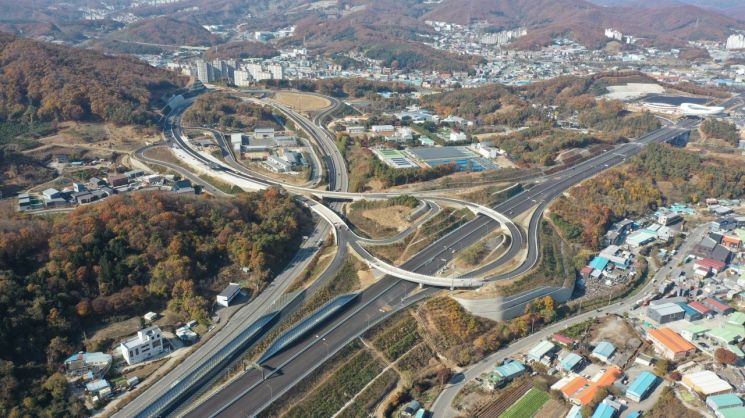 A view of Bukyongin IC on the Anseong~Yongin~Guri section of the Sejong~Pocheon Expressway, which opened on the first day of the new year, January 1. It is expected to become a key axis connecting Yongin City with the eastern Seoul area, northern Gyeonggi, and the Chungcheong region. Provided by Yongin City
A representative change in the Yongin area transportation network in the new year is the opening of the Anseong~Yongin~Guri section of the Sejong-Pocheon Expressway. This road network, opened on the 1st, is expected to become a key north-south arterial road connecting Yongin with major regions alongside the existing Gyeongbu Expressway. The Yongin section of the newly opened road is 26 km long, connecting to the Yeongdong Expressway via the Yongin Junction and to the Seoul Metropolitan Area 2nd Ring Road at the Bukyongin Junction, greatly improving access to Osan and Hwaseong.
The city plans to open the 2.32 km section of Local Road 321 from Maesan to Ilsan, which connects to the Bukyongin IC (Mohyeon), within the year to facilitate easy access to the IC, and is also requesting Gyeonggi Province to expedite the design of the 3.7 km section from Yuwon to Maesan and to include the expansion plan for the 2.3 km section from the entrance of Maesan 4-ri to Maesan Intersection.
The city's conceptualized 'L-shaped triple road network' is also expected to gain momentum. This concept consists of the semiconductor expressway axis (L1) and two semiconductor inland road axes (L2, L3). The L1 axis is a route connecting the underground Gyeongbu Expressway and the semiconductor expressway (Hwaseong Yanggam~Yongin Namsa·Idong~Anseong Iljuk).
Among these, the undergrounding project of the Gyeongbu Expressway section from Giheung IC to Yangjae IC (26.1 km) passed the preliminary feasibility study by the Ministry of Economy and Finance in August last year. Upon completion, the project is expected to alleviate congestion on the Gyeongbu Expressway and improve logistics movement among semiconductor companies concentrated in Yongin. Approximately 3.7879 trillion KRW will be invested in the project. The Ministry of Land, Infrastructure and Transport plans to complete feasibility studies and detailed designs this year, start construction in 2027, and complete it by 2032.
One of the L3 axes, the Yongin~Seongnam Expressway, was requested for a KDI private investment eligibility review by the Ministry of Land, Infrastructure and Transport at the end of last year. This expressway was proposed by a private business operator to the Ministry earlier last year and connects the Yeongdong Expressway and the Seoul Metropolitan Area 1st Ring Expressway.
Regarding the Dongbaek IC (tentative name) on the Yeongdong Expressway, which was confirmed last year, the city plans to sign an agreement with the Korea Land and Housing Corporation (LH) in the first half of the year to share the total project cost at a ratio of 70.5 to 29.5. The Korea Expressway Corporation will start detailed design in the first half and carry out construction from 2027 to 2029.
Road Networks Around the Semiconductor Belt Also Progressing
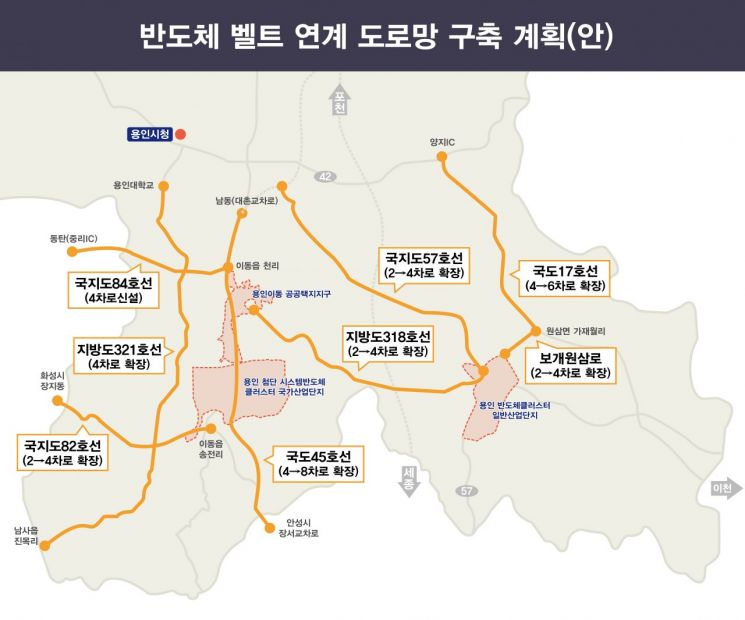
The expansion of transportation networks around the semiconductor belt, where Samsung Electronics and SK Hynix are establishing large-scale production lines, such as the 'Yongin Advanced System Semiconductor National Industrial Complex' in Idong and Namsa-eup, Cheoin-gu, and the 'Yongin Semiconductor Cluster General Industrial Complex' in Wonsam-myeon, will also be in full swing.
First, the government exempted the preliminary feasibility study for roads, power, and water supply to facilitate the smooth establishment of the Advanced System Semiconductor National Industrial Complex, accelerating the expansion of the 12.5 km section of National Road 45 from Daechon Intersection in Namdong, Cheoin-gu to Jangseo Intersection in Yangseong-myeon, Anseong City (from 4 lanes to 8 lanes), which was a habitual congestion area, with completion expected by 2030, more than three years earlier than originally planned.
The expansion of the 6.8 km section of Local Road 82 from Chang-ri, Namsa-eup, Cheoin-gu to Jangji-dong, Hwaseong City to 4 lanes is also expected to accelerate. Although this project was included in the 4th Five-Year Plan for National and Local Roads in 2016, it had been stalled due to re-examination of feasibility. Recently, due to the city's efforts, the re-examination was withdrawn, and the project was included in the linked transportation measures following the designation of the national industrial complex last year, brightening its prospects.
The 5.3 km 4-lane expansion plan for Local Road 321 between Bongmyeong-ri and Agok-ri in Namsa-eup is also included in the related linked transportation measures. A total of 156.8 billion KRW will be invested, with completion expected by 2030.
The 4-lane expansion of the 4.6 km section from Wanjang-ri, Namsa-eup to Seori, Idong-eup, included in the 3rd Gyeonggi Province Road Construction Plan, is expected to begin in earnest after the detailed design is completed in 2026.
The 6-lane expansion construction of the 3.08 km section from Yangji IC to Pyeongchang Intersection on National Road 17 is underway under the supervision of the Seoul Regional Land Management Office, with a target completion in 2030. The city is currently requesting to extend the expanded section of this road, which leads to the Yongin Semiconductor Cluster, from Pyeongchang Intersection to Bogeowonsam-ro (4.2 km).
To prevent congestion around the Yongin Semiconductor Cluster, where SK Hynix will start its first production line construction in March, the main access road Bogeowonsam-ro will be expanded from 2 lanes to 3 lanes at both ends. The entire 1.88 km section of Bogeowonsam-ro will be expanded to 4 lanes within the year.
The construction of an underground road on Local Road 315 to alleviate habitual congestion in the Bora-dong area of Giheung-gu will also be completed within the year. The total project cost is 102.9 billion KRW, with 20 billion KRW funded by the city.
Active Promotion of Metropolitan Railway Network Construction
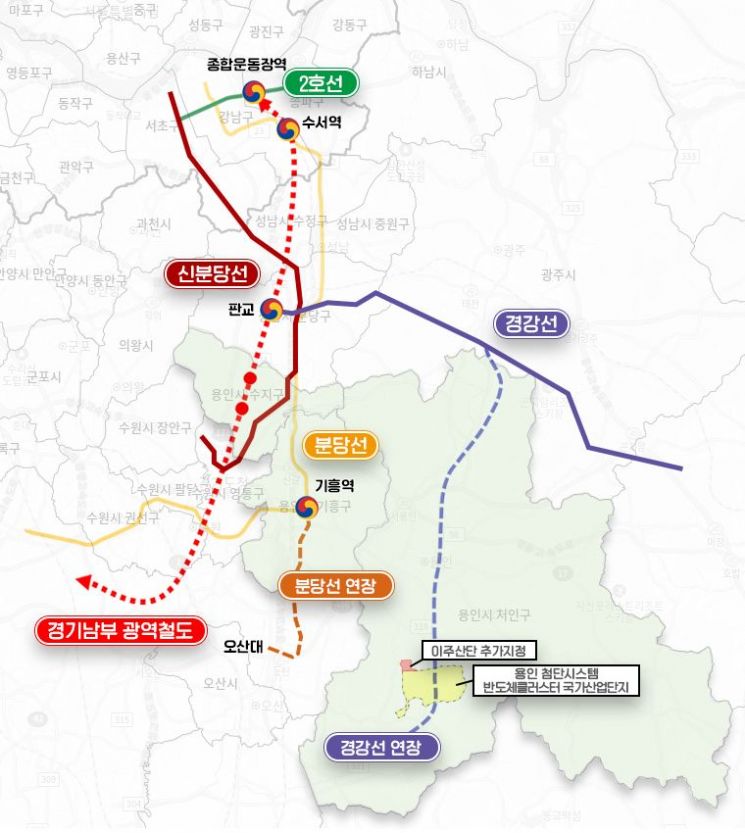
The city plans to mobilize all administrative power to expedite the construction of metropolitan railway networks including ▲extension of the Gyeonggang Line ▲establishment of the Southern Gyeonggi Metropolitan Railway ▲Southern Gyeonggi East-West Transversal Line.
The Gyeonggang Line extension project connects 37.97 km from Gyeonggang Line Gyeonggi Gwangju Station branching to Yongin Idong and Namsa. The Southern Gyeonggi Metropolitan Railway is a railway network jointly promoted by Yongin City along with Suwon, Seongnam, and Hwaseong cities, connecting a total of 50.7 km from Seoul Sports Complex Station through Suseo Station, Seongnam Pangyo, Yongin Sinbong and Seongbok-dong, Suwon Gwanggyo, to Hwaseong Bongdam. The Southern Gyeonggi East-West Transversal Line is a concept connecting 40.6 km east-west between Dongtan Station, Idong, Wonsam, and Icheon Bubal, a major semiconductor belt. The city is committed to ensuring these three projects are included in the Ministry of Land, Infrastructure and Transport's 5th National Railway Network Construction Plan.
The Bundang Line extension project from Giheung Station to Osan University Station, already included as a new project in the 4th National Railway Network Construction Plan, has completed the preliminary feasibility study by the Korea Rail Network Authority, and the Ministry of Land, Infrastructure and Transport recently applied to the Ministry of Economy and Finance for a review of the preliminary feasibility study. This line is expected to become a key axis connecting major economic hubs in Yongin such as the Advanced System Semiconductor National Industrial Complex, Platform City, and Samsung Electronics Giheung Campus.
The double-track electrified railway from Indeokwon to Dongtan passing through the western part of the city is already under construction in the Yongin section. The goal is to open the entire line by 2029. Of the total project cost of approximately 4.2127 trillion KRW, the city's share is about 199.6 billion KRW.
Increasing Bus Operation Rates and Expanding Public Parking Lots... Improving Public Transportation Infrastructure
Yongin City plans to actively establish an efficient transportation system within the city as well as metropolitan transportation networks.
First, 1.1 billion KRW will be invested to improve the traffic systems at seven major intersections within the city, including Myeongji Intersection, Kyunghee University Samgeori, and Jeil Intersection, which cause congestion due to bottlenecks. As an alternative to new construction requiring large budgets and complex permits, customized traffic system improvements such as intersection integration, installation of roundabouts, separation of traffic islands, and lane creation using national and public land will be implemented.
In residential and commercial areas with poor parking environments, 46.3 billion KRW will be invested to create three public parking lots with a total of 352 spaces this year. Target areas include ▲Towol in Pungdeokcheon-dong, Suji-gu (113 spaces) ▲Yeokbuk District, Cheoin-gu (125 spaces) ▲Anmaeul in Gugal-dong, Giheung-gu (114 spaces).
The 30-year-old old Yongin Public Bus Terminal will also be reborn next month with a completely new look. The new terminal will have one basement floor and two above-ground floors, with a total floor area of 2,881 square meters, including bus platforms, commercial facilities, rest areas and accommodations for transportation workers, and rest spaces for female workers.
The city will invest 720 million KRW this year to increase the operation rate of city and village buses by more than 20%. The budget will be used to improve the treatment of new and long-term transportation workers to address the shortage of transportation workers.
Additionally, the city will invest 400 million KRW to install enclosed shelters at five metropolitan bus transfer stops including Gangnam University Station and Gangnam University Entrance. The shelters will feature a photo zone using the city character Joayang, bus information terminals, and heated/cooled seats.
© The Asia Business Daily(www.asiae.co.kr). All rights reserved.
![Clutching a Stolen Dior Bag, Saying "I Hate Being Poor but Real"... The Grotesque Con of a "Human Knockoff" [Slate]](https://cwcontent.asiae.co.kr/asiaresize/183/2026021902243444107_1771435474.jpg)













