LCCs Have Grown Bigger but Lack Heavy Maintenance Capability
Hard to Handle Unless FSC
Domestic MRO Capacity Insufficient, Mostly Outsourced
Government Must Foster Korean MRO Sector
It has been identified that domestic low-cost carriers (LCCs) outsource more than 70% of their heavy maintenance, such as engine repairs, overseas. Since it is realistically difficult to establish in-house heavy maintenance capabilities without the scale of a major airline (FSC) like Korean Air, there are calls for the government to focus on fostering the domestic aircraft MRO (Maintenance, Repair, and Overhaul) industry.
According to the Ministry of Land, Infrastructure and Transport on the 2nd, overseas maintenance costs for LCCs increased by 63.6%, from 307.2 billion KRW in 2019 to 502.7 billion KRW in 2023. The proportion of maintenance performed overseas also rose from 62.2% to 71.1% during the same period. This means that 7 out of 10 suspected aircraft malfunctions are repaired abroad. Although the number of aircraft requiring repairs has significantly increased over the past decade as the LCC industry has grown, the domestic maintenance environment has remained stagnant.
Among domestic airlines, only Korean Air and Asiana Airlines have hangars and possess the MRO capabilities to repair major airframe defects such as engine failures. LCCs currently outsource to other companies both domestically and internationally. There are only two domestic MRO companies: Korean Air and Korea Airport Engine Maintenance Services (KAEMS). This is why the proportion of heavy maintenance outsourced overseas by the growing LCCs is increasing. Kim E-bae, CEO of Jeju Air, recently stated in a briefing, "We perform routine maintenance in-house and send heavy maintenance to MRO companies," adding, "KAEMS has limited slots (maintenance space), so only part of the work is entrusted to them, and the rest is sent to overseas MRO companies."
Due to the enormous costs, it is burdensome for LCCs to develop their own maintenance capabilities, leading to calls for the government to actively foster the domestic aviation MRO industry. The Ministry of Land, Infrastructure and Transport announced a plan to strengthen the competitiveness of the aviation MRO industry in August 2021, aiming to raise the domestic MRO maintenance volume share to 70% by this year, but it only reached 59% by 2023. The groundbreaking ceremony for the MRO cluster, the 'Incheon Airport Advanced Complex Aviation Cluster,' was held only in April last year.
An aviation industry official explained, "It requires enormous costs for LCCs to establish their own heavy maintenance, and it is not efficient from a business model perspective," adding, "Government support is essential, such as fostering a large-scale aviation MRO company dedicated to LCCs."
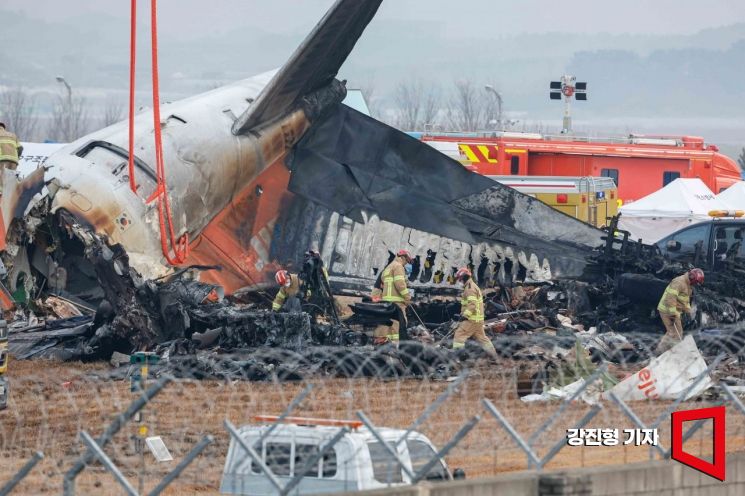 Firefighters are searching for fuel items at the site of the Jeju Air passenger plane collision and explosion accident that occurred at Muan International Airport, Jeonnam, 30 days ago. Photo by Kang Jin-hyung
© The Asia Business Daily(www.asiae.co.kr). All rights reserved.

















