Financial Authorities Plan to Share Household Debt Management Direction with Financial Sector via Inspection Meeting
Penalty Imposed on Financial Firms Failing to Meet Last Year's Household Loan Management Targets
Annual Household Loan Increase Last Year Reached 40 Trillion Won... Shinhan, Woori, Hana Among Those Missing Annual Targets
Prepare for Loan Demand Stimulating Events in New Year Including July Stress DSR 3-Step Measures and Interest Rate Cuts
Financial authorities have set a goal to manage the scale of household loans within the nominal Gross Domestic Product (GDP) growth rate again this year, following last year, and will conduct monthly and quarterly monitoring of household loans in the financial sector. In particular, financial institutions that exceeded their individual household loan growth targets last year will have the excess amount excluded from their loan growth limits this year.
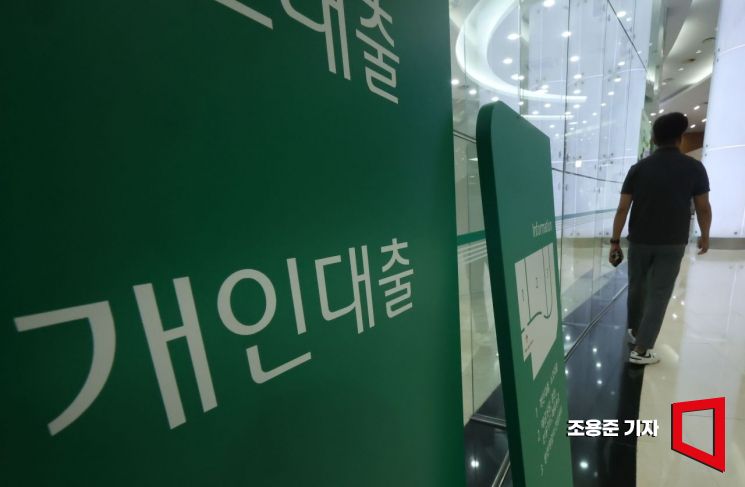 Commercial banks are raising mortgage loan interest rates one after another to slow down the pace of household loan growth. On the 3rd, a loan information board was posted at a commercial bank branch in Euljiro, Jung-gu, Seoul. Photo by Jo Yongjun jun21@
According to the financial sector on the 2nd, the financial authorities plan to hold the first household debt inspection meeting of the new year soon and share the direction of household debt management, centered on these points, with the financial sector. Given the increasing concerns over prolonged political uncertainty due to the presidential impeachment situation, they intend to focus on enhancing predictability.
The financial authorities plan to first induce the management of this year’s household loan growth rate within the nominal GDP growth rate. Considering that this year’s GDP growth rate is expected to be between 3.6% and 4.0%, the total household loan growth limit is estimated to reach 60 trillion won. A financial authority official explained, "We have continuously consulted with the financial sector regarding household loan management targets, and the overall direction will not differ significantly from last year. However, we are reviewing how much difference to apply to each financial institution based on whether they achieved last year’s management targets."
Financial institutions that failed to meet their household loan management targets last year may face a 'penalty' applied to part or all of the amount exceeding their annual target. This measure aims to enhance the effectiveness of the policy by differentiating targets between financial institutions that met their annual targets last year and those that did not.
The annual household loan increase of major commercial banks last year was tentatively estimated to have exceeded 40 trillion won. The growth rate compared to the end of December last year surpassed 6%. Shinhan Bank, Hana Bank, and Woori Bank are known to have exceeded the management targets they submitted at the beginning of last year. These commercial banks focused on managing the total volume of household loans by raising loan interest rates and tightening conditions for mortgage loans, jeonse deposit loans, and unsecured loans, but it appears these efforts were insufficient. Additionally, some internet-only banks and regional banks reportedly also failed to meet their targets.
Monitoring of household loans across the entire financial sector will continue monthly and quarterly as it did last year. Since the implementation of the second phase of the stress Debt Service Ratio (DSR) measure in September, the financial authorities have strengthened monitoring to proactively respond to the so-called 'balloon effect,' where household debt demand shifts to the secondary financial sector.
This year, detailed management is necessary as issues such as the third phase of the stress DSR measure and interest rate cuts, which could stimulate pending household loan demand, are expected. The financial authorities announced last year that the third phase of the stress DSR measure would be implemented tentatively from July this year. Once implemented, the stress DSR third phase will apply a 100% stress interest rate (1.5 percentage points) to all household loans.
A financial authority official stated, "We expect household loans in the banking sector to be managed relatively stably," adding, "This year, unlike last year, we will induce supply without concentration by considering monthly and quarterly fund demand so that household loans are not concentrated in specific periods."
© The Asia Business Daily(www.asiae.co.kr). All rights reserved.

















