Feeling Full Just by Swallowing Food After Taking Diet Pills
Result of GLP-1 Mimetic Acting on the Hypothalamus
A domestic researcher has discovered that the gastrointestinal hormone 'glucagon-like peptide-1' (GLP-1) induces a feeling of fullness simply by perceiving food through sight or smell, earning the first 'Scientist of the Month Award' of the year.

On the 1st, the Ministry of Science and ICT and the National Research Foundation of Korea announced that Professor Choi Hyung-jin of the Department of Brain and Cognitive Sciences at Seoul National University was selected as the January recipient of the Scientist of the Month Award. Professor Choi was recognized for elucidating the appetite-suppressing mechanism of GLP-1, known as a treatment for metabolic and cardiovascular diseases, contributing to the improvement of obesity and metabolic disorders.
The obesity treatment drug 'Wegovy,' made famous as a diet pill used by celebrities such as Tesla CEO Elon Musk, is also known to be a substance that mimics GLP-1. In a paper published online in the international journal Science in June last year, Professor Choi explained that "GLP-1 acts on the hypothalamus in the brain to induce satiety and regulate appetite." The hypothalamus is a part of the brain that controls the autonomic nervous system and hormone secretion, maintaining bodily homeostasis. He added that this is not a gradual response occurring over a long period but an immediate reaction.
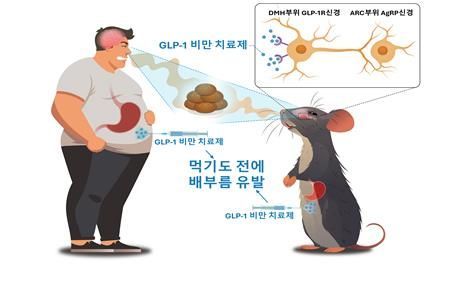 Mechanism of Appetite Suppression by GLP-1 Obesity Treatment Drug Identified. Ministry of Science and ICT
In fact, the hormone can induce a feeling of fullness even without eating food. The research team demonstrated the effect of GLP-1 through a 'chicken experiment.' One group was given the 'obesity treatment drug,' while the other group was not. After providing chicken to both groups, the degree of satiety was quantified. The actual results were surprising. The group that received the obesity treatment drug and only 'looked at' the chicken felt fuller than the group that did not receive the drug but actually 'ate' the chicken. Consequently, participants who naturally received the obesity drug ate relatively less chicken, leading to weight loss.
Similar results were observed in rat experiments. Using optogenetics, the researchers artificially activated GLP-1 receptor neurons in rats, which immediately induced cessation of eating, and conversely, when inhibited, eating continued.
The research results were evaluated as an important achievement that clearly elucidated the brain mechanism of GLP-1 appetite suppressants. It explained the previously unclear appetite-suppressing mechanism of drugs like Wegovy. Professor Choi said, "This research is significant in elucidating how appetite is regulated in the brain and how GLP-1 appetite suppressants work using neuroscience tools," adding, "I will continue to investigate the causes of metabolic diseases in modern people and challenge the development of new appetite suppressants."
© The Asia Business Daily(www.asiae.co.kr). All rights reserved.
![Clutching a Stolen Dior Bag, Saying "I Hate Being Poor but Real"... The Grotesque Con of a "Human Knockoff" [Slate]](https://cwcontent.asiae.co.kr/asiaresize/183/2026021902243444107_1771435474.jpg)











