Ministry of Land, Infrastructure and Transport Avoids Clear Answer on 'Concrete Berm' Violation Controversy Cited as Cause of Disaster
"Need to Review Overseas Standards"
Joint Investigation Underway with 10 US Investigators
Examining Condition of Concrete Berm, Engine Debris, and Bird Strike Evidence
Concrete Facilities Also Present on Runways at Yeosu, Pohang Gyeongju, and Jeju Airports
Ministry States "Other Airport Facilities Operate According to Standards"
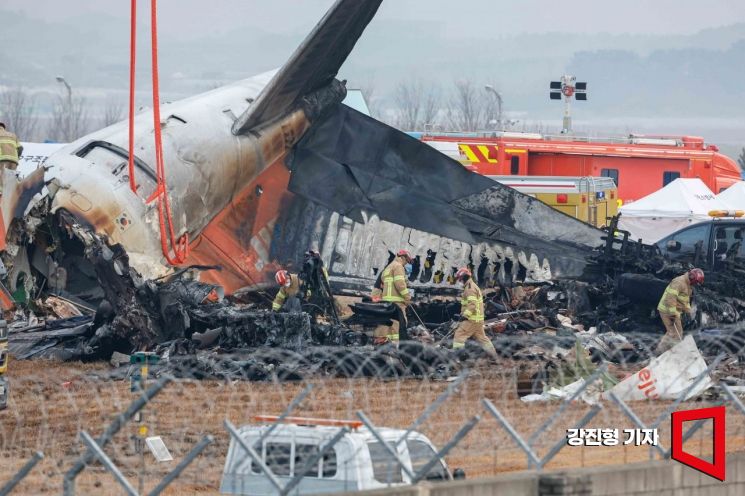 Firefighters are searching for belongings at the site of the Jeju Air passenger plane collision and explosion accident that occurred 30 days ago at Muan International Airport in Jeonnam. Photo by Kang Jin-hyeong
The Ministry of Land, Infrastructure and Transport (MOLIT) announced regarding the investigation of the black box related to the passenger plane disaster at Muan International Airport in Jeollanam-do, "The Cockpit Voice Recorder (CVR), one of the two devices inside the black box, has already started the data extraction process, and the first phase of the work has been completed," adding, "We have begun the process of converting this data into audio."
The ministry, which oversees aviation safety, made this announcement during a briefing held at 11 a.m. at the Government Complex Sejong, presided over by Joo Jong-wan, Director General of the Aviation Policy Office.
Regarding the other black box, the Flight Data Recorder (FDR), he explained, "The connector was found missing, so we are conducting a final check on how to extract the data," and added, "If the connector joint is detached, sophisticated technical skills are required to reconnect it."
Concrete Berm That Increased Disaster Scale Still Under Controversy for Regulatory Violations
It was not clearly confirmed whether the concrete berm structure (localizer) was installed according to guidelines or regulations. Director Joo stated, "We are examining the consistency between international standards and our national standards," and added, "We are also reviewing overseas cases."
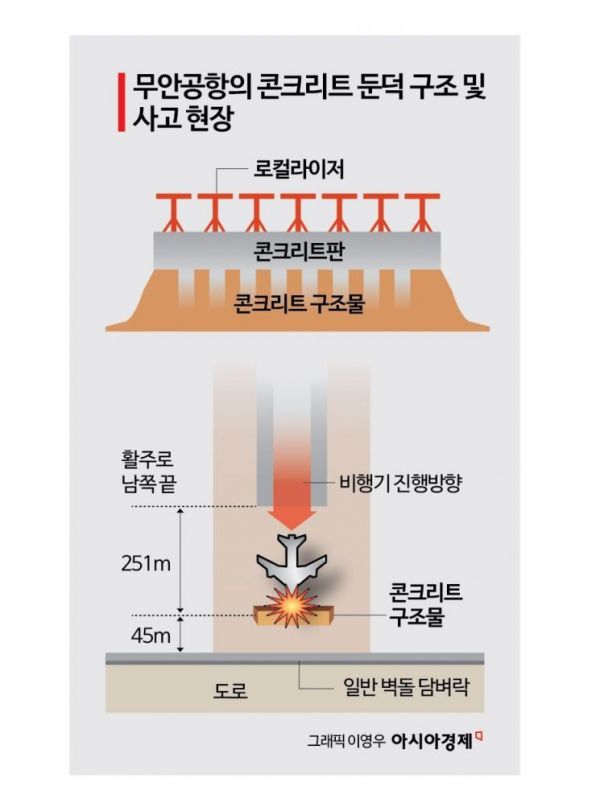
When criticism arose that the localizer increased casualties, MOLIT initially refuted by stating, "The localizer at Muan Airport was installed in accordance with relevant regulations." However, as suspicions of guideline violations contrary to MOLIT’s explanation surfaced, the ministry changed its stance to "We will reconsider."
The localizer is an essential airport facility that transmits radio signals to aircraft to assist safe landing on the runway. However, in this disaster, it has been cited as a factor that caused many casualties. At the time of the accident, the aircraft landed on its fuselage without lowering the landing gear (wheels), slid along the runway, and then collided head-on with the localizer about 264 meters beyond the runway end, breaking apart and engulfed in flames.
MOLIT: Other Airports with Concrete-Supported Localizers Also Operate According to Facility Standards
MOLIT also stated, "Two additional investigators from the United States arrived last night, and a joint Korea-US investigation team has been formed, establishing a temporary headquarters at the airport to conduct on-site investigations." The current US investigation team consists of 10 members: one from the Federal Aviation Administration, three from the National Transportation Safety Board, and six employees from Boeing, the aircraft manufacturer. The joint investigation team, which began the first on-site inspection yesterday, closely examined the accident aircraft and the localizer at the airport where the collision occurred. Starting from the 1st, they plan to begin visual inspections of the wreckage, including the aircraft body and engines, as well as bird strike traces.
Concrete was also used as a support for localizers to raise antenna heights at Yeosu, Pohang-Gyeongju, and Jeju airports. Regarding the safety of these airports, Director Joo said, "Facility standards are meticulously established at Korean airports, and the facilities are operated according to these standards," adding, "However, as special safety inspections are being conducted across aviation safety, if any issues are raised, necessary measures will be taken."
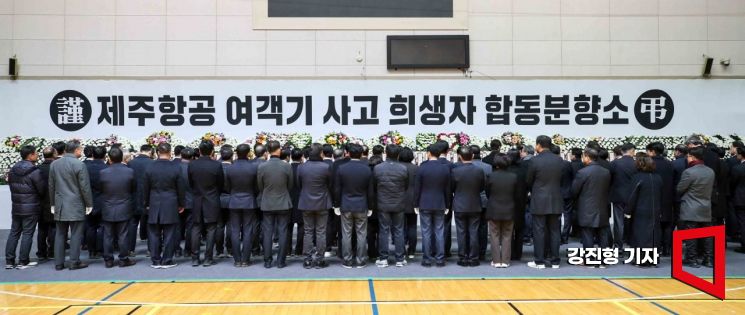 Amid the Jeju Air passenger plane disaster that resulted in 179 deaths, local residents visited the joint memorial altar set up at Muan Sports Park near Muan International Airport in Jeollanam-do on the 30th to pay their respects to the victims. Photo by Kang Jin-hyung
Regarding claims that the landing gear of the accident aircraft was operational during the first landing attempt, he responded, "We plan to review this during the investigation by compiling various testimonies."
As for the circumstances under which the aircraft landed on runway 19 at Muan Airport (the opposite direction of the originally attempted landing), he explained, "The pilot attempted a go-around and turned right, during which the air traffic controller guided the pilot to the closest direction," adding, "The pilot agreed to this, and there was a mutual agreement to attempt the landing in that manner."
© The Asia Business Daily(www.asiae.co.kr). All rights reserved.

![Clutching a Stolen Dior Bag, Saying "I Hate Being Poor but Real"... The Grotesque Con of a "Human Knockoff" [Slate]](https://cwcontent.asiae.co.kr/asiaresize/183/2026021902243444107_1771435474.jpg)
















