Special Semiconductor Act and Power Grid Act Ultimately Delayed Past Year-End
Fate of Overseas Companies Diverges Amid Political Strife After Opening
After the opening of the 22nd National Assembly, the power struggle between the two major parties caused pension reform and advanced industry support laws for semiconductors and nuclear power plants to lose momentum. Additionally, the emergency martial law and impeachment crisis further narrowed the space for the ruling and opposition parties to discuss livelihood issues.
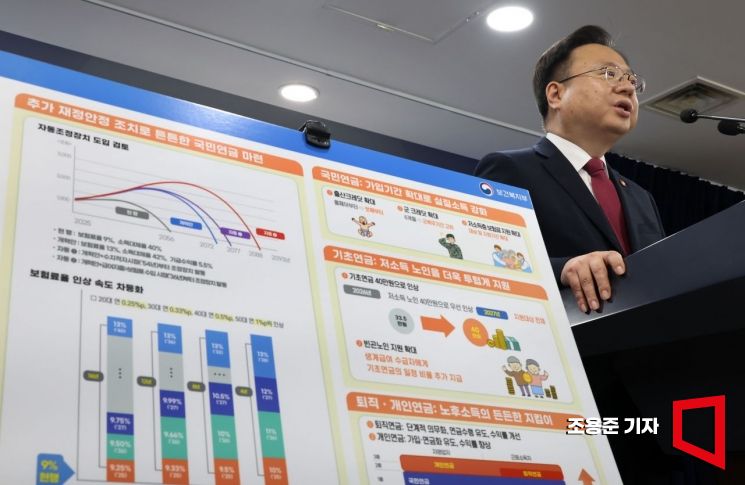 Minister of Health and Welfare Cho Kyu-hong is announcing the pension reform promotion plan on the 4th at the Government Seoul Office in Jongno-gu, Seoul. Photo by Jo Yong-jun jun21@
A key official from the People Power Party said in a phone call on the 31st, "Due to impeachment, the request for reconsideration, and the Muan Airport disaster, pension reform has gone underwater," adding, "It seems it will have to be discussed in the new year." Since the 22nd National Assembly opened on May 30, the ruling and opposition parties have been discussing pension reform, but it has ultimately extended beyond the year.
The biggest disagreement between them was the 'method' for discussing pension reform. The People Power Party advocated creating a permanent Pension Reform Special Committee in the National Assembly, as was done in the 21st National Assembly. The Democratic Party of Korea preferred to discuss it within the National Assembly’s Health and Welfare Committee. Since the Democratic Party holds the majority in the standing committee, they could lead the discussion there, whereas in the special committee, the ruling and opposition parties would maintain equal numbers, which was a better condition for the People Power Party. Ultimately, over the past six months, the two parties only engaged in a power struggle over how to discuss pension reform.
While the ruling and opposition parties colored the 22nd National Assembly with impeachment, legislative unilateralism, and requests for reconsideration, pension reform was not the only issue that extended beyond the year. The Semiconductor Special Act, the High-Level Radioactive Waste Special Act, and the National Power Grid Expansion Act to support the electricity needed for these advanced industries?all led by the ruling party?were not processed.
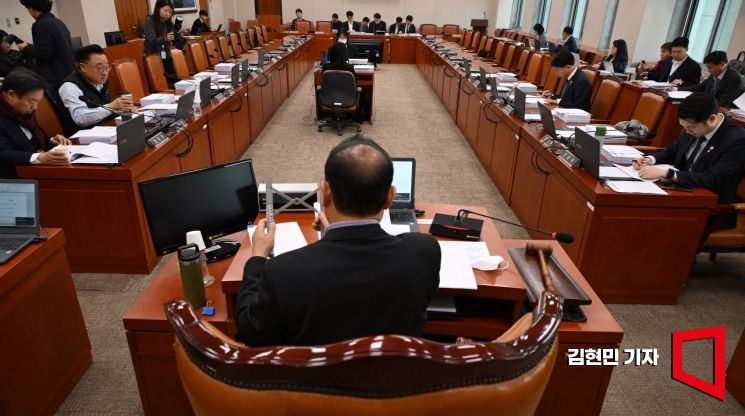 On the 26th, the Subcommittee on Industrial, Trade, and Energy Patents of the Industry, Trade, and Energy Small and Medium Venture Business Committee was held at the National Assembly. During the subcommittee meeting, the "Special Act on Strengthening Competitiveness and Innovative Growth of the Semiconductor Industry (Semiconductor Special Act)" was discussed. Photo by Kim Hyun-min
The Semiconductor Special Act failed to narrow differences between the ruling and opposition parties in the National Assembly’s Industry, Trade, Energy, Small and Medium Enterprises Committee over the exemption clause for the 52-hour workweek. Both parties blame each other for the failure to pass the Semiconductor Special Act. The People Power Party argued that high-salary research workers in the semiconductor industry should be exempt from the 52-hour work regulation. The Democratic Party opposed this in principle, stating that exceptions allowing work beyond the 52-hour limit already exist and can be used.
Lee Jung-moon, Deputy Chair of the Democratic Party’s Policy Committee, said at the party’s floor strategy meeting that day, "There is consensus within the Industry Committee that the Semiconductor Special Act is urgent, but it is stalled due to the People Power Party’s passive attitude," adding, "Cooperation between the ruling and opposition parties is more important than ever. We urge the People Power Party to promptly return to the standing committee and the bill subcommittee and proactively engage in discussions to pass livelihood and economic bills even today."
If the ruling and opposition parties reach an agreement on the Semiconductor Special Act next year, the focus will likely be on simplifying the existing exceptions under the Labor Standards Act or revising government enforcement ordinances.
While the parties failed to narrow differences on the Semiconductor Special Act, the fates of Korean and overseas semiconductor companies diverged. From May 30, when the 22nd National Assembly opened, to December 27, the stock price of AI semiconductor company Broadcom rose about 77%, from $136.41 to $241.75 per share. During the same period, Nvidia rose about 24%. In contrast, Samsung Electronics fell about 27%, from 73,500 won to 53,700 won per share, and SK Hynix also dropped about 11%, from 195,700 won to 174,500 won.
The ruling and opposition parties have not completely abandoned livelihood issues. Centered on the policy chiefs of both parties, a 'Common Livelihood Pledge' promotion council was formed, and bills without disagreements were passed even amid political strife. There were also economic legislative achievements such as the abolition of the financial investment income tax, raising the deposit insurance limit, and the passage of the AI Basic Act. Although late, attention is focused on whether the ruling and opposition parties can reach an agreement on pension reform and advanced industry support laws in the new year.
© The Asia Business Daily(www.asiae.co.kr). All rights reserved.
![Clutching a Stolen Dior Bag, Saying "I Hate Being Poor but Real"... The Grotesque Con of a "Human Knockoff" [Slate]](https://cwcontent.asiae.co.kr/asiaresize/183/2026021902243444107_1771435474.jpg)

















