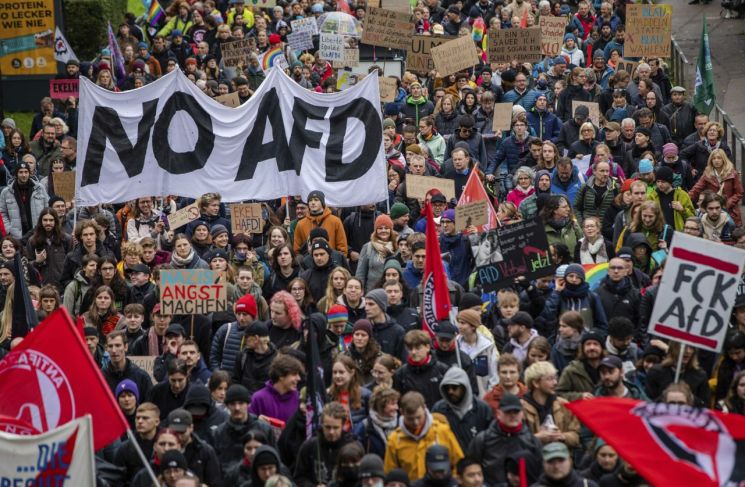
 Scenes from an anti-far-right protest held last October in Ulm, Germany. A banner reading "NO AFD" opposing the far-right party Alternative for Germany (AfD) is displayed. Photo by AP and Yonhap News.
Politicians from Germany's far-right party, Alternative for Germany (AfD), have been accused of discussing deportation plans with neo-Nazi groups. With the general election scheduled for February next year and AfD's support soaring, there is growing interest in how this might affect the election.
According to Berlin-Brandenburg (RBB) broadcasting on the 29th (local time), Lena Kottre, a member of the Brandenburg state parliament from AfD, admitted to attending a far-right group meeting held in Switzerland on the 14th. At the meeting, which was attended by neo-Nazi organizations, Kottre reportedly revealed plans to revoke the citizenship of immigrants who committed crimes in Germany and to industrialize and privatize immigrant deportations.
Earlier, the independent media outlet Correctiv, which raised suspicions about Kottre's attendance at the far-right group meeting, reported that Kottre also proposed deportation plans based on identifying refugees' regions of origin through genetic and linguistic analysis. The meeting included members of the Swiss far-right group Junge Tat, members of the German unconstitutional organization Blood and Honour, and AfD federal parliament member Roger Beckamp, according to Correctiv.
In December last year, it was revealed that AfD politicians had discussed deporting millions of immigrants with far-right figures, sparking large-scale protests nationwide and fierce criticism. Although AfD downplayed the incident as not being a party-level event at the time, it has shown little reaction this time. Since the controversy last year, AfD has seen an increase in party membership and performed well in this year's European Parliament and state elections, which used the slogan of refugee "resettlement," indicating a consolidation of its support base.
With the early general election just two months away, AfD's support rate is approaching 20%, putting it on the verge of becoming the second-largest party in the federal parliament. Furthermore, Elon Musk, CEO of Tesla and a rising power in the upcoming U.S. administration, published a pro-AfD article in the German weekly Bild am Sonntag on the 28th, raising expectations that he could serve as a bridge to the Trump administration, which is likely to further expand AfD's influence.
© The Asia Business Daily(www.asiae.co.kr). All rights reserved.

















