Overseas Experts Diagnose Cause of Accident
"Low Possibility of Landing Gear Damage Due to Bird Strike"
Although 'bird strike' has been identified as the cause of the Jeju Air passenger plane disaster at Muan International Airport, overseas aviation safety experts have diagnosed that it is difficult to consider bird strike as the sole cause of the accident.
According to major foreign media on the 30th, overseas experts related to the cause of the Jeju Air passenger plane disaster emphasized the possibility that various issues acted in combination.
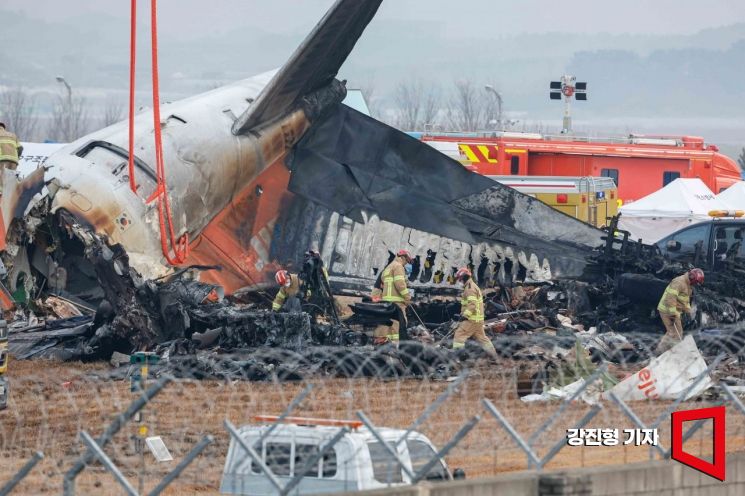 Firefighters are searching for fuel items at the site of the Jeju Air passenger plane collision and explosion accident that occurred 30 days ago at Muan International Airport in Jeonnam. Photo by Kang Jin-hyeong
Experts first pointed out that it is difficult to conclude that bird strike alone caused the accident when looking at the scene where the aircraft belly-landed. In the video footage of the accident, the main braking systems that reduce speed during landing?the landing gear (wheels and other devices necessary for takeoff and landing), flaps (high-lift devices), and engine reverse thrust?appear not to have functioned properly. As a result, even after the belly landing, the aircraft could not reduce speed and collided with the concrete structure at the end of the runway.
Christian Beckert, a pilot for the German airline Lufthansa and an aviation safety expert, pointed out that the possibility of bird strike damaging the landing gear, which had not yet been lowered, is low, and if the bird strike occurred after the landing gear was already down, it would be even more difficult to retract it again. He added, "The landing gear operates as an independent system and has a backup system. It is very rare and unusual not to be able to lower it."
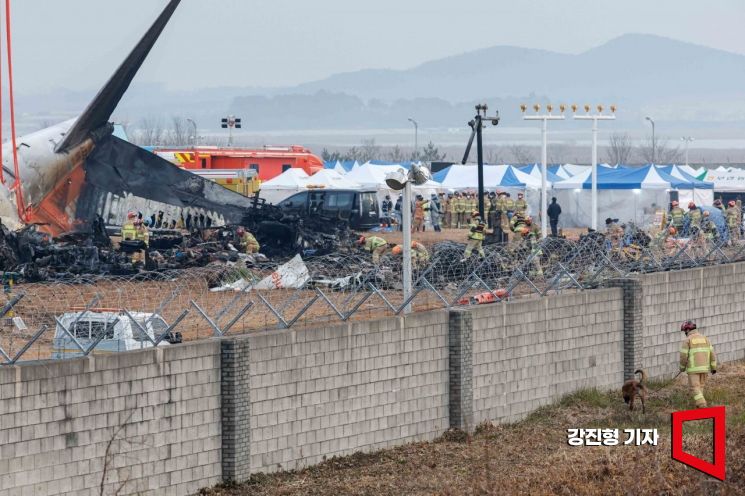 Firefighters are searching for belongings at the site of the Jeju Air passenger plane collision and explosion accident that occurred at Muan International Airport, Jeonnam, 30 days ago. Photo by Kang Jin-hyung
Gregory Allegzi, an aviation expert and former instructor at the Italian Air Force Academy, also noted that it is difficult to explain the scale of this disaster by bird strike alone. He said, "Of course, there may have been a bird strike, but the consequences are too severe. It cannot be the direct cause of the accident." He further questioned, "Why was the aircraft's speed so high? Why did the flaps not operate? Why was the landing gear not lowered?"
The rapid progression from belly landing to collision is also a reason why bird strike cannot be seen as the single cause of the accident. According to the Ministry of Land, Infrastructure and Transport, the accident passenger plane declared a 'Mayday' distress signal just one minute after receiving a bird strike warning from the Muan Airport control tower, and the accident occurred only four minutes later.
Australian expert Jeffrey Dell explained that even if a bird is sucked into the aircraft's engine, the engine does not stop immediately, so pilots generally have time to respond.
Marko Chan, a professor of Aviation Operations at Buckinghamshire New University in the UK, said, "Changing the landing direction quite late seems to have added workload to the pilot," and added, "At this point, it remains quite a mystery."
Australian aviation consultant Trevor Jensen said that at the time, fire and rescue teams prepared for a belly landing were not ready at Muan International Airport, stating, "It seems to have happened suddenly."
© The Asia Business Daily(www.asiae.co.kr). All rights reserved.


















