New Year's Press Conference Held
The Gyeongbuk Office of Education (Superintendent Lim Jong-sik) held a New Year's press conference on the 30th for attending reporters under the main theme, "Paving a New Path for Education in the Republic of Korea and Creating the Map of Global Education Together," and explained the "2025 Gyeongbuk Education Promotion Directions."
The New Year's press conference reflected on Gyeongbuk education over the past year, explained the core values and key promotion tasks of Gyeongbuk education in 2025, and proceeded with a Q&A session with the press corps.
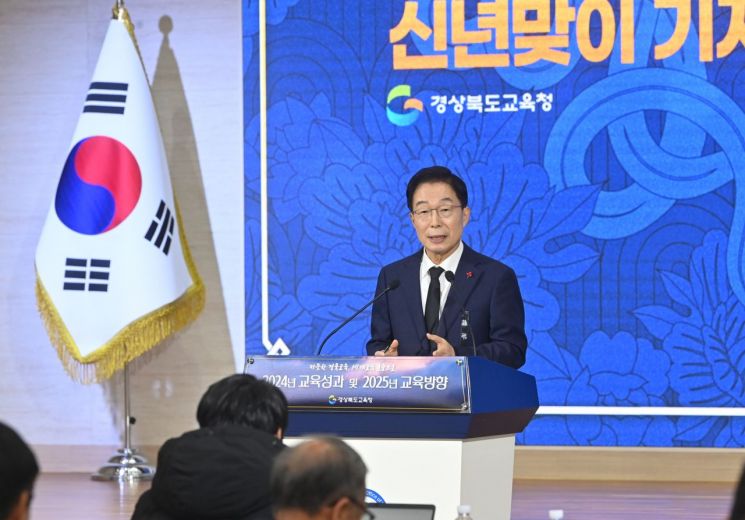 Lim Jong-sik, Superintendent of Gyeongbuk Office of Education, is holding a New Year's press conference. Gyeongbuk Office of Education
Superintendent Lim Jong-sik stated, "In 2025, Gyeongbuk education will adopt 'Growth, Harmony, and Future' as its core values and create global education standards through change and innovation amid rapidly changing environments such as artificial intelligence, population decline, climate crisis, and polarization," expressing strong aspirations.
The press conference specifically presented the 2025 education policy directions centered on four key tasks: supporting mental health to restore the educational community, strengthening academic competence through an integrated achievement evaluation system, resolving educational gaps by providing customized educational services, and realizing educational settlement by expanding school functions.
The first core task of Gyeongbuk education in 2025 is the "restoration of the educational community" through mental health support.
Starting with realizing one's own value, efforts will focus on supporting the mental health of students, teachers, and parents so that everyone can lead a healthy life.
‘Mind Growth’ textbooks for social-emotional learning in elementary and middle schools and customized ‘Mind Meditation’ video materials will be distributed to provide opportunities to experience the precious self. Additionally, 12 multilingual mental health prevention guidebooks will be distributed for students and parents with migrant backgrounds to strengthen comprehensive mental health care for all.
Furthermore, the Onjaram semester system for character education by life cycle and the ‘Teacher Rest Camp Heairim (林)’ program for healing teachers' pain will be operated, and a school violence prevention class support group (Hakye-dan) will carry out a zero school violence challenge.
Along with this, the nation’s first online parent school will be established to strengthen cooperation between parents and schools. Programs such as Education Empathy Talk that listens to teachers' voices, Dandi Jjakkkung as a beautiful companionship between teachers and students, and family camps practicing familial love will be actively promoted to complete an educational community that communicates more and empathizes more deeply.
The second core task is "strengthening academic competence" through an integrated achievement evaluation system.
The Gyeongbuk Office of Education plans to establish an integrated achievement evaluation system in the field, composed of basic academic skills, literacy, numeracy, digital literacy, academic achievement, and capabilities for college admission and employment.
For basic academic skills, diagnostic evaluations will be conducted in September for first and second graders, and the Challenge! Dream Achievement Certification System will be expanded from arts, physical education, and volunteer areas to include certifications in physical fitness, English, literacy, and digital literacy.
Additionally, academic achievement evaluations will be conducted from third grade of elementary school to second grade of high school, and evaluation questions developed in-house for grades 3 to 6 will be distributed to schools in December to provide students with growth records.
‘Check Jung (check中)’ autonomous evaluation questions enabling third-grade middle school students to self-assess their social and science academic achievement levels will be produced and distributed to support preparation for the 2028 college entrance exams. The expansion of the ‘Gyeongbuk-type CSAT evaluation questions,’ which showed high accuracy this year, and the operation of the ‘Level Up! CSAT Study Club’ will further strengthen students’ college admission capabilities.
Moreover, 10 schools?including 3 elementary, 5 middle, and 2 high schools?will introduce IB candidate schools, preparing step-by-step for experiencing the world-class International Baccalaureate (IB) program.
The third core task is "resolving educational gaps" through customized educational services.
A new employment support officer system for students with disabilities will be established to provide professional career, vocational education, and employment support, and walking rehabilitation robots will be provided to students with special education needs.
Schools with a foreign student ratio of 40% or more will reduce class sizes to 20 students per class and open special multicultural classes to provide customized Korean language and life education support.
Additionally, customized services will be provided in reducing teacher workload and supporting classes through pilot operations of teacher work delivery services, life libraries, and mobile work messengers. The introduction of cutting-edge automated systems combining food tech such as cooking robots, automated meal equipment, and food scanners will continuously improve the working environment of meal service workers.
In the selection of professional teaching staff, written exams will be abolished, and portfolio evaluations, policy execution abilities, and character assessments will be strengthened to enhance support capabilities in school settings. Along with this, an additional regional priority selection system requiring eight years of mandatory service will be implemented in four areas?Cheongsong, Yeongyang, Yeongdeok, and Uljin?where new teachers are less preferred and transfer rates are high, providing opportunities to local and prospective teachers to alleviate difficulties in class management and student guidance.
The fourth core task is "realizing educational settlement" through the expansion of school functions.
Superintendent Lim emphasized that a strong local community is essential to expand globally and announced plans to conduct policy research and operate pilot schools related to ‘Settlement Schools’ where people do not leave their regions for education but come to regions that need education.
Following the attraction of 56 outstanding international students from five countries this year, the second season of attracting overseas students will welcome 78 students in 2025, focusing on creating a settlement education ecosystem where employment and settlement continue.
He also announced plans to build ‘Aureum Schools’ that connect schools to overcome weaknesses and maximize strengths. Vertically, this will serve as transitional education and articulation curricula between school levels, and horizontally, it will serve as joint curricula, urban-rural connection schools, and online schools, laying the foundation for educational settlement for mutual growth.
By integrating kindergartens and elementary schools and operating Neulbom Schools inside and outside schools, public education will be expanded, and school functions will be extended. A K-School Expo linked with APEC to be held in Gyeongju will raise the status of Gyeongbuk education.
Furthermore, through the operation of student overseas volunteer groups, educational informatization support projects targeting Guatemala and Ethiopia, and the Book Bundle Sharing Project in addition to Gyeongbuk-R Computer, efforts will be made in overseas sharing to present education that is worthy of the world and not neglectful of sharing.
Superintendent Lim Jong-sik said, "In 2025, Gyeongbuk education aims to pave a new path for education in the Republic of Korea and create the map of global education together. I sincerely thank you for your support throughout the year and hope you will continue to join us with unwavering commitment."
© The Asia Business Daily(www.asiae.co.kr). All rights reserved.

















