Changes in Financial Systems in 2025
Customized Debt Adjustment for Borrowers Before Delinquency
Reduced Card Fees for Small Franchisees
Mid-term Repayment Fees Halved
Liquidity Ratio Regulations Introduced for Mutual Finance Sector
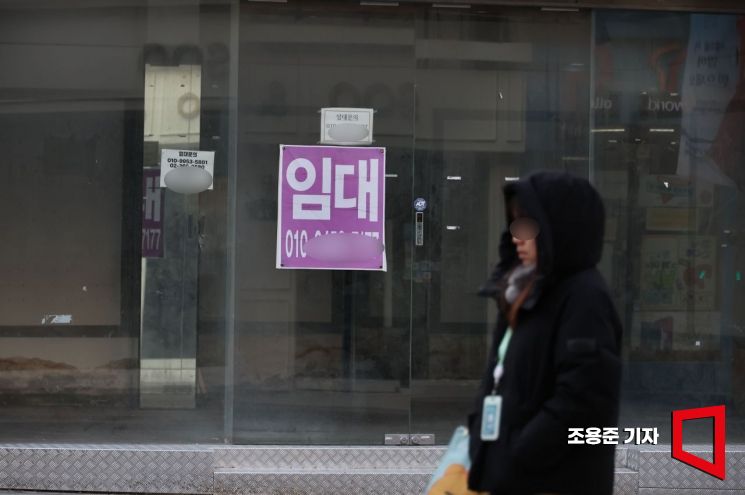 Amid domestic and international adversities such as economic recession and sluggish domestic demand, the number of small business closures is rapidly increasing, and on the 26th, vacant stores lined up in a commercial area in Sinchon, Seoul. Accordingly, the scale of the small business closure mutual aid fund exceeded 1.3 trillion won this year, marking an all-time high. Photo by Jo Yongjun
In the new year of 2025, self-employed individuals who close their businesses will be able to convert their loans to low-interest rates for up to 30 years, and the deposit protection limit will be raised from the current 50 million KRW to 100 million KRW.
On the 30th, the Financial Services Commission announced the 'Financial System Changes Starting from the New Year 2025' containing these details. First, under the 'Small Business Financial Support Plan,' banks will conduct customized debt adjustments for borrowers before delinquency and implement low-interest, long-term installment repayment (March-April 2025) and mutual growth guarantees and loans (April-July 2025) for those who close their businesses. The preferential card fee rates for small and medium-sized merchants will also be reduced by 0.05 to 0.1 percentage points according to sales brackets. These measures aim to alleviate the financial burdens of small business owners and low-income earners who are facing difficulties due to the economic downturn.
The eligibility for the New Start Fund will be expanded to small business owners who operated from April 2020 to November 2024. Previously, only those who operated until June of this year were eligible. The preferential principal reduction rate will also be expanded to include educational programs such as Polytech vocational training and regional credit guarantee foundation re-employment education. After completing the New Start Hope Project and successfully gaining employment or starting a business, public information will be immediately released to support a return to normal financial life.
Expansion of Youth Leap Account Contributions... Reducing Debt and Fee Burdens for Low-Income Earners
Deposit protection will also be significantly strengthened. For the first time in 24 years since 2001, the deposit protection limit will be raised from 50 million KRW to 100 million KRW, and the amount eligible for mistaken remittance return support will also be expanded from 50 million KRW or less to 100 million KRW or less. The voluntary return request period for mistaken remittance recipients will be shortened from 3 weeks to 2 weeks.
Youth asset formation support will be expanded as well. Starting January 2025, contributions to the Youth Leap Account will increase from a maximum of 24,000 KRW per month to 33,000 KRW, and tax exemption and contribution benefits will be available even if maintained for more than 3 years. Previously, contributions were not provided for payments exceeding the matching limit, and early termination before the 5-year maturity incurred taxes and forfeited contributions.
Customized debt adjustment will be strengthened. For basic livelihood security recipients and severely disabled persons with debts under 5 million KRW and delinquency over one year, repayment will be deferred for one year, and if repayment ability does not improve, the principal will be fully forgiven.
The early repayment fee system will also be reformed. From January 13 next year, charging fees beyond actual costs such as opportunity costs due to fund operation disruption and administrative or recruitment costs related to loans will be prohibited. The financial sector expects that this reform will reduce early repayment fees at commercial banks to about half of the current rates.
Financial service convenience will improve. From January next year, corporations will be able to view integrated accounts at one bank through open banking, and from October, claims for indemnity insurance will be simplified, allowing processing through computer systems without visiting counters at 70,000 clinics and 25,000 pharmacies.
Bank LCR Ratio 97.5% → 100%... Support for Financial Sector Innovation
Financial company soundness management will also be strengthened. Starting January, a responsibility structure clarifying internal control duties by executives will be implemented for financial holding companies and banks. The temporarily relaxed bank LCR regulatory ratio (97.5%) will be normalized to 100% from January 1, 2025. The LCR (Liquidity Coverage Ratio) is an indicator used to assess a bank's soundness by quantifying high-liquidity assets that can be immediately converted to cash under a potential 30-day liquidity crisis scenario.
Liquidity ratio regulations will be introduced for mutual finance sectors, and new loan limits by industry will be established, restricting real estate and construction loans to within 30% per sector and 50% in total of all loans.
Innovation at the financial company level will accelerate. As a follow-up to the 'MyData 2.0 Promotion Plan' released in April this year, amendments to the Credit Information Business Supervision Regulations will be completed to enable easier service use for youth and digitally vulnerable groups. Specifically, the age at which youth can use MyData without legal guardian consent will be lowered from under 19 to under 14 years old.
© The Asia Business Daily(www.asiae.co.kr). All rights reserved.

















