Captain Demanded Replacement of Substandard 'Indicator Pin'
Refused, Then Refused to Fly... "Aircraft Defect"
Flight Delayed 15 Hours... Severe Disciplinary Action Due to Passenger Inconvenience
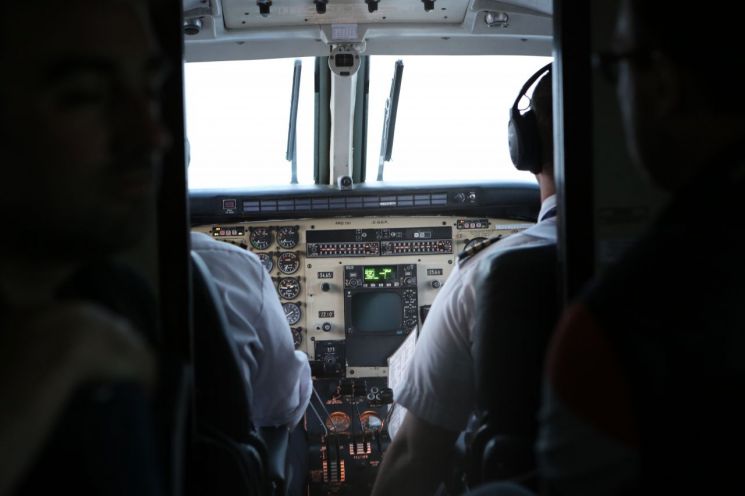
Jeju Air employees are pouring out criticisms on anonymous communities, pointing out that the Jeonnam Muan International Airport disaster was a foreseeable accident. Amid this, a pilot who was severely disciplined by the company after refusing to fly due to a 'aircraft defect' in the past is being reexamined online.
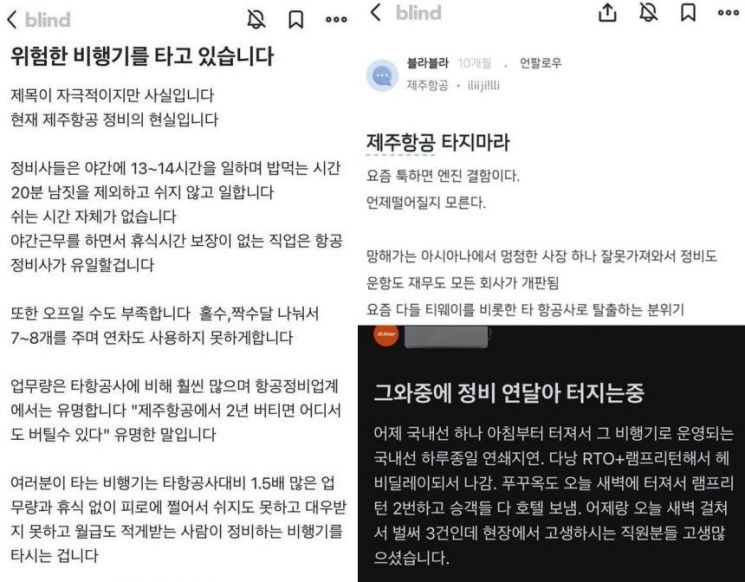
On the 30th, on the workplace community Blind, testimonies from Jeju Air employees continued, stating that the maintenance environment was poor and aircraft defects were frequent from the beginning. In February, Jeju Air employee A posted a message titled "Don't fly Jeju Air," saying, "These days, it's engine defects at every turn. You never know when it will fall," and "Bringing in the wrong CEO messed up maintenance, operations, and finance all together."
There were also claims that aircraft safety was originally precarious due to poor working conditions, such as maintenance technicians not being guaranteed rest time and being assigned excessive work compared to other airlines. A Jeju Air maintenance technician appealed, "Maintenance workers work 13 to 14 hours at night. Except for about 20 minutes to eat, there is no rest time at all," and added, "(Passengers) are flying on planes maintained by people who are overworked 1.5 times more than other airlines and exhausted without rest. It would not be surprising if a major accident happens at any time."
Meanwhile, an incident in January where T'way Air pilot B refused to fly due to an aircraft defect before takeoff at Nha Trang Airport in Vietnam is gaining attention again across various online communities. At that time, B confirmed that the length of the 'indicator pin,' which shows the wear status of the brake pads, did not meet the company's operational technical notice standards and demanded brake replacement from the company. According to T'way Air's 'Operational Technical Notice 23-49' established on October 11 last year, brakes must be replaced if the indicator pin length is 1 mm or less. At that time, the pin length was 0.8 mm. The company demanded takeoff, claiming it was safe to operate, but pilot B ultimately decided not to fly.
Due to a 15-hour delay caused by this issue, T'way Air issued a final five-month suspension to B, citing passenger inconvenience and other reasons. A suspension of three months or more is a severe disciplinary action that can affect pilot qualifications. Regarding this, T'way Air initially claimed that replacing the brake when the indicator pin length was over 1 mm would incur penalties from the parts manufacturer, but after it was revealed that neither Boeing nor the parts manufacturer had such regulations, the company changed its explanation to a cost issue rather than a penalty.
Netizens responded with comments such as "Pilots like the T'way captain are heroes," "Maybe they prevented a disaster," "What are they thinking risking a major accident like that," "Airlines' safety negligence is really serious. It's frustrating," "Why would anyone want to fly like this," "Severe discipline is outrageous," and "After reading Blind posts, I'm scared to fly in the future," and "I probably won't travel abroad for a while." These were among the reactions.
© The Asia Business Daily(www.asiae.co.kr). All rights reserved.


















