34 Airport and Aviation-Related Bills Pending
National Turmoil Causes Delays in Aviation Safety Legislation
Decline in Aircraft Maintenance Standards Since COVID-19
As public anxiety grows following the Jeju Air passenger plane disaster at Jeonnam Muan International Airport, it has been revealed that not a single aviation safety and security-related bill proposed during the 22nd National Assembly has been processed. Due to ongoing partisan conflicts and political turmoil, key aviation industry bills directly related to public safety are being pushed to the sidelines.
According to the National Assembly Legislative Information System on the 30th, a total of 34 aviation and airport-related amendment bills were proposed during the 22nd National Assembly. Among these, none have passed the National Assembly, with most still pending review in their respective committees. In particular, six bills related to aviation safety and security, which directly affect citizens' lives, were proposed, but none have passed the systematic and detailed review stages.
The partial amendment to the Aviation Security Act, which strengthens penalties for acts endangering passenger safety and was primarily proposed by Rep. Ju Ho-young of the People Power Party, is also pending in the National Assembly. This bill was prepared as a follow-up measure after an incident last May where a passenger forcibly and illegally opened an emergency exit on an Asiana Airlines flight from Jeju to Daegu during landing. According to the current Aviation Security Act, manipulation of aircraft doors, emergency exits, and equipment is prohibited, with violators subject to imprisonment of up to 10 years. The proposed amendment adds provisions for the death penalty, life imprisonment, or imprisonment of seven years or more if casualties occur.
A bill to standardize air traffic operations in preparation for the 2026 International Civil Aviation Organization (ICAO) safety audit is also pending in the National Assembly. Since 1998, ICAO has been evaluating member countries' compliance with international standards under the Convention on International Civil Aviation. South Korea is likely to undergo an aviation safety audit in the year after next. Currently, the Ministry of Land, Infrastructure and Transport (MOLIT) handles related policies and regulations through the Aviation Policy Office, while regional aviation offices and the Air Traffic Headquarters provide air traffic services. However, there is no legal provision defining the function of overseeing air traffic operations across affiliated agencies. It is urgent to establish a legal basis delegating the evaluation of air traffic operations and personnel management to the Minister of Land, Infrastructure and Transport in preparation for the audit.
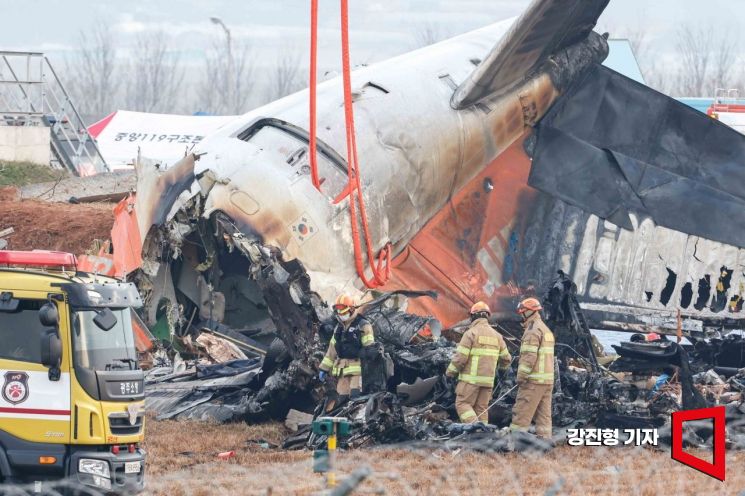 Firefighters are searching for fuel items at the site of the Jeju Air passenger plane collision and explosion accident that occurred on the 30th at Muan International Airport in Jeonnam. Photo by Kang Jin-hyeong
The bill to establish a fatigue risk management system for the safety of pilots and other air transport operators is also stalled. Current law mandates air transport operators to manage crew fatigue either by adhering to work hour limits or by establishing and operating a fatigue risk management system. However, unlike the United States and the European Union, South Korea lacks a fatigue risk management system and operates solely under work hour restrictions. Domestic airlines are also promoting fatigue risk management systems that reflect the specific work characteristics of each crew member, but discussions between ruling and opposition parties must begin for the related bill to pass.
In the political sphere, voices are growing to additionally review bills that strengthen aircraft maintenance (MRO) related to aviation safety following the Jeju Air disaster. There are concerns that additional safety maintenance accidents may increase in the domestic aviation industry, which has weakened due to the COVID-19 pandemic. Although the direct cause of the Jeju Air accident is presumed to be a 'bird strike,' criticisms are emerging that inspection levels are continuously declining amid shrinking domestic maintenance infrastructure. According to data submitted by the Ministry of Land, Infrastructure and Transport to Rep. Kwon Young-jin of the People Power Party, a member of the National Assembly Land, Infrastructure and Transport Committee, the proportion of aircraft maintenance performed by domestic airlines dropped sharply from 54.5% in 2019 to 41% in 2023.
© The Asia Business Daily(www.asiae.co.kr). All rights reserved.

















