First Vice Minister Gijae Takes the Lead Instead of Choi Sang-mok
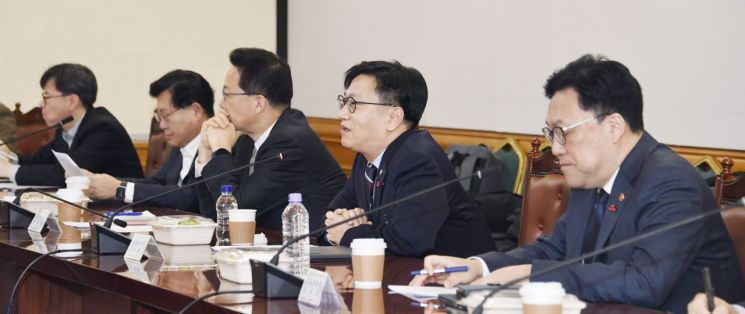 Kim Beom-seok, First Vice Minister of Strategy and Finance, is delivering opening remarks at the "Macroeconomic and Financial Issues Meeting" held on the morning of the 30th at the Bankers' Hall in Jung-gu, Seoul.
In the midst of a major political crisis where both the President and the Acting President have been impeached, Lee Chang-yong, Governor of the Bank of Korea, held an emergency macroeconomic and financial issues meeting (F4 meeting) and delivered a message aimed at stabilizing the market. Amid severe political turmoil extending down to the Acting Prime Minister for Economic Affairs, Kim Beom-seok, the 1st Vice Minister of the Ministry of Economy and Finance, attended the F4 meeting on behalf of Choi Sang-mok, the Acting Prime Minister for Economic Affairs and Minister of Strategy and Finance.
At the F4 meeting held on the 30th at the Federation of Banks building, chaired by Governor Lee, participants stated, "Since the National Assembly passed the impeachment motion against the Prime Minister last week, volatility has increased," and added, "Relevant agencies will closely cooperate to monitor market conditions 24 hours a day and will make every effort to manage the financial and foreign exchange markets as stably as possible by mobilizing all available means."
They also reaffirmed their position to promptly implement additional market stabilization measures if excessive concentration phenomena occur.
The participants evaluated, "Considering the net external financial assets of approximately $977.8 billion (as of the end of Q3), foreign exchange reserves ranking 9th in the world at $415.4 billion (as of the end of November), and the balance of market stabilization programs such as the KRW 27 trillion bond market stabilization fund, the government and the Bank of Korea still have sufficient capacity to respond."
The Bank of Korea has supplied a total of KRW 38.6 trillion in short-term liquidity since the 4th of this month by additionally purchasing repurchase agreements (RPs) worth KRW 5 trillion, and will continue to promptly implement further measures if necessary to stabilize the market and improve short-term funding conditions.
Along with expanding infrastructure for foreign investors' government bond investments and efforts to improve foreign exchange supply and demand, support to promote foreign direct investment (FDI) will also be included in next year's economic policy direction and pursued accordingly.
Despite a series of adverse events including the unprecedented political crisis with successive impeachments and a major aviation disaster, the stock market rebounded as bargain buying entered. On the morning of the day, the KOSPI recorded 2,421.89, up 0.71% from the previous session at the start of trading (9:30 a.m.). The index opened at 2,397.49, down 0.30% from the previous session, showed a slight decline, then turned to an upward trend. At the same time, the KOSDAQ index was at 675.29, up 1.40% from the previous session.
© The Asia Business Daily(www.asiae.co.kr). All rights reserved.

















