Korea Investment & Securities Report
Korea Investment & Securities forecasted on the 30th that volatility in the market will continue through the year-end and New Year period. The firm pointed out that the attractiveness of the Korean stock market is declining due to the downward revision of various economic indicators and the lack of clear policy momentum.
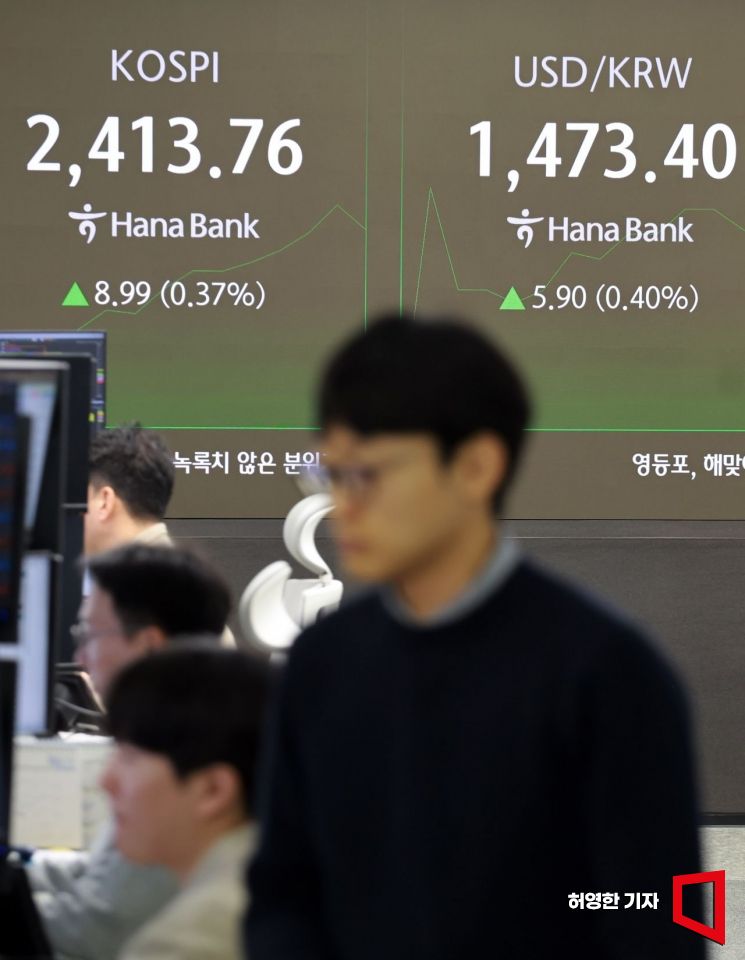 On the 30th, the last trading day of the year, the KOSPI and KOSDAQ started with a slight decline but then turned to a rebound. The won-dollar exchange rate rose again to the mid-1470 won range. Employees are working in the dealing room at the Hana Bank headquarters in Euljiro, Seoul. Photo by Heo Young-han
In a report released that day, researcher Kim Dae-jun of Korea Investment & Securities stated, "The year-end market is far from a Santa rally. The KOSPI only rose 0.03% last week. As of the closing price on the 27th, it barely held the 2400-point level, but it would not be surprising if it falls again. This is because investor sentiment has been extremely depressed."
Researcher Kim pointed out that buying and selling stocks ultimately depend on investor sentiment, and the problem is that sentiment recovery seems distant. He cited policy uncertainty as the main factor. Kim said, "Coincidentally, the 2025 economic policy direction has also been postponed, making it impossible to know the government's plans. Amid the downward revisions of various economic indicators, the lack of clear policy momentum is a factor that lowers the attractiveness of the Korean stock market."
It is also difficult to expect corporate earnings improvement. On the contrary, the KOSPI net profit estimates, centered on Samsung Electronics, continue to decline. Kim explained, "Especially the fourth-quarter earnings season is a period with large one-off costs, making it difficult to predict earnings volatility. If there were positive aspects from a macro perspective, some earnings uncertainty could be tolerated, but currently, even that is difficult."
He also focused on price indicators that have no time lag with the Korean situation, which suggest an uneasy market atmosphere. Kim noted, "The credit default swap (CDS) premium is rising, and the KOSPI volatility index (VKOSPI) is rising again, recording 21, which is higher than the VIX. The won-dollar exchange rate exceeds 1470 won, reaching levels seen during the 2008 financial crisis. Although foreign exchange reserves stand at $415.4 billion, twice that of 2008, the rate of decline could increase, so anxiety is unlikely to be resolved."
He predicted that the index movement will remain sluggish for the time being. Although the KOSPI’s 12-month forward price-to-earnings ratio (PER) has fallen to 8.1 times, highlighting undervaluation appeal, it is difficult to expect a rapid influx of bargain buying.
He said, "A rebound will take time without support from macro factors and corporate earnings. Ultimately, sector-specific responses are important. For reference, foreigners are focusing on shipbuilding, utilities, and software. Shipbuilding and utilities are expected to benefit from Trump-related factors, and software has investment appeal due to its low sensitivity to the economic cycle," he analyzed.
© The Asia Business Daily(www.asiae.co.kr). All rights reserved.

















