Among 15 National Airports, Lowest Usage Rate
Dreaming of a Rebound with Daily Scheduled Flights
"Priority on Accident Management and Support for Bereaved Families"
Muan Airport, once disparaged as the 'airport where chili peppers are dried' due to low passenger traffic, dreamed of revitalization by introducing daily regular routes 17 years after its opening, but it has now suffered a major disaster.
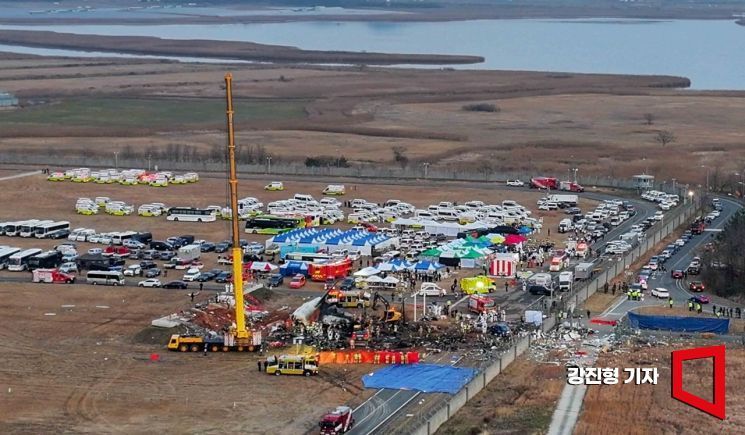 On the 29th, a Jeju Air passenger plane carrying 181 passengers collided with the outer wall of the runway while landing at Muan International Airport, causing a fire that resulted in the deaths of most passengers. The wreckage of the accident aircraft is placed on the runway at Muan International Airport, Jeollanam-do. Photo by Kang Jin-hyung
Muan Airport opened on November 8, 2007. With a project cost of 305.7 billion KRW, Muan Airport is located on a 2,567,690㎡ site and features a 2,800-meter-long runway capable of handling 140,000 takeoffs and landings annually. It also has an apron of about 90,000㎡ that can accommodate nine aircraft simultaneously, a parking lot that can hold 2,095 vehicles at once, and a passenger terminal with an annual capacity of 5.19 million people.
Since its opening, it aimed to be a hub airport in the West Sea region by operating nine weekly flights to destinations such as Shanghai, China, but due to low flight frequency and passenger numbers, its status as an international airport was even at risk. In 2022, Muan Airport had a runway utilization rate of only 0.1%, ranking last among 15 airports nationwide. That year, the airport served just 29,394 passengers, averaging fewer than 100 people per day. Due to the low passenger volume, it was once said that "chili peppers are dried on the runway."
However, last year, after three years of the COVID-19 pandemic, international regular flights resumed, starting operations on five routes to ▲Japan ▲China ▲Taiwan ▲Vietnam ▲Thailand. From this month, daily international flights were introduced for the first time since the airport's opening. Currently, 18 international routes to nine countries, including the Bangkok route in Thailand where the accident occurred, as well as ▲Nagasaki, Japan ▲Taipei, Taiwan ▲Kota Kinabalu, Malaysia, are in operation.
Jeollanam-do Province expected tourism revitalization starting with the daily regular routes, but an unexpected major disaster has cast a red light on the airport's revitalization efforts. A Jeollanam-do official stated, "Our priority is to focus on accident recovery and support for the bereaved families," adding, "We will cooperate with related organizations such as the airport corporation to support the normal operation of Muan Airport."
Jeju Air flight 7C2216, carrying 181 passengers and crew, attempted a belly landing at Muan International Airport at around 9:03 a.m. that day, resulting in a collision and fire. So far, only two crew members have been rescued. The main cause of the accident is believed to be a 'bird strike' (when a bird collides with the aircraft body or engine during takeoff, landing, or cruising). According to data submitted by Korea Airports Corporation to the office of Democratic Party lawmaker Lee Yeon-hee, there were a total of 10 bird strike incidents at Muan Airport from 2019 to August of this year. Considering that 11,004 flights operated at Muan Airport during this period, the occurrence rate is estimated at 0.09%. The total number of bird strike incidents at airports nationwide has been steadily increasing, which is presumed to be due to climate change causing migratory birds to become territorial or changes in the timing and species of birds appearing. In particular, many airports in South Korea are located near rivers or coastlines, and due to the geographical characteristics of airports, which often have many fields, the possibility of collisions with birds is considered higher.
© The Asia Business Daily(www.asiae.co.kr). All rights reserved.

















