Investigating the Causes of Solar Wind and Corona
The NASA (National Aeronautics and Space Administration) solar probe has successfully completed a close approach flight to the Sun.
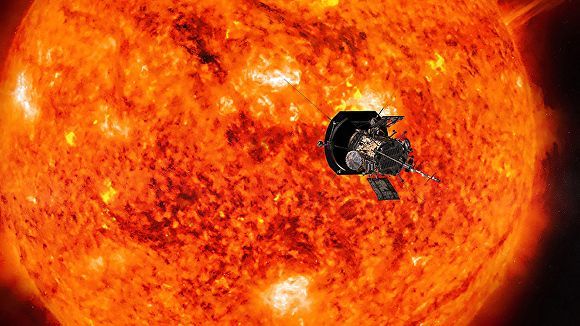 Artist's rendering of the Parker Solar Probe's close approach flight to the Sun. Photo by AP Yonhap News.
On the 27th (local time), NASA announced that the solar probe 'Parker Solar Probe' sent a signal to the ground control team just before midnight Eastern Time the previous night. This confirmed that the probe had completed its close approach flight to the Sun and was operating normally. NASA expects the Parker probe to send detailed data about its current status on January 1. After data transmission, it will orbit at a safe distance from the Sun.
Joe Westlake, head of NASA's solar physics division, expressed, "This data will provide fresh information about a place humanity has never experienced before."
Earlier, on Christmas Eve, the 24th, the probe lost communication with the ground control team while passing through the Sun's corona (the plasma state outermost layer of the Sun's atmosphere). At that time, the probe was flying at a speed of 430,000 miles per hour (692,018 km/h) at a point just 3.8 million miles (6,115,507 km) from the Sun's surface. This speed is less than 30 seconds from London to New York. The Parker probe is the closest any human-made probe has ever come to the Sun. The previous closest approach record was an altitude of 7.26 million km from the Sun's surface, achieved in September last year and March this year.
The Parker probe was launched in 2018 with the goal of exploring the Sun. In April 2021, it successfully passed through the upper corona for the first time and has since repeatedly broken close approach records. This spacecraft is the fastest ever built and is equipped with an 11.5 cm thick heat shield to withstand the extreme environment of the Sun's atmosphere. Thanks to this heat shield, the Parker probe can endure temperatures of up to 1,370 degrees Celsius.
Since its launch in 2018, the Parker Solar Probe has significantly contributed to solving long-standing mysteries about our star. On its way to the Sun, the probe accidentally captured rare close-up images of a passing comet and provided clues about how Venus, Earth's twin but a hellish planet, might have lost its water.
The core mission of the Parker probe is to find out why the temperature of the Sun's outer atmosphere, the 'corona,' rises and to identify the cause of the solar wind. Notably, the corona, the outer edge of the Sun's atmosphere, is heated to millions of degrees, far hotter than the Sun's surface temperature of 6,000 degrees Celsius. This phenomenon remains a mystery even to experts. Parker's next close approach flights to the Sun are scheduled for March 22 and June 19 of next year.
© The Asia Business Daily(www.asiae.co.kr). All rights reserved.
![Clutching a Stolen Dior Bag, Saying "I Hate Being Poor but Real"... The Grotesque Con of a "Human Knockoff" [Slate]](https://cwcontent.asiae.co.kr/asiaresize/183/2026021902243444107_1771435474.jpg)
















