Busan Public Technology-Based Startups Show Continuous Growth Trend
Need for Quality Improvement and Ecosystem Enhancement to Secure Growth Drivers
Perception Survey and In-Depth Interviews... Four-Stage Policy Directions Proposed
The Busan Institute of Science and Technology Promotion (BISTEP, Director Kim Young-bu) published a report titled "Study on the Activation Plan for Public Technology-Based Startups in Busan" on the 27th, analyzing the status of public technology-based startups in the region and presenting policy directions to revitalize the startup ecosystem.
Public technology-based startups are founded on technologies developed and held by public research institutions such as universities and research institutes, either by the technology holders themselves or through technology investment and transfer. This technology-intensive startup model is evaluated as an important type of startup that practically utilizes national R&D achievements, fosters new industries, and contributes to regional economic revitalization.
This study highlighted the importance of public technology-based startups and their role in regional economic development, deeply analyzing the current status and perception characteristics of public technology-based startups in Busan to explore policy directions for Busan City.
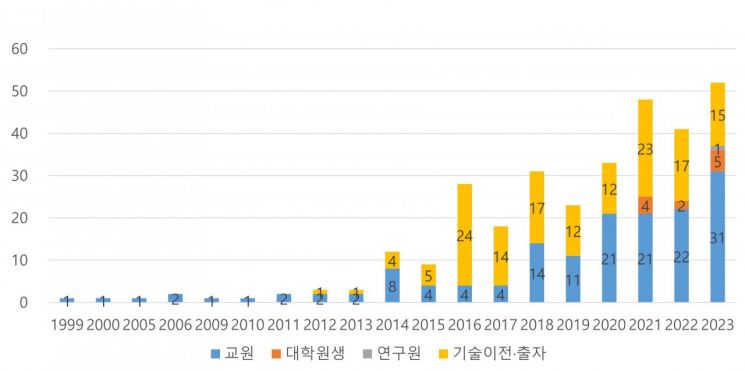
First, focusing on universities and research institutes located in Busan, it was confirmed that the number of 354 public technology-based startup companies has been quantitatively expanding since 2014. Among them, 48.9% were faculty startups, and more than 90% of the total were university technology-based startups. However, most are small-scale and lack financial stability for sustainable operation.
In fact, a survey on startup companies' perceptions identified securing funds and lack of management knowledge as major difficulties both during and after the startup process. Most early-stage startups rely on personal funds (90.9%), and only about 22% of companies attracted investment, highlighting the need to expand startup funding support. Additionally, in-depth interviews with entrepreneurs pointed out major challenges such as lack of space for business expansion, difficulties in securing talent, and insufficient support systems.
Based on these findings, BISTEP researchers proposed a four-stage policy direction to activate public technology-based startups: ① enhancing startup accessibility and spreading startups, ② improving stability of early-stage startups, ③ supporting policy demands of growth companies, and ④ expanding public technology startup diffusion and local government-led ecosystems.
In particular, from a short-term perspective, they pointed out the need for measures to improve startup accessibility for technology holders, such as support for securing commercialization funds, strengthening entrepreneurial capabilities, and supporting startup preparation environments. They also emphasized the need to focus support on creating growth spaces and securing talent so that startups with excellent technologies can take root in the region, grow stably, and contribute to the regional economy and job creation.
Senior Researcher Hong Ja-yeon of BISTEP stated, "Public technology-based startups are an important tool that can innovate the regional economy and create quality youth jobs," and emphasized, "Continuous expansion of the startup innovation ecosystem and customized support policies tailored to regional characteristics are necessary to activate public technology-based startups in Busan."
Busan City is pursuing measures to strengthen the overall startup ecosystem by establishing an implementation roadmap with the goal of becoming an "Asia Startup Hub City," a core policy of the 8th local government administration. It is expected that the activation of high value-added startups, including public technology-based startups, will play a key role in creating youth jobs and fostering new industries in the future.
© The Asia Business Daily(www.asiae.co.kr). All rights reserved.
![Clutching a Stolen Dior Bag, Saying "I Hate Being Poor but Real"... The Grotesque Con of a "Human Knockoff" [Slate]](https://cwcontent.asiae.co.kr/asiaresize/183/2026021902243444107_1771435474.jpg)
















