KAIST Research Team Develops Core Technology for Multipurpose Vertical Takeoff and Landing Hoverbike
The core technology of the futuristic transportation device 'Hoverbike,' used by the protagonist Luke in the movie Star Wars, has been secured with domestic technology. Following internal combustion engine vehicles and electric cars, 'Made in Korea' is expected to become an important milestone in securing leadership in the upcoming era of Personal Aerial Vehicles (PAV) and Urban Air Mobility (UAM), which will shape future urban air transportation.
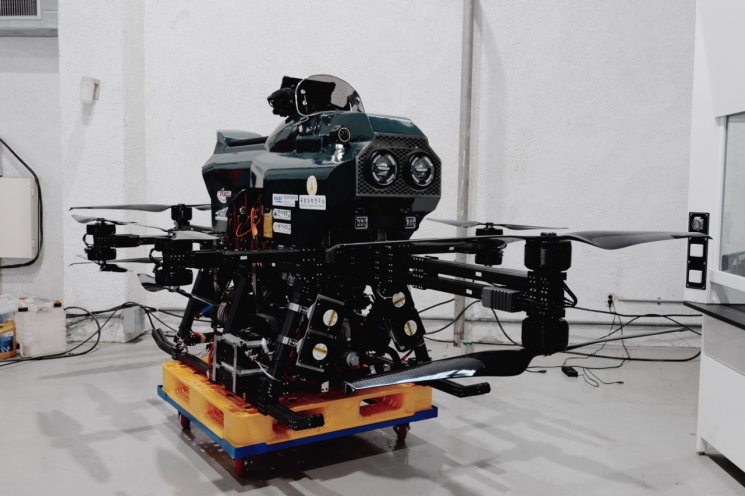
KAIST (President Kwang Hyung Lee) announced on the 27th that the research team led by Professor Hyochung Bang of the Department of Aerospace Engineering successfully developed the core technology of a highly reliable, multipurpose vertical takeoff and landing (VTOL) hoverbike capable of both manned and unmanned operation.
This research involved the participation of Professor Jaeheung Han, Professor Jiyoon Lee, Professor Jaemyung Ahn, Professor Hanlim Choi, Professor Changhoon Lee from KAIST’s Department of Aerospace Engineering, Professor Dongjin Lee from Hanseo University’s Department of Unmanned Aerial Vehicles, and Professor Jongoh Park from Dong-A University’s Department of Electronic Engineering.
The KAIST research team secured key technologies including optimal design of multipurpose aircraft, hybrid propulsion systems, highly reliable precision navigation and flight control systems, autonomous flight, and fault detection to develop a high-performance hoverbike.
The hoverbike is expected to be a next-generation mobility solution that can complement existing transportation systems. The hoverbike enables vertical takeoff and landing, allowing more freedom in takeoff and landing locations compared to fixed-wing UAM, making it suitable for use as a personal aircraft. It can operate in the air even in complex urban traffic conditions, making it a transportation means not constrained by ground traffic environments, and can also be used for personal leisure sports activities.
By applying autonomous flight technology, precise route flying is possible even without a driver. Additionally, it can carry heavy cargo, making it applicable for drone delivery services. It can also be used for search and rescue and relief operations in areas difficult to access on the ground. To this end, the research team configured a highly reliable autonomous flight system that selects safe automatic landing zones and implemented a guidance method for automatic landing on helipads with high accuracy. The application of obstacle avoidance and automatic landing autonomous flight technology enables stable operation even in complex environments.
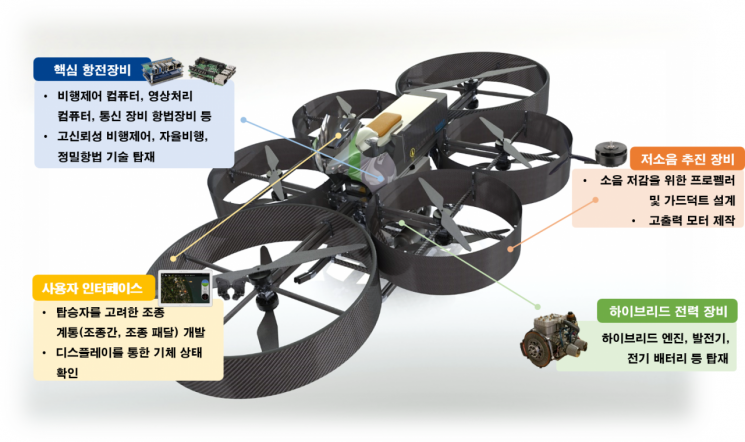
In particular, this hoverbike platform is characterized by the introduction of a hybrid system based on a gasoline engine to overcome the limitations of battery-based drones. The research team explained that it achieved about 60% superior performance and maximum payload compared to overseas technology levels. With longer operation times, various applications for both civilian and military use can be expected.
Professor Hyochung Bang, the lead researcher, stated, "We have demonstrated the high practicality of the hoverbike in various environments through highly reliable flight control and precision navigation technologies," adding, "The hoverbike not only provides a key gateway to PAVs and future aircraft but is also a promising research achievement that can surpass existing drone technologies by several levels."
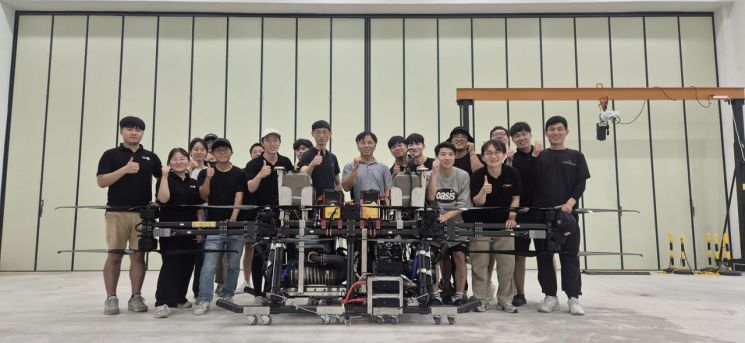
This research began in 2019 under the Defense Acquisition Program Administration’s Future Challenge Defense Technology R&D Project and was conducted over five years until 2024 under the management of the Agency for Defense Development. The research funding invested was approximately 7.3 billion KRW. The developed aircraft will be showcased for the first time at the 2025 Drone Show Korea (DSK2025), held at BEXCO in Busan from February 26 to 28 next year.
© The Asia Business Daily(www.asiae.co.kr). All rights reserved.



















