Joint Venture to be Established Next Year with 50-50 Investment Ratio
Shinsegae to Offset Gmarket's Slump... Alibaba Gains from Selling Korean Products
New 2nd Largest Domestic E-commerce Company by User Count
Coupang Hard to Catch Up in Short Term
As Shinsegae Group and Alibaba Group join forces in the e-commerce sector, attention is focused on whether they can become a rival to Coupang, which has emerged as a 'giant' in the domestic distribution market.
According to the distribution industry on the 27th, Shinsegae Group announced the day before that it will establish a joint venture with Alibaba International, a subsidiary of Alibaba. The investment ratio is 5 to 5, with Shinsegae Group participating by contributing Gmarket as an in-kind investment. Alibaba International will contribute shares of AliExpress Korea as an in-kind investment and also make a cash investment.
Survival and Expansion, a Strategic Choice
 Vice Chairman Jeong Yong-jin of Shinsegae Group is attending the new employee completion ceremony held at 'Shinsegae Namsan' and answering questions. Photo by Shinsegae Group
The sudden alliance between Shinsegae and Alibaba is strategically interpreted as reflecting their mutual interests. Shinsegae Group's collaboration with Alibaba Group is a choice to compensate for its sluggish performance in the e-commerce market and to enhance competitiveness. Previously, in 2021, Shinsegae Group acquired an 80.01% stake in Gmarket from the U.S. e-commerce company eBay for about 3.44 trillion won. However, Gmarket recorded a cumulative loss of 100 billion won over two years from 2022 to last year. In the first half of this year, it also posted an operating loss of 22.1 billion won. This is due to Coupang's dominance and intensified competition in the domestic e-commerce market.
Through an alliance with Alibaba, which has established networks in over 200 countries and regions worldwide and built a global sales network, Shinsegae is expected to seek breakthroughs such as strengthening competitiveness beyond mere survival. Shinsegae emphasized that the 600,000 sellers registered on Gmarket will be able to showcase their products on Alibaba's global platform. A Shinsegae Group official said, "An important goal of establishing this joint venture is to strengthen the competitiveness of domestic small and medium enterprises and sellers, such as existing Gmarket sellers entering Alibaba International's platform," adding, "Specific implementation plans to enhance the competitiveness of Gmarket sellers will be announced."
From Alibaba's perspective, there is an advantage in attracting customers by selling Korean products handled by Gmarket sellers on its global platform. Alibaba has designated the Korean market as a sourcing base for products in the global market and has continued large-scale investments in Korea. Notably, earlier this year, it submitted an investment plan worth 1.5 trillion won to the Korean government, including investments in large logistics centers.
Alibaba is also operating a 'Global Selling Program' that supports domestic sellers' global expansion (reverse direct purchase). Launched in October, the Global Selling Program allows domestic sellers to sell their products on the AliExpress platform operating overseas. Through this program, domestic sellers entering the 'K-Venue' channel of AliExpress Korea can introduce their products not only to the Korean market but also to 150 million global consumers on AliExpress. K-Venue is a sales channel exclusively for domestic products launched by AliExpress in October last year. It operates similarly to existing open markets in e-commerce. Sellers register and sell products on K-Venue, and AliExpress currently does not charge listing or sales fees for K-Venue.
Additionally, Alibaba's B2B (business-to-business) platform Alibaba.com launched a dedicated B2B website for Korean companies called 'Korea Pavilion' in August. Korea Pavilion is a site supporting B2B sales for Korean companies, and it is the first time Alibaba has built a country-specific B2B website in Asia. Alibaba operates global B2C (business-to-consumer) platforms such as AliExpress, Taobao, Tmall, Lazada, and Daraz.
Anti-Coupang Vanguard: Catfish Effect vs. Tempest in a Teapot
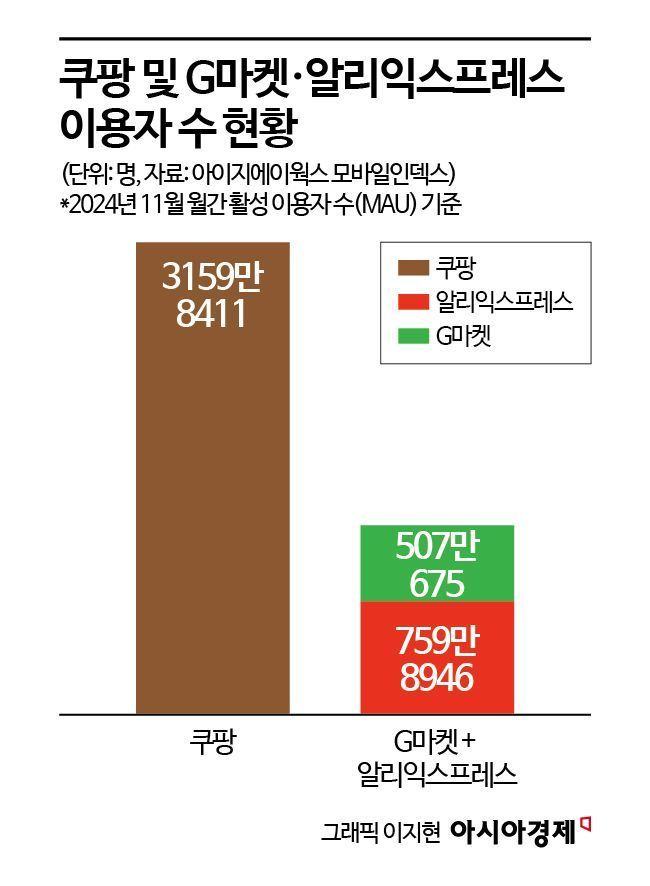
The establishment of the joint venture between the two companies is expected to cause a seismic shift in the domestic e-commerce industry. AliExpress, which has shown rapid growth by increasing investment in the Korean market, and Gmarket, regarded as the 'original open market' in Korea with steady performance, will be placed under one roof through the joint venture. Combining the two platforms will instantly make them the second-largest in the country based on monthly active users (MAU).
Jung Hyung-kwon, CEO of Gmarket, also expressed his ambition in an internal notice, saying, "The market is becoming increasingly fierce, and the position of leading companies is solidifying," adding, "We will grow into a market-leading player by utilizing Gmarket's product reliability and service system and Alibaba's competitively priced products." This is effectively seen as a challenge to Coupang.
However, it is expected to be difficult to surpass Coupang, which has rapidly risen as the largest domestic e-commerce platform, in the short term. Coupang's user numbers and other indicators are overwhelming. Coupang's average monthly users this year are around 30 million, and according to the app analytics service Mobile Index, Coupang's MAU last month was about 31.6 million. In contrast, Gmarket and AliExpress recorded MAUs of 5.07 million and 7.6 million respectively last month. Even combined, the two companies reach about 13 million, which does not match Coupang. Profitability is also expected to be difficult to recover quickly, as AliExpress has engaged in de facto 'price wars' centered on ultra-low-price sales. Last month, the online card payment market share of the domestic e-commerce industry was only about 4% when combining AliExpress and Temu.
Meanwhile, Alibaba Korea, the domestic affiliate of Alibaba, is being reserved about this alliance. An Alibaba Korea official said, "This joint venture establishment is a partnership between Shinsegae Group and Alibaba International headquarters in China," and added, "There is nothing to disclose regarding the partnership."
© The Asia Business Daily(www.asiae.co.kr). All rights reserved.
![Clutching a Stolen Dior Bag, Saying "I Hate Being Poor but Real"... The Grotesque Con of a "Human Knockoff" [Slate]](https://cwcontent.asiae.co.kr/asiaresize/183/2026021902243444107_1771435474.jpg)

















