National Assembly Industry Committee Ends Meeting Without Discussion
Special Semiconductor Law Unlikely to Pass This Year
Companies and Economic Groups Plan to Continue Emphasizing Importance
"Looking to Explore Various Communication Methods"
There is widespread sighing in the business community on the 27th following the near collapse of the passage of the 'Special Act for Strengthening Competitiveness and Innovative Growth of the Semiconductor Industry (Semiconductor Special Act)' within the year, which includes provisions exempting semiconductor research and development (R&D) personnel from the 52-hour workweek regulation. Amid this, companies and economic organizations agree that efforts to convey the necessity of these provisions must continue through the end of this year and early next year, showing a willingness to take active measures.
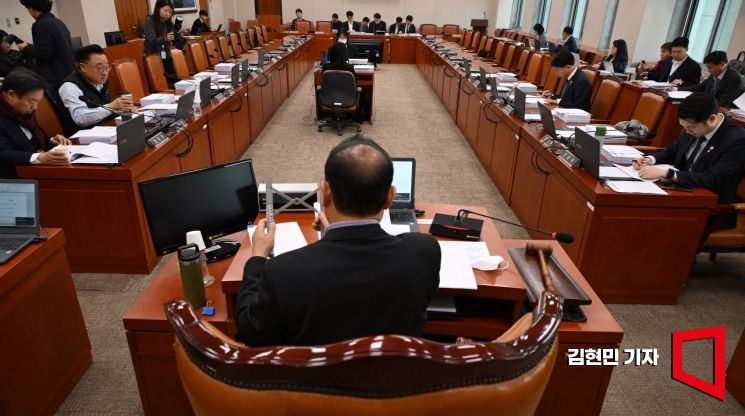 On the 26th, the Subcommittee on Industrial, Trade, and Energy Patents of the Industry, Trade, Energy, Small and Medium Venture Business Committee was held at the National Assembly. The agenda included the "Special Act on Strengthening Competitiveness and Promoting Innovative Growth in the Semiconductor Industry (Semiconductor Special Act)." Photo by Kim Hyun-min
According to the business community and political circles on this day, the National Assembly's Industry, Trade, Energy, Small and Medium Enterprises Committee held a subcommittee meeting the previous day intending to review the Semiconductor Special Act, but ended the meeting without even starting discussions. As a result, the likelihood of the Semiconductor Special Act being submitted to the plenary session scheduled for the 30th has become 'zero.' Since the 28th and 29th are holidays, the subcommittee will not reconvene, making passage within the year impossible.
It is uncertain whether the bill will be submitted to the plenary session after passing the subcommittee next year. This is because the differences in opinion between the ruling and opposition parties regarding the exemption of semiconductor R&D from the 52-hour workweek regulation remain unresolved as the new year approaches. The People Power Party maintains that the provision is essential for restoring the competitiveness of Korea's semiconductor industry, while the Democratic Party and other opposition parties oppose exempting only semiconductor R&D from the 52-hour workweek.
Meanwhile, companies and economic organizations are reportedly planning to continue emphasizing the necessity of the exemption by delivering additional explanatory documents to the Democratic Party and conducting related surveys one after another. A business community official said, "Companies and economic organizations are considering various ways to convey their opinions."
The Korea Chamber of Commerce and Industry conducted an 'Advanced Strategic Industry Regulation Perception Survey' on the 25th, revealing that the need for exemption from the 52-hour workweek for semiconductor R&D personnel is seriously recognized on the ground. Among 433 advanced companies surveyed, the largest portion, 29.6%, responded that 'technical regulations' such as R&D should be the focus of improvement. Companies that answered 'personnel regulations' (17.8%) added that "due to the nature of advanced strategic industries, securing skilled professionals is essential, but the implementation of the 52-hour workweek imposes many practical constraints."
It is also anticipated that companies may submit petitions urging the National Assembly to pass the bill. The industry expects events led by the Korea Semiconductor Industry Association, which unites semiconductor companies, to take place. Previously, on the 28th of last month, the Korea Semiconductor Industry Association invited Kim Moon-soo, Minister of Employment and Labor, to Samsung Electronics' Pyeongtaek plant for a meeting.
Companies are expected to emphasize that the exemption of semiconductor R&D from the 52-hour workweek is not about 'overnight work' but 'autonomous work,' highlighting the status of global companies like TSMC (Taiwan), where extended work hours are possible with labor-management agreements, and the nature of R&D that requires autonomy when researching and developing technology. Researchers have told this publication that R&D is "a profession that must be free from the constraints of time and place." Since ideas about technology can arise anytime and anywhere, autonomy over time and place must be granted. However, when ideas emerge, a significant amount of working hours must be guaranteed. A person familiar with R&D said, "When an idea comes up, it often hits like a storm, leading to research and report writing. In such cases, it is common to work late into the night." They added, "If one has to leave work early to comply with the 52-hour workweek, that flow can be interrupted."
© The Asia Business Daily(www.asiae.co.kr). All rights reserved.
![Clutching a Stolen Dior Bag, Saying "I Hate Being Poor but Real"... The Grotesque Con of a "Human Knockoff" [Slate]](https://cwcontent.asiae.co.kr/asiaresize/183/2026021902243444107_1771435474.jpg)
















