Economic 8 Organizations and People's Solidarity Seminar on 'Value Up and Shareholder Protection Issues and Tasks'
Opposition to Commercial Act Amendment "Weakens Corporate Competitiveness"... Support "Fundamental Problem Solving"
In the National Assembly, a bill to amend the Commercial Act and the Capital Markets Act, which expands the duty of directors to act faithfully from companies to shareholders or establishes a duty to protect shareholder interests, has been proposed. Meanwhile, the eight major economic organizations and the People's Solidarity for Participatory Democracy (PSPD) remain at odds. Opinions clashed between those opposing the amendment, arguing that slower director decision-making would weaken corporate competitiveness, and those supporting it, stating that fundamental issues related to shareholder protection must be addressed through amendments.
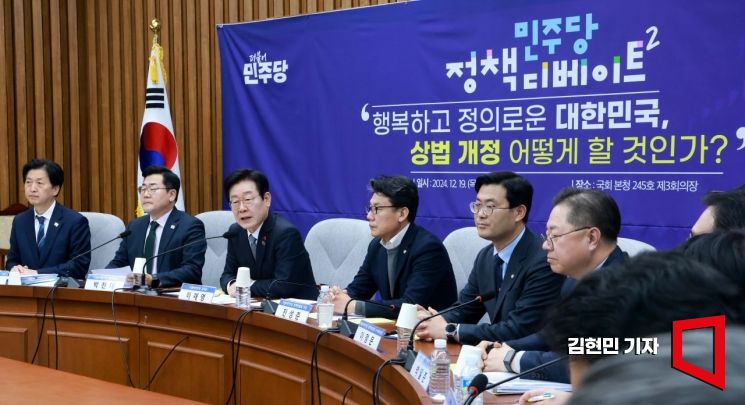 Lee Jae-myung, leader of the Democratic Party of Korea, is speaking at the Democratic Party policy debate held at the National Assembly on the 19th, on the topic of "How to Amend the Commercial Act." Photo by Kim Hyun-min
The Korea Chamber of Commerce and Industry (KCCI) announced that on the 27th, the eight economic organizations and PSPD jointly held a seminar titled "Key Issues and Tasks of Value-Up and Shareholder Protection" at the Sang-ui Hall in Jung-gu, Seoul. The eight economic organizations include KCCI, the Korea Employers Federation, the Korea International Trade Association, the Federation of Korean Industries, the Korea Federation of Small and Medium Business, the Korea Association of Mid-sized Companies, the Korea Listed Companies Association, and the KOSDAQ Association. Approximately 80 participants attended the seminar, including Park Il-jun, Executive Vice Chairman of KCCI, Kim Jong-bo, Director of the Economic and Financial Center at PSPD, experts on the Commercial Act and corporate governance, and corporate representatives.
The business community and investors showed differing views on expanding the duty of directors to act faithfully or establishing a duty to protect shareholders. In his opening remarks, Executive Vice Chairman Park Il-jun said, "The amendment to the Commercial Act, contrary to its purpose of protecting general shareholders apart from controlling shareholders, has a high risk of being exploited by overseas speculative funds with capital power," adding, "especially mid-sized and small businesses are vulnerable to disputes." Director Kim Jong-bo expressed in his welcoming remarks, "I believe an amendment to the Commercial Act reflecting the duty of directors toward shareholders is necessary."
Concerns were raised that there is no clear legislative precedent regarding shareholder protection duties in the proposed amendment to the Commercial Act. Professor Kwon Yong-su of Konkuk University pointed out, "The duty of directors to shareholders is abstract and unclear," adding, "until specific behavioral guidelines and the scope of responsibility are presented and precedents accumulate, there is a possibility of conflict with practical practices such as Environmental, Social, and Governance (ESG) management, and corporate confusion over legal interpretation may increase."
He emphasized the need to utilize shareholder protection measures already established under current law. Professor Kwon stated, "Under current law, shareholders can file derivative lawsuits if the company suffers damages, and if shareholders suffer direct damages, they can claim compensation from directors," and argued, "It is desirable that the duty of directors to protect shareholders be concretized based on interpretations of current law and the development of precedents rather than amending the Commercial Act."
There was also an opinion that amending the law could actually decrease corporate value. Professor Ji In-yeop of Dongguk University said, "If the amendment to the Commercial Act leads to activist funds seizing management rights, companies will focus only on short-term performance." Professor Choi Seung-jae of Sejong University criticized, "The core of value-up is corporate performance," adding, "In a globally challenging business environment, if the vague concept of 'prioritizing the interests of all shareholders' is introduced into the Commercial Act, directors may refrain from making any decisions due to concerns about breach of fiduciary duty, which could hinder corporate growth."
On the other hand, there was a counterargument that amending the law is necessary to resolve the Korea discount (the undervaluation of the Korean stock market). Professor Jung Jun-hyuk of Seoul National University School of Law said, "The general perception among domestic and foreign investors that shareholder protection in Korea is insufficient compared to other countries negatively affects the capital market." He added, "Courts and boards of directors often do not thoroughly review the impact of corporate decisions such as organizational restructuring on the interests of general shareholders," and emphasized, "It is necessary to amend the law to codify the duty to protect shareholders." He also proposed supplementary measures such as establishing guidelines for mergers, new stock issuance, and investments, realizing executive liability insurance, and enacting prosecution guidelines for breach of trust in business operations.
There was also criticism that the government's amendment proposal alone is insufficient. Professor Kim Woo-jin of Seoul National University said, "Since there are shareholder interest infringement acts beyond the four major capital transactions specified in the Capital Markets Act amendment, it is necessary to introduce general principles for shareholder protection." The four major capital transactions mentioned by Professor Kim refer to the four types of transactions regulated under Article 165-4 of the Capital Markets Act: mergers, splits, significant business asset acquisitions and disposals, and comprehensive stock exchanges or transfers.
Some view amending the Commercial Act as inevitable for improving corporate governance. Ryu Young-jae, CEO of Sustainvest, argued, "Although regulations for shareholder protection such as those against internal trading exist, amending the Commercial Act to expand the duty of directors to act faithfully is unavoidable for more fundamental remedies." Cheon Jun-beom, Vice Chairman of the Korea Corporate Governance Forum, said, "Declaring decision-making principles for all shareholders in the Commercial Act is the most efficient solution."
However, the business community and investors generally agreed on amendments to the Capital Markets Act concerning mergers and splits. They saw the need for "pinpoint regulations" on problematic cases such as standards for merger price calculation and new stock allocation to existing parent company shareholders after physical splits of listed companies. Professor Kwon Jae-yeol of Kyung Hee University said, "Problematic cases should be pinpoint regulated through the Capital Markets Act."
A KCCI official stated, "We will monitor the legislative progress, including public hearings in the National Assembly, and together with other economic organizations, we plan to convey opinions to minimize the burden on companies regarding amendments to the Commercial Act and the Capital Markets Act."
© The Asia Business Daily(www.asiae.co.kr). All rights reserved.
![Clutching a Stolen Dior Bag, Saying "I Hate Being Poor but Real"... The Grotesque Con of a "Human Knockoff" [Slate]](https://cwcontent.asiae.co.kr/asiaresize/183/2026021902243444107_1771435474.jpg)
















