The 4th Basic Mining Plan Confirmed
The government is set to ease regulations to foster the recycling industry of critical minerals such as rare earth elements, lithium, nickel, and cobalt. It will also promote a carbon capture, utilization, and storage (CCUS) project that stores carbon dioxide captured from factories in abandoned mines.
The Ministry of Trade, Industry and Energy announced on the 27th that it has finalized the "4th Basic Mining Plan (2025?2034)" after review by the Energy Committee. The Basic Mining Plan is a national mid- to long-term mining plan established every 5 years for a 10-year period under the Mining Act. The government prepared the plan through consultations with the mining industry, academia, experts, and related agencies, as well as coordination with relevant ministries.
The basic plan presents 13 policy tasks based on four major strategies: strengthening the supply base of critical minerals, enhancing mining competitiveness through digital infrastructure, leading mine safety and carbon neutrality, and creating a sustainable mining ecosystem.
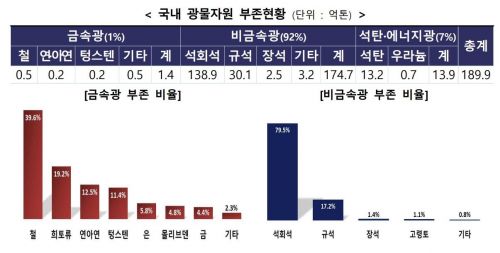
To strengthen the supply base of critical minerals, the government plans to support exploration and development of domestic resources while fostering the recycling industry of critical minerals. As countries worldwide are promoting a circular economy to secure critical minerals and achieve carbon neutrality, there is growing demand domestically for recycling critical minerals due to limited domestic resources.
Specifically, the government will expand technology development and consulting for fostering the recycling industry and build a database (DB) for the top 10 critical minerals (neodymium, dysprosium, terbium, cerium, lanthanum, lithium, cobalt, nickel, manganese, and graphite). It also plans to establish a raw material-material convergence cluster for critical minerals to create a circular economy ecosystem across upstream and downstream industries.
To activate the recycling industry, the government will collaborate with related ministries and agencies to improve systems, including easing import regulations on raw materials. For example, it will simplify import requirements and procedures for major critical mineral recycling raw materials and consider classifying the recycling industry as "manufacturing" under the standard industrial classification. It will apply tariff quotas on key recycling raw materials such as printed circuit boards (PCB) and catalysts and prevent indiscriminate outflow and illegal export of recycling raw materials generated domestically.
The government will continuously expand stockpiles of rare metals (22 types) and increase the items and quantities of stockpiles. Currently, under the comprehensive metal stockpiling plan established in 2022, the goal is to stockpile 100 to 180 days’ worth by 2031. Additionally, by 2027, the government plans to invest 225.5 billion KRW to build a dedicated national stockpile base for critical minerals in the Saemangeum National Industrial Complex in Gunsan, Jeonbuk.
The government will establish a mid- to long-term roadmap for creating a limestone processing industry cluster and promote using domestic abandoned mine tunnels as underground storage for captured carbon dioxide. CCUS projects utilizing abandoned mines are actively being promoted worldwide.
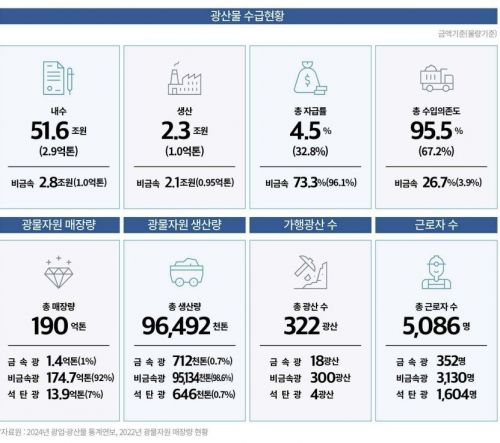
Meanwhile, domestically, coal mines sharply declined after the 1989 coal rationalization policy, and most metal mines have been closed or suspended since 1992 due to the influx of low-cost minerals following diplomatic relations with China. Non-metal mines have also mostly closed since the International Monetary Fund (IMF) financial crisis, with only high-grade limestone mines currently operating actively. As of 2023, there are 300 non-metal mines, 18 metal mines, and 4 coal mines in operation in South Korea.
The annual production value of domestic mined products is about 2 trillion KRW (2.3 trillion KRW in 2023), accounting for 0.1% of the gross domestic product. About 70% of mines have sales under 1 billion KRW, indicating most are small-scale. The self-sufficiency rate is extremely low, with 95.5% of mined products (by value) dependent on imports.
Choi Nam-ho, the 2nd Vice Minister, stated, "In response to the recent intensifying competition for securing critical minerals and global supply instability, it is a very important time to establish a stable supply base for industrial raw material minerals. We will steadily promote domestic critical mineral exploration and development, digital and eco-friendly mining, recycling, and rare metal stockpiling to strengthen the competitiveness of our mining industry and create a sustainable industrial ecosystem."
© The Asia Business Daily(www.asiae.co.kr). All rights reserved.
![Clutching a Stolen Dior Bag, Saying "I Hate Being Poor but Real"... The Grotesque Con of a "Human Knockoff" [Slate]](https://cwcontent.asiae.co.kr/asiaresize/183/2026021902243444107_1771435474.jpg)

















