Establishing a Foundation for Citizens to Enjoy Digital Technology Benefits
Scheduled for Implementation from January 2026
Expansion of Kiosk Installation for Disabled and Elderly
The 'Digital Inclusion Act,' which establishes a foundation for all citizens to enjoy the benefits of digital technology without discrimination, passed the National Assembly plenary session on the 26th.
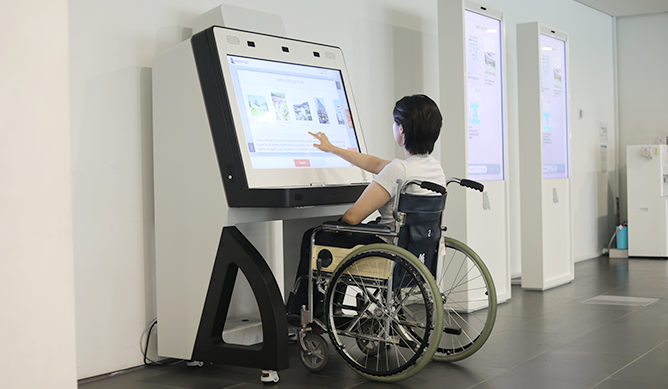
The newly enacted Digital Inclusion Act defines the concept of digital inclusion as "an environment where all members of society can equally enjoy the benefits of intelligent information technology without discrimination or exclusion."
This law stipulates necessary matters for the establishment and implementation of digital inclusion policies and promotes the creation of a foundation for fostering digital inclusion technologies and industries to contribute to improving the quality of life of individuals in society and social integration.
The definition of digitally vulnerable groups, previously limited to persons with disabilities and the elderly, has been expanded to ensure that any citizen experiencing difficulties in using digital technology can receive support.
The government is required to prepare policies so that all members of society can use digital (intelligent information) services and products. Additionally, digital competency centers will be designated, and standard textbooks and programs will be developed to help local residents enhance their digital skills.
In particular, through the Digital Inclusion Act, unmanned information terminals (kiosks) are expected to be modified so that people with low vision, wheelchair users, and others can use them without inconvenience.
To facilitate the convenient use of kiosks, which have rapidly expanded recently, an obligation has been newly established for kiosk manufacturers and rental businesses to provide user convenience. The obligation to install 'barrier-free kiosks' supporting height adjustment, voice assistance, Braille notation, and other features has been imposed on kiosk manufacturers and rental operators.
Those who manufacture or rent kiosks must take necessary reasonable measures to ensure that digitally vulnerable groups can easily access and use them, as prescribed by Presidential Decree. If reasonable measures are not taken, the Minister of Science and ICT may order corrective action, and failure to comply with the correction order may result in a fine of up to 30 million won.
Furthermore, the law promotes the participation of companies and civic groups in the policy-making process for digital inclusion and supports voluntary activities in the private sector.
The Digital Inclusion Act will be transferred to the government and, after a one-year preparation period following its promulgation, is expected to be implemented as early as January 2026. Minister Yoo Sang-im of the Ministry of Science and ICT emphasized, "The Digital Inclusion Act is a law to support all citizens in easily using AI and digital technologies to realize true digital innovation," adding, "We will spare no policy support to achieve the legislative purpose."
© The Asia Business Daily(www.asiae.co.kr). All rights reserved.

















