190,000 Overloaded Freight Truck Cases in the Past 5 Years
Minimal Effectiveness Despite Strengthened Shipper Responsibility
Earlier this month, a 15-ton truck descending a hill in Tongyeong-si, Gyeongnam, caused a 14-vehicle pileup by consecutively crashing into vehicles waiting at a traffic signal. The police are investigating the exact circumstances, believing that the overloaded cargo hindered the vehicle's braking, leading to the accident.
On the 25th of last month, in Gijang-gun, Busan, a 4.5-ton truck traveling downhill broke through a protective railing and fell 5 meters down a retaining wall, resulting in the driver's death. Police reviewing CCTV footage just before the fall noted that the truck's brake lights were on, but the brakes did not seem to function properly. They are investigating the exact cause of the accident, including possible overloading.
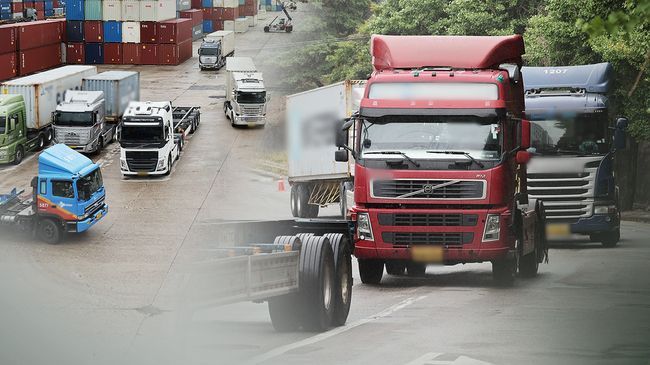
Amid ongoing incidents and accidents caused by 'overloaded trucks' carrying cargo beyond recommended limits, legal gaps remain. Experts point out the limitations of current laws that place responsibility solely on drivers and emphasize the need to strengthen the legal accountability of cargo owners and transport companies.
According to the Ministry of Land, Infrastructure and Transport on the 27th, from 2020 to July this year, there have been 190,000 cases of overloaded trucks detected over the past five years. The number of overloaded truck detections (on general national roads and expressways) exceeded 40,000 annually: 44,002 cases in 2020, 44,431 in 2021, and 40,653 in 2022. This year (as of July 31), about 23,000 overloaded trucks were detected?3,600 on general national roads and 19,471 on expressways. As a result, fines totaling 2.651 billion KRW on general national roads and 9.23 billion KRW on expressways were imposed.
Industry insiders and experts cite the fundamental cause of persistent truck overloading as the 'lack of legal responsibility for cargo owners and transport companies.' They argue that current laws excessively shift responsibility onto the vehicle owners. Under the current Road Traffic Act, drivers operating vehicles exceeding 110% of the maximum load capacity or with a total weight over 40 tons face fines ranging from 300,000 KRW to 3 million KRW.
A representative from the Korea Federation of Freight Truck Transport Associations said, "Common sense tells us no truck owner would want to carry more cargo just for the sake of it. Cargo owners demand transporting as much as possible at once to reduce shipping costs, but truck owners, whose livelihoods depend on it, find it difficult to refuse and cannot verify if the loading amounts provided by cargo owners are accurate," lamenting the situation. Kim (52), a transport industry worker, also pointed out, "The focus should be on strengthening supervision of cargo owners and transport companies, not punishing innocent drivers who are in a subordinate relationship with cargo owners."
Although related legislation strengthening penalties for cargo owners and transport companies was amended once in May last year, it is also criticized for lacking effectiveness. According to the current Freight Truck Transport Business Act, cargo owners and transport companies who demand overloading or falsely report cargo weight or volume to truck owners can be fined up to 5 million KRW.
However, attorney Jeong Gyeong-il of the law firm L&L explained, "While the law stipulates fines if cargo owners demand overloading, in reality, investigative agencies rarely pursue cargo owners' responsibility so persistently, and such cases are rare. Ultimately, the structure requires truck owners to report cargo owners and transport companies, but fear of losing business relationships makes reporting very difficult."
Experts advise clearly specifying the legal responsibility ratios among cargo owners, transport companies, and truck owners in revised legislation. Attorney Kwak Jun-ho of the law firm Chung emphasized, "Since cargo owners and transport companies control the livelihoods of truck owners, relying solely on truck owners to report and punish them is like putting a bell on a cat’s neck. The most practical solution is to set the proportions of fines and legal responsibilities for cargo owners and truck owners explicitly in the amendment. Enforcing legal responsibility on cargo owners and transport companies this way will enhance effectiveness."
© The Asia Business Daily(www.asiae.co.kr). All rights reserved.

















