Major Companies Also Face 'Urgent Crisis'
As the won-dollar exchange rate surpassed 1,470 won, it is analyzed that the net profits of the two companies, POSCO and Hyundai Steel, have been reduced by nearly hundreds of billions of won solely due to the exchange rate. The depreciation of the won caused the import prices of raw materials such as iron ore to rise, resulting in losses of hundreds of billions of won in a short period. Steelmakers have urgently begun revising their New Year's management strategies established last month. The extreme situation where 1,500 won becomes the new normal and scenarios including 1,600 won are being considered.
According to the business reports of POSCO and Hyundai Steel on the 27th, if the won-dollar exchange rate rises by 10%, POSCO's net profit (before corporate tax expenses) is estimated to decrease by 583.5 billion won, and Hyundai Steel's by 14.2 billion won. As of 9:30 a.m. on the 27th, the won-dollar exchange rate recorded 1,473.2 won, rising more than 14% compared to the end of last year (1,290 won). If the exchange rate continues to rise, the scale of net profit reduction is expected to increase further.
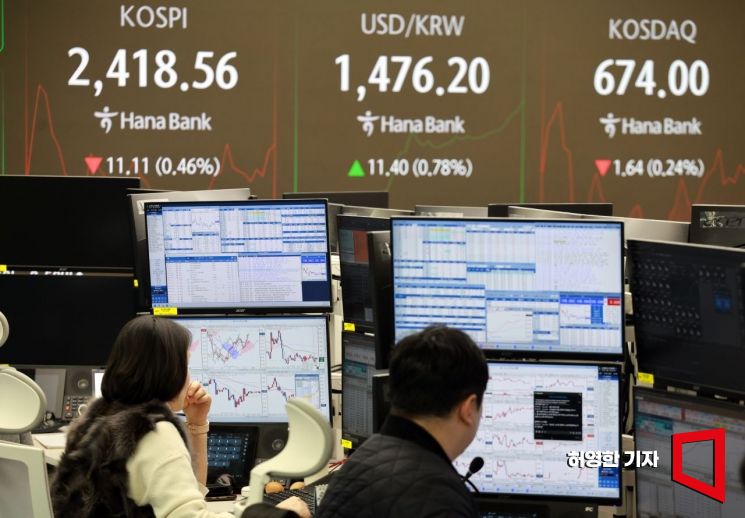 On the 27th, the domestic stock market started with a slight decline, and the won-dollar exchange rate surpassed 1,475 won intraday for the first time since the 2009 financial crisis. Employees are working in the dealing room at the Hana Bank headquarters in Euljiro, Seoul. Photo by Heo Young-han
POSCO has accumulated foreign exchange translation losses exceeding 1 trillion won up to the third quarter due to the depreciation of the won. When importing large quantities of raw materials, foreign currency purchase liabilities arise, and as the exchange rate rises (won depreciation), the debt burden increases. Simply put, the same amount of raw materials must be purchased at a higher cost in won. This structure affects non-operating losses and increases net losses. During the same period, Hyundai Steel also recorded a foreign exchange translation loss of 9.3 billion won.
Steel industry players such as POSCO and Hyundai Steel have become busy revising their exchange rate increase projections. These companies are reportedly including the possibility of 1,600 won, beyond 1,500 won, in next year's exchange rate scenarios. Initially, the fluctuation range for next year's exchange rate was set, but after the martial law situation, the exchange rate exceeded the fluctuation range, making revision inevitable.
An industry insider said, "Exchange rate forecasts are estimated based on data provided by management research institutes, but recent sharp rises in the exchange rate have made predictions difficult," adding, "The worst-case scenarios exceeding 1,500 won and 1,600 won can no longer be ruled out."
Jeon Gyu-yeon, a researcher at Hana Securities, said, "Domestic political uncertainty continues, and the Federal Reserve's rate cut pace adjustment is fueling the global US dollar strength, putting the won in a difficult position both domestically and internationally," adding, "If the exchange rate does not stabilize, it is necessary to keep the possibility of a 1,500 won range next year open."
Hyundai Steel has decided to take strategic responses by business division. In the raw material procurement sector, it plans to expand the proportion of long-term supply contracts with fixed prices rather than spot price transactions in preparation for further exchange rate increases. In the sales sector, it is revising its strategy to increase the export ratio rather than domestic sales to minimize foreign exchange losses. The so-called 'natural hedging' ratio, which involves not converting secured foreign currency from exports into won but using it for imports, is also being increased.
Fortunately, the overall weakness in raw material prices is considered a silver lining. The industry has decided, as a last resort, to reflect the increase in raw material costs due to the high exchange rate in product prices. Recently, POSCO reportedly informed distribution clients that it will raise the prices of hot-rolled and thick plates by 30,000 won per ton starting next month.
The exchange rate fear is spreading not only to the steel industry but also to the entire industrial sector. Export companies such as semiconductor firms are also concerned that the burden of raw material imports will increase, reducing profit margins next year.
The electronics industry is also preparing for risks by setting standards in their New Year's management strategies that exceed the possibility of the exchange rate rising to 1,500 won. Especially in the semiconductor industry, competition is fierce, making it difficult to reflect cost increases due to exchange rate rises in product prices.
Even the finished car companies, considered beneficiaries of a high exchange rate, are uncomfortable with the high volatility. Hyundai Motor Group usually starts planning next year's management strategy around August or September and refines detailed business plans by the end of the year, but it is adjusting next year's plans overall. Hyundai Motor and Kia experience a combined operating profit difference of about 500 billion won for every 10 won fluctuation in the exchange rate. The new US plant, which involved investments of tens of billions of dollars, is also expected to incur additional costs before reaching full operation.
A Hyundai Motor Group official said, "We believe the possibility of maintaining the current exchange rate level next year is low," but added, "The uncertainty itself is a burden."
© The Asia Business Daily(www.asiae.co.kr). All rights reserved.


















