Ministry of Health and Welfare-Central Cancer Registry, 2022 National Cancer Registration Statistics Released
Increase in Cancers Mainly Occurring in the Elderly, Such as Prostate and Pancreatic Cancer
With advances in medical technology, the survival rate of cancer patients has been steadily increasing, with 7 out of 10 cancer patients in South Korea surviving for more than 5 years. The 5-year relative survival rate of cancer patients has continuously improved, rising by 18.7 percentage points compared to the relative survival rate (54.2%) of patients diagnosed between 2001 and 2005.
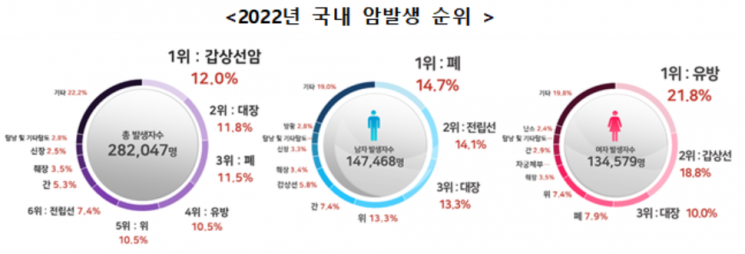
The Ministry of Health and Welfare and the Central Cancer Registry announced the '2022 National Cancer Registration Statistics' collected through the National Cancer Registration Statistics project on the 26th.
The number of newly diagnosed cancer patients in 2022 was 282,047, a decrease of 154 cases (0.05%) compared to the previous year. The number of male patients increased by 1,230 (0.84%) to 147,468, while female patients decreased by 1,384 (1.02%) to 134,579.
New cancer cases were 259,351 in 2019 and 252,251 in 2020, but as medical utilization recovered after COVID-19, the numbers rose again to 282,201 in 2021 and 282,047 in 2022.
The age-standardized incidence rate of cancer per 100,000 population was 522.7, a decrease of 12.8 (2.4%) from the previous year. The age-standardized incidence rate is calculated by weighting the standard population ratio of each age group to compare incidence rates across regions and periods with different age structures. The cancer incidence rate per 100,000 was 519.4 in 2019, 491.2 in 2020, and 535.5 in 2021.
Additionally, if Koreans live up to the life expectancy (79.9 years for men, 85.6 years for women), the probability of developing cancer is estimated at 37.7% for men and 34.8% for women.
5-Year Relative Survival Rate of Cancer Patients at 72.9%
In 2022, the most common cancer among both men and women was thyroid cancer, followed by colorectal cancer, lung cancer, breast cancer, stomach cancer, prostate cancer, and liver cancer. Compared to the previous year, the number of cases increased mainly in cancers prevalent among the elderly, such as prostate cancer (1,744 cases), pancreatic cancer (590 cases), breast cancer (354 cases), and lung cancer (102 cases). As the population aged 65 and older continues to grow, it is expected that cancers common in the elderly will increase further.
Looking at incidence rates by cancer type, stomach, lung, liver, and colorectal cancers (since 2011) have shown a decreasing trend in men, while stomach, liver, and colorectal cancers (since 2012) have decreased in women. Prostate cancer in men and breast cancer in women continue to increase, and thyroid cancer has also shown an upward trend since 2016. Conversely, cervical cancer, which ranked third among women’s cancers in 1999, has sharply declined and fallen out of the top 10.
The 5-year relative survival rate for cancer patients diagnosed in the recent 5 years (2018?2022) was 72.9%, slightly higher than the previous year’s 72.1%. Compared to the relative survival rate of 54.2% for patients diagnosed between 2001 and 2005, this is an increase of 18.7 percentage points. This means that 7 out of 10 cancer patients survive for more than 5 years. Notably, the 5-year survival rate for women (78.8%) was higher than that for men (67.2%), which is attributed to the higher incidence of cancers with high survival rates such as thyroid and breast cancer in women. Survival rates were high for thyroid cancer (100.1%), prostate cancer (96.4%), and breast cancer (94.3%), while lung cancer (40.6%), liver cancer (39.4%), gallbladder and other biliary cancers (29.4%), and pancreatic cancer (16.5%) had relatively low survival rates.
Especially, cancer patients diagnosed at a localized stage, where the cancer has not spread beyond the organ of origin, showed a high survival rate of 92.1%, whereas those diagnosed with distant metastasis had a survival rate of only 27.1%. Even among patients diagnosed at a localized stage, survival rates varied by cancer type: thyroid, colorectal, stomach, breast, prostate, and kidney cancers showed high survival rates above 94%, while lung cancer (79.8%), liver cancer (62.3%), and pancreatic cancer (46.6%) had relatively lower survival rates.
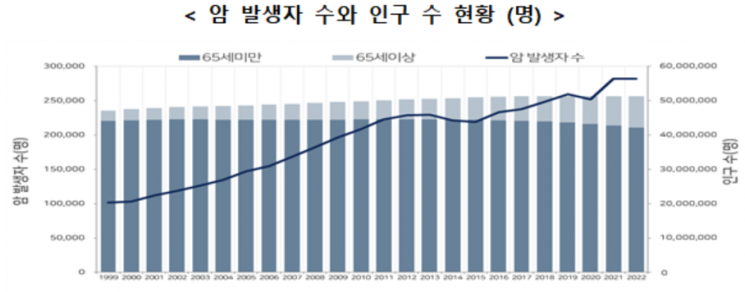
1 in 20 Koreans is a Cancer Patient or Cancer Survivor
In 2022, the number of cancer survivors, including patients and those cured of cancer, was approximately 2,588,079, equating to 1 in every 20 Koreans. This was an increase of 153,990 from the previous year (2,434,089). Cancer survivors aged 65 and older numbered 1,302,668, accounting for 50.3% of all survivors, meaning that 1 in 7 people aged 65 and older (14.5%) was a cancer survivor.
The cancer with the highest number of survivors among both men and women was thyroid cancer (554,693 cases, 21.4%), followed by stomach cancer (356,507 cases, 13.8%), breast cancer (330,854 cases, 12.8%), colorectal cancer (326,251 cases, 12.6%), prostate cancer (147,618 cases, 5.7%), and lung cancer (131,496 cases, 5.1%).
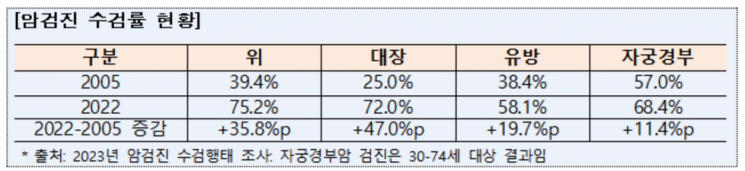
More than half (61.3%) of all cancer survivors, totaling 1,587,013 people, had survived more than 5 years after diagnosis, an increase of 107,477 compared to the previous year (1,479,536).
Looking at the number of survivors by elapsed time since diagnosis for major cancer types, cancers with relatively high survival rates such as stomach, colorectal, and breast cancers showed a gradual decrease in survivor numbers. In contrast, lung and prostate cancers, which are mainly diagnosed in the elderly, showed a rapid decrease in survivor numbers after diagnosis, with lung cancer, which has a low survival rate, showing a larger decline.
Yang Han-kwang, Director of the National Cancer Center, stated, "The 5-year survival rate of cancer patients in South Korea is high at 72.9%, and especially the survival rates for stomach and colorectal cancers are very high among major comparison countries, thanks to high health screening participation rates. However, since 1 in 5 cancer patients is still diagnosed at a stage with distant metastasis, national cancer management projects for early detection and treatment remain crucial."
Jung Tong-ryong, Director of Public Health Policy at the Ministry of Health and Welfare, said, "The increase in cancer patients diagnosed at a localized stage is a significant achievement of early screening. As the population ages and the number of cancer cases and cancers common in the elderly increase, we will strive to develop effective cancer management policies to address these changes."
© The Asia Business Daily(www.asiae.co.kr). All rights reserved.
![Clutching a Stolen Dior Bag, Saying "I Hate Being Poor but Real"... The Grotesque Con of a "Human Knockoff" [Slate]](https://cwcontent.asiae.co.kr/asiaresize/183/2026021902243444107_1771435474.jpg)


















