Won-Dollar Exchange Rate Closes in 1450 Won Range for 4 Consecutive Trading Days
Opens at 1455.2 Won on the Morning of the 26th, Rises to the 1460 Won Threshold
"Exchange Rate May Rise Until Q1 Next Year"
The won-dollar exchange rate has closed in the 1450 won range for four consecutive trading days recently, and on the 26th, it rose to around 1460 won, leading to forecasts that the exchange rate could increase until the first quarter (January to March) of next year.
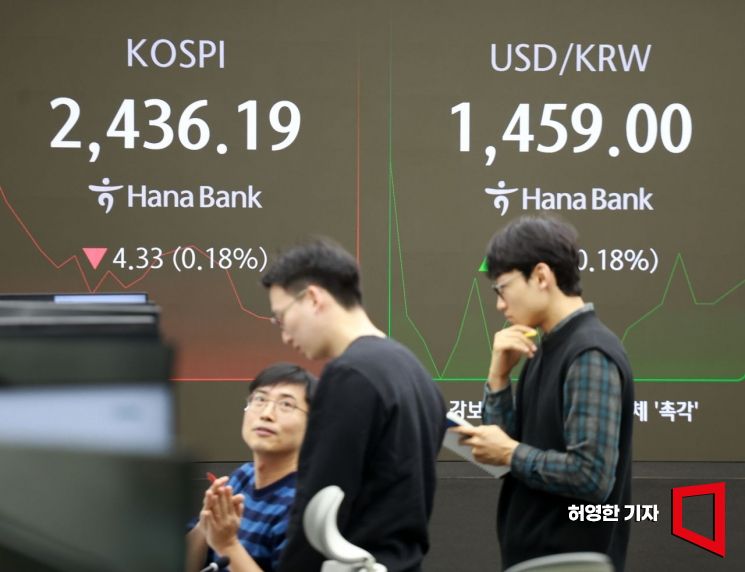 As major U.S. stock indices rose together in a "Santa Rally," the KOSPI opened at 2,449.52 points, up 9 points (0.37%), and has since been fluctuating slightly. The KOSDAQ also saw a modest increase, while the won-dollar exchange rate rose, approaching 1,460 won. Various indices are displayed in the dealing room at the Hana Bank headquarters in Euljiro, Seoul.
On the 26th, in the Seoul foreign exchange market, the won-dollar exchange rate was trading at 1459.0 won as of 9:30 a.m. The exchange rate opened at 1455.2 won, down 1.2 won from the previous trading day's closing price (3:30 p.m.), then rose to just below 1460 won.
The won-dollar exchange rate closed at 1456.4 won in the weekly trading on the 24th, setting a new high. This is the highest level since March 13, 2009 (1483.5 won) during the global financial crisis. On that day, the intraday high reached 1460.30 won. It was the first time since March 16, 2009 (1488.50 won) that the won-dollar exchange rate exceeded 1460 won based on the high price.
Since the beginning of this month, the won-dollar exchange rate has steadily remained in the 1400 won range. The exchange rate started at 1300.40 won on January 2 this year (based on the 3:30 p.m. closing price), stayed in the mid-to-high 1300 won range after April, and broke through the 1400 won range on November 12 (1403.50 won), right after Trump's election. It then surged to 1410.10 won on the 4th, the day after the declaration of martial law. Since the FOMC (Federal Open Market Committee) meeting on the 19th, it has closed in the 1450 won range for four consecutive trading days.
The recent rise in the exchange rate is largely due to the dollar's strength as the U.S. hinted at slowing the pace of interest rate cuts, increasing policy uncertainty. The dollar index, which was around 106-107 earlier last week, rose to the low 108 range as of the 24th.
Concerns over prolonged domestic political uncertainty also put upward pressure on the exchange rate. On the 24th, the Democratic Party announced it would push for the impeachment of Acting President Han Deok-soo and said it would decide on the final impeachment based on whether a constitutional court judge candidate is appointed by the morning of the 26th. If Acting President Han does not appoint a constitutional court judge candidate, the impeachment vote could take place as early as the 28th.
Accordingly, the average won-dollar exchange rate this year has also surged. From January 2 to the 24th, the average won-dollar exchange rate (based on the 3:30 p.m. closing price) is 1363.09 won. It is the first time in 26 years since 1998 (1394.97 won) that the annual average exchange rate has surpassed 1350 won. The average exchange rate from the 4th to the 24th, after the declaration of martial law, is 1435.10 won.
Exchange Rate Expected to Continue Rising Until First Quarter of Next Year
The won-dollar exchange rate is expected to continue its upward trend at least until the first quarter of next year. It is assessed that it will be difficult for the won to strengthen (exchange rate to fall) as long as the dollar remains strong and political uncertainty is not resolved.
Moon Da-woon, a researcher at Korea Investment & Securities, said, "During the process of handling the impeachment bill, the inherent downward pressure on the won is expected to continue at least until the first quarter of next year," adding, "Not only the political instability itself but also the weakening of negotiation power due to the lack of leadership in our government during the early Trump administration, the downward revision of Korea's economic growth outlook next year, and the slow narrowing of the Korea-U.S. interest rate differential are likely to stimulate the won's weakness."
Kwon Ah-min, a researcher at NH Investment & Securities, also said, "As expectations for U.S. interest rate cuts retreat, the dollar index is expected to maintain a firm trend at least until the first half of next year," adding, "The won's weakness pressure combined with the dollar's strength is likely to continue at least until the first half of next year."
Lee Joo-won, a researcher at Daishin Securities, said, "Foreign exchange authorities' intervention is expected to act as a factor to moderate the speed of exchange rate increases, but unless the dollar's strength pressure is resolved, there are limits to reversing the direction of the won-dollar exchange rate," adding, "To shift the exchange rate to a downward trend, it is necessary to resolve domestic political uncertainty and restore confidence in China's economic stimulus."
Some also see the possibility of the won-dollar exchange rate rising to the 1500 won range.
Park Sang-hyun, a researcher at iM Securities, said, "Considering the heightened policy risks since President Trump's inauguration and the increased uncertainty in the impeachment political situation centered on Acting President Han recently, the exchange rate will face upward pressure from January to the first half of next year," adding, "Taking into account the policy uncertainty of Trump's second term, domestic political uncertainty, and the possibility of a base rate cut in January next year, the won-dollar exchange rate could rise to 1500 won in early next year."
© The Asia Business Daily(www.asiae.co.kr). All rights reserved.

















