No Response and Noncompliance with Attendance Request on the 25th
Prosecutors' Office: "No Submission of Defense Counsel Appointment Notice"
Analysis of Meeting Arrest Warrant Issuance Requirements
President Yoon Seok-yeol, who is accused of being the ringleader of a rebellion, has not responded at all to the High-ranking Officials' Crime Investigation Agency's (HCIA) request to appear on Christmas, raising the possibility of an arrest warrant being issued. Legal circles both inside and outside the judiciary believe that the conditions have already been largely met.
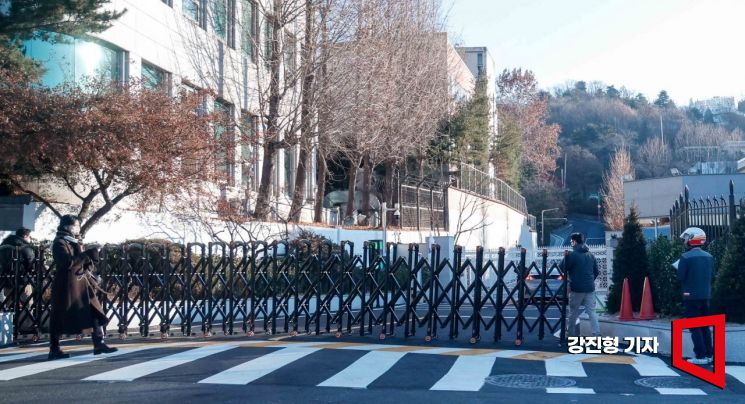 On the 24th, a postal worker is holding mail in front of the presidential residence in Hannam-dong, Yongsan-gu, Seoul, where President Yoon Suk-yeol is refusing to accept the Public Corruption Investigation Office's summons and the Constitutional Court's impeachment trial documents. Photo by Kang Jin-hyung
According to the HCIA on the 26th, President Yoon did not comply with the HCIA's request to appear for questioning at the HCIA office in the Government Complex Gwacheon by 10 a.m. the previous day. The HCIA waited until 6 p.m. that day for his appearance, but since President Yoon ultimately did not show up and his legal team did not provide any statement, the investigation was considered to have been canceled. The HCIA stated, "There has been no contact from President Yoon's side, and no notice of attorney appointment has been submitted."
The HCIA had also sent a first summons on the 16th, requesting President Yoon to appear for questioning on the 18th, but he did not respond then either. Maintaining silence even during this second summons issued a week later, the HCIA now faces a crossroads of either issuing a third summons or requesting an arrest warrant for President Yoon.
The Criminal Procedure Act stipulates that an arrest warrant can be requested from the court when ▲ there is reasonable suspicion that the suspect has committed a crime and ▲ the suspect either refuses to comply with the investigative agency's summons without justifiable reason or there is concern that they will not comply. In President Yoon's case, the legal community generally views that these two conditions required for issuing an arrest warrant have been partially fulfilled. Regarding the former, since key emergency martial law officials such as former Minister of National Defense Kim Yong-hyun and former Commander of the Defense Counterintelligence Command Yeo In-hyung have been consecutively detained on charges related to important duties in the rebellion, the court may consider the conditions met.
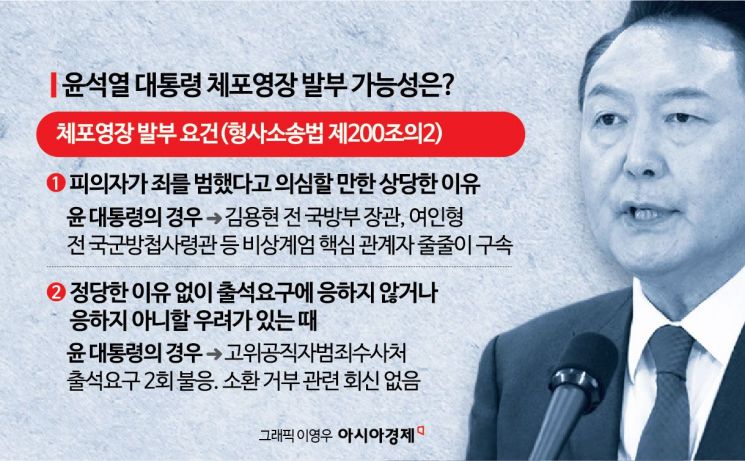
In particular, the latter condition is objectively met as President Yoon has failed to respond to summons twice without any reply. A criminal defense attorney from a law firm said, "Even if a suspect does not comply with a summons, it is common to communicate reasons for not being able to appear or to request rescheduling," adding, "Not contacting the investigative agency itself can work against the suspect in the future."
Moreover, President Yoon's side maintaining the position that impeachment proceedings take precedence over the investigation is likely to influence future investigations. Attorney Seok Dong-hyun, who is involved in forming President Yoon's proxy and defense teams, said, "The President believes that since the National Assembly has impeached him, the Constitutional Court's impeachment trial procedure should take priority." However, since impeachment trials and investigations proceed separately, the HCIA may judge that there is a risk President Yoon will continue to refuse to appear.
Typically, when requesting an arrest warrant, consideration is also given to requesting a detention warrant later, which is expected to be a burden for President Yoon's side. Investigative agencies must request a detention warrant within 48 hours after arresting a suspect, and if the court does not grant it, the suspect must be released. Under the Criminal Procedure Act, grounds for detention include the risk of flight or the risk of evidence destruction. The seriousness of the crime and the risk of reoffending are also considered. In President Yoon's case, it is generally viewed that there is no risk of flight due to his fixed residence, but considering the previous case where the Security Office refused police searches of the Presidential Office and residence, as well as the gravity of the charges, the possibility of detention following arrest is also being discussed. HCIA Chief Oh Dong-woon has stated, "Detention investigations are the principle for ringleaders of rebellion and major criminals."
© The Asia Business Daily(www.asiae.co.kr). All rights reserved.


















