A joint research team from Korea and the United States has developed a technology that can measure bio-impedance more precisely than before using only two electrodes.
Bio-impedance measurement technology allows monitoring of the body's resistance characteristics (physiological state within the body) that interfere with the flow of alternating current when current is passed through the body using commonly used devices such as the ‘InBody’. Recently, with the activation of wearable devices, the importance of bio-impedance measurement is increasing.
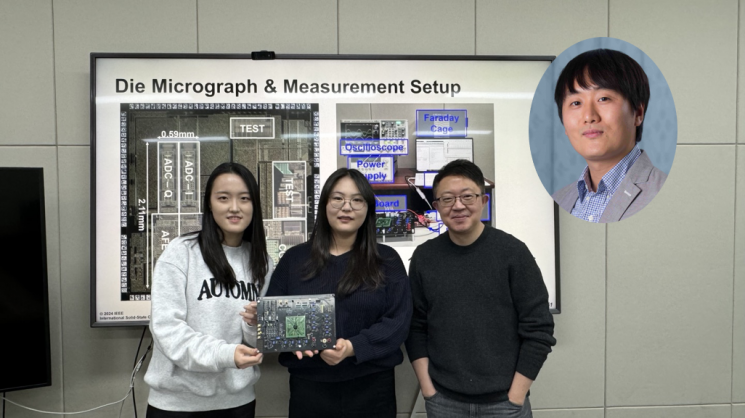 (From left) Cheon Song-yi, Choi Hae-dam, PhD candidates in the Department of Electrical and Electronic Engineering, Professor Je Min-gyu, (top) Professor Ha So-myeong, NYUAD. Provided by KAIST
KAIST announced on the 26th that a joint research team led by Professor Min-Kyu Je from the Department of Electrical Engineering and Computer Science at KAIST and Professor Ha So-Myung from New York University Abu Dhabi (NYUAD) has developed a high-resolution bio-impedance measurement technology optimized for wearable devices.
The measurement technology developed by the joint research team can measure bio-impedance using only two electrodes (compared to the conventional four electrodes), making it easier to miniaturize and suitable for integration into wearable devices.
However, the two-electrode system measures signals that include the impedance value of the electrodes themselves, requiring a wide input range, and noise that interferes with accurate measurement increases proportionally to the measured impedance value, which has made its use difficult until now.
To overcome the technical limitations of the existing two-electrode system, the joint research team developed a semiconductor circuit design technology that can effectively remove the baseline, which is the electrode's own impedance value, and the measurement noise generated from the baseline.
The system applying this technology can eliminate the need for a separate current generation circuit required by existing technologies, thereby reducing power consumption. The joint research team explained that this technology effectively solves the noise problem caused by changes in the phase and magnitude of impedance during the bio-impedance measurement process, achieving both high precision and efficiency.
Professor Min-Kyu Je said, “The bio-impedance measurement technology developed in this study achieved noise performance up to five times better than the conventional impedance model method,” and added, “The joint research team expects this technology to contribute to advancing personalized health management and disease prediction technologies utilizing bio-impedance measurement in the future.”
Meanwhile, this study involved Haedam Choi and Songyi Cheon, doctoral candidates from the Department of Electrical Engineering and Computer Science at KAIST, as co-first authors, and Professors Min-Kyu Je of KAIST and Ha So-Myung of New York University Abu Dhabi as co-corresponding authors. The paper was presented at the International Solid-State Circuits Conference (ISSCC), a conference on semiconductor integrated circuits and systems.
© The Asia Business Daily(www.asiae.co.kr). All rights reserved.

















