After deducting accommodation and other expenses, 1.12 million KRW remains monthly
Came as a care expert but works as a housekeeper in Korea
Excessive workload and commuting time... harsh conditions
Rep. Lee Yong-woo "Need to reconsider, not expand the project"
It has been revealed that Filipino domestic workers introduced by the Ministry of Employment and Labor and the Seoul Metropolitan Government are struggling with living expenses, covering various costs such as accommodation with a monthly salary of 1.12 million won.
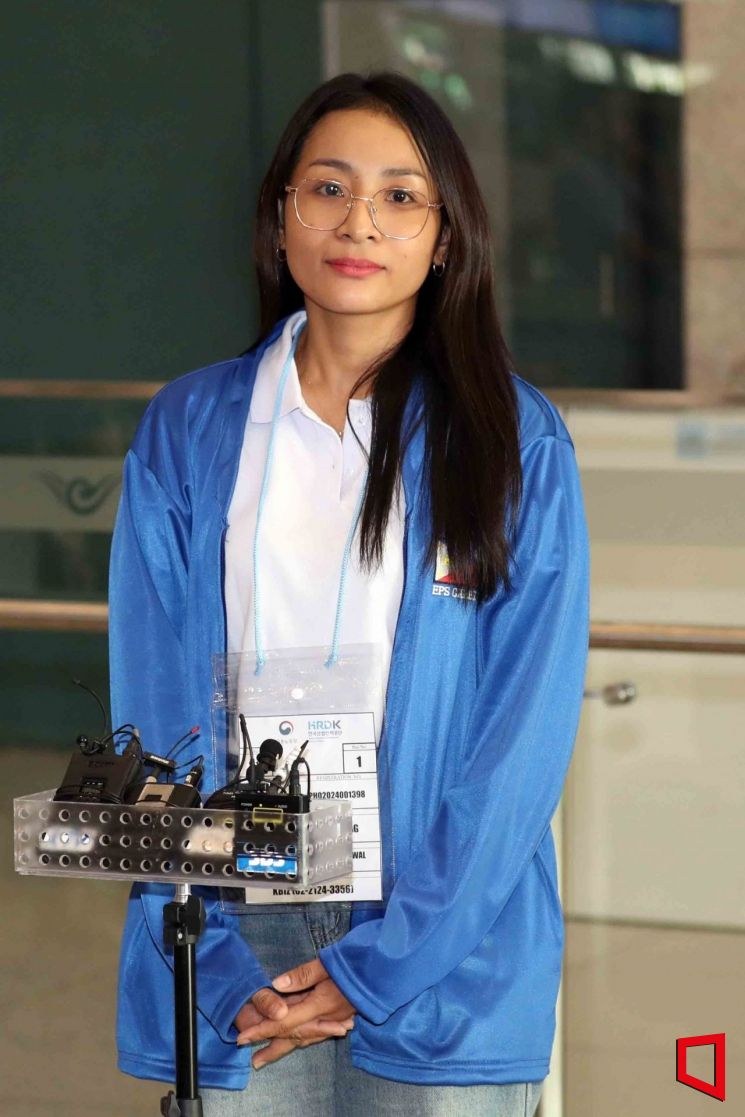 Filipino workers participating in the pilot project for foreign domestic workers entered through Incheon International Airport last August, and Ms. Glory is answering questions. Photo by Airport Photographers Group
On the 23rd, the office of Lee Yong-woo, a member of the Environment and Labor Committee of the National Assembly from the Democratic Party of Korea, announced that the Korea Federation of Small and Medium Business conducted a survey last October targeting foreign workers participating in the 'Filipino Domestic Worker Pilot Project.' According to the survey results, a Filipino domestic worker's September payslip showed that out of a total of 1.83 million won, about 710,000 won, accounting for 40%, was deducted for various fees. These included accommodation costs of 539,000 won and communication fees of 33,000 won. The accommodation where they reside is reported to be located in Gangnam-gu, Seoul.
Ultimately, they have to cover all living expenses with 1.12 million won per month. Given this situation, domestic workers have been saying, "Since individuals bear various costs such as lodging, transportation, and food expenses while staying in Seoul, the amount they actually save is almost nothing."
Additionally, complaints regarding the scope of work have been identified. Filipino domestic workers are care providers who have obtained professional qualifications in their home country. However, in Korea, they work as helpers. Concerns about the ambiguous scope of their duties have been raised even before the pilot project began.
One domestic worker appealed, "I have to clean five rooms, do laundry, and hand wash clothes continuously for eight hours without a break," adding, "It is so hard that it brings me to tears." Furthermore, commuting times have been found to be excessive. Many are responsible for two or more households, traveling from their accommodation in Gangnam-gu to areas such as Eunpyeong-gu and Gangseo-gu, resulting in a round-trip commute time of four hours. Another domestic worker lamented, "I work four hours at one house, and just moving to another house takes four hours round-trip."
The pilot project has been plagued with issues, including two domestic workers leaving their shared accommodation. There have been claims that minimum wage should not be applied to them, and criticisms labeling the policy as benefiting the wealthy. Nevertheless, the government plans to expand the pilot project to 1,200 participants next year. It is also reported that diversification of sending countries is under consideration.
Because of this, Representative Lee criticized the government's hasty project implementation, stating, "The project proceeded without sufficient review of wages, work, and housing issues," and emphasized, "A full reconsideration, not expansion, is necessary."
© The Asia Business Daily(www.asiae.co.kr). All rights reserved.
![Clutching a Stolen Dior Bag, Saying "I Hate Being Poor but Real"... The Grotesque Con of a "Human Knockoff" [Slate]](https://cwcontent.asiae.co.kr/asiaresize/183/2026021902243444107_1771435474.jpg)











