Pre-feasibility B/C 1.03... First Gate Passed
88 Olympic Legacy Utilized for Sustainable Games
85.2% of Citizens Support Hosting in Survey
Oh Se-hoon "Focusing Efforts for a Harmonious Olympics"
Seoul has secured both the economic feasibility and public support necessary for hosting the '2036 Seoul Olympics.' A preliminary feasibility study showed sufficient business viability, and a citizen survey revealed that 85% are in favor of hosting the event.
On the 25th, the Seoul Metropolitan Government announced that the benefit/cost ratio (B/C) exceeded 1 in the preliminary feasibility study conducted by the Korea Institute of Sport Science from May to November for the 2036 Seoul Olympics bid.
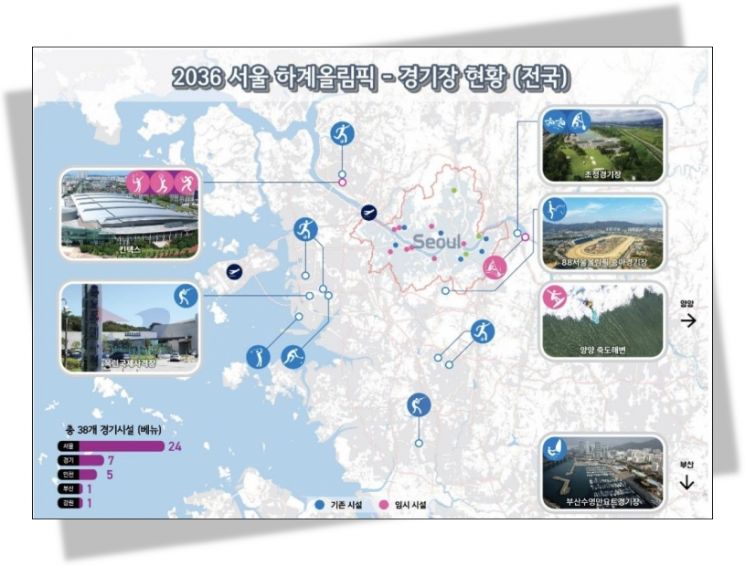
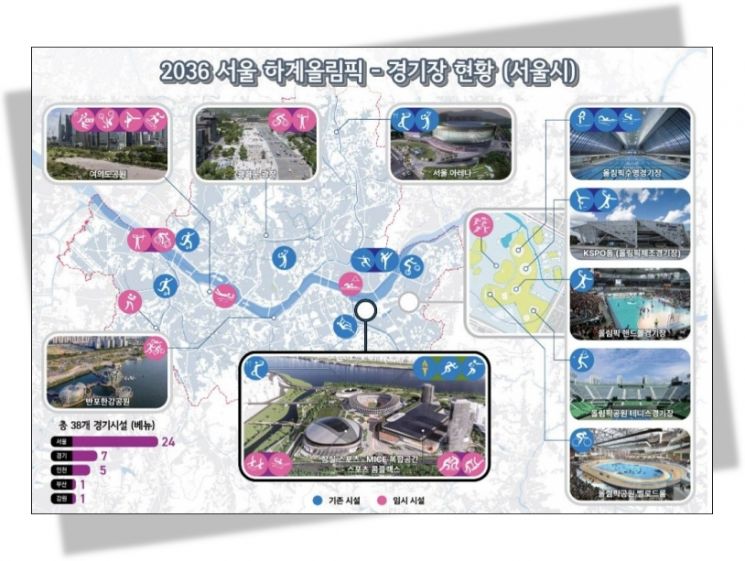 Status of stadiums available for use in Seoul and nationwide. Provided by the Seoul Metropolitan Government
According to the 'International Sports Event Support Act,' local governments wishing to host the Olympics must request a preliminary feasibility study from a specialized institution designated by the Minister of Culture, Sports and Tourism and submit the results.
In this study, the total cost of hosting the '2036 Seoul Olympics' was estimated at 5.0833 trillion KRW, and the total benefit at 4.4707 trillion KRW. When converted to present value, these amounts are 3.0358 trillion KRW and 3.1284 trillion KRW respectively, resulting in a B/C ratio of 1.03.
The total cost consists of 3.5405 trillion KRW (69.7%) for event operation expenses (including competition operations, accommodation, cultural events, and promotion) and 1.5428 trillion KRW (30.3%) for facility costs (such as renovation of stadiums and installation of temporary venues). The total benefit was calculated as the sum of non-market benefits estimated based on the average household willingness to pay (WTP) of 1.9307 trillion KRW and market benefits during the Olympic period, including IOC grants, marketing, and ticket sales revenue totaling 2.5400 trillion KRW. The total cost of 5.0833 trillion KRW is notably the lowest compared to other Olympics held since 2000. Seoul plans to maximize the use of existing venues without new construction based on the experience and legacy of the 1988 Seoul Olympics and to utilize venues in other cities and provinces for some lacking facilities. In fact, the hosting costs of recent Olympics held around the last decade exceeded 10 trillion KRW: London 2012 at 16.6 trillion KRW, Rio 2016 at 18.2 trillion KRW, Tokyo 2020 at 14.8 trillion KRW, and Paris 2024 at 12.3 trillion KRW.
Previously, Seoul completed agreements with other cities and provinces such as Gyeonggi-do, Incheon, Busan, and Gangwon-do to jointly use major facilities and venues for marine sports that Seoul lacks. Detailed plans have also been prepared. The Seonhak Hockey Stadium (Yeonsu-gu, Incheon), opened for the 2014 Incheon Asian Games, is scheduled to be renovated by the end of this month to obtain international certification. The Swimming Bay Yacht Stadium, created for the 1988 Olympic sailing events, will be redeveloped by 2026 through a Build-Transfer-Operate (BTO) private investment project.
Additionally, Seoul plans to reuse the 1988 Seoul Olympic venues (within Olympic Park, Songpa-gu), remodel the Jamsil Olympic Main Stadium by 2026, and develop a private investment-based Jamsil Sports and MICE complex by 2032. Temporary venues for beach volleyball, archery, skateboarding, and other sports will be installed at major landmarks such as Gwanghwamun and the Han River. Seoul estimates that the Games can be hosted sufficiently with a budget of about 5 trillion KRW.
Public support has also been secured. In a survey on the '2036 Seoul Olympics' bid, 85.2% of Seoul citizens (81.7% nationwide) supported hosting the Olympics, and 93.8% (89.8% nationwide) believed the 2036 Seoul Olympics would be successfully held. The reasons for supporting the bid were ranked as follows: 'Enhancing the national image of the Republic of Korea' (41.3%), 'Contributing to national and regional economic development' (40.1%), and 'Playing a positive role in domestic sports development' (12.4%).
Since the first Athens Olympics in 1896, only six countries have hosted the Olympics more than twice. Considering that the second hosting typically occurs about 50 years later, 2036, which is 48 years after 1988, is seen as an appropriate time for Seoul to host the Olympics again. Accordingly, Seoul submitted a 'Hosting Plan' to the Korean Sport & Olympic Committee on the 12th of last month to bid for the 2036 Summer Olympics. On-site inspections and comprehensive evaluations will follow, with the evaluation committee planning visits to the Jamsil Main Stadium and COEX.
Seoul Mayor Oh Se-hoon stated, "The 2036 Seoul Olympics will be a successful model of a sustainable Olympics, which is a core value of the IOC's 'Olympic Agenda 2020+5.' If the bid is confirmed, we will devote all our efforts together with the government, local governments, and the IOC to make it an Olympics of peace and harmony."
© The Asia Business Daily(www.asiae.co.kr). All rights reserved.


















