Publication in Prestigious Materials Journal
Expected Improvement in Display Stability
Professor Lee Wihyung's research team at Konkuk University has succeeded in developing a new material technology using deuterium.
On the 25th, Konkuk University announced that Professor Lee's research team, in collaboration with Dr. Lee Junghoon from Northwestern University and Professor Koo Jaseung from Chungnam National University, achieved this research result. The study was published online on the 27th of last month in 'Advanced Functional Materials,' a leading journal in the field of materials science.
 From the left: Student Im Suhwan (Konkuk University), Professor Lee Wihyung (Konkuk University), Dr. Lee Junghoon (Northwestern University), Student Kim Minsong (Chungnam National University), Professor Koo Jaseung (Chungnam National University). Konkuk University
The research involved Professor Lee and Professor Koo Jaseung as corresponding authors, with Dr. Lee Junghoon from Northwestern University as the first author. Konkuk University student Lim Suhwan and Chungnam National University student Kim Minsong contributed as co-first authors. The research team conducted the technology development with support from the Ministry of Science and ICT and the Ministry of Trade, Industry and Energy.
The team expects this research to contribute to the stability and performance enhancement of next-generation display technologies, as deuterium plays a crucial role in improving the performance and stability of electronic devices in these technologies.
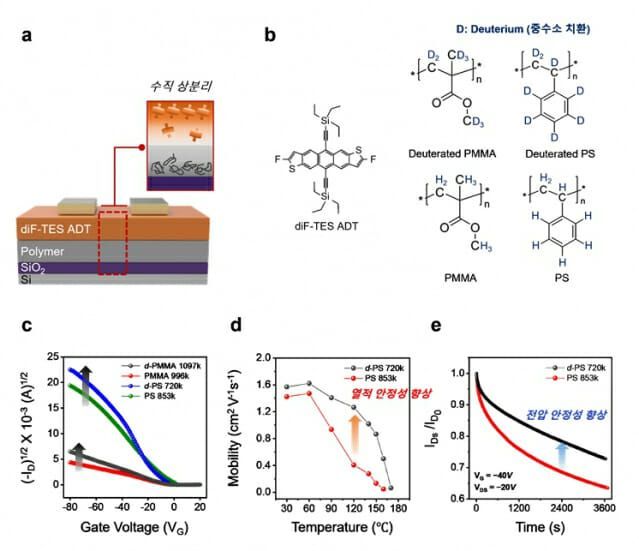
Until now, the direct introduction of deuterium into the active layer has been criticized for its high production costs. To overcome this limitation, the research team proposed a new phase separation structure by mixing insulating polymers containing deuterium (PMMA, PS) with organic semiconductors as an alternative. This approach allowed simultaneous improvement in high mobility, thermal stability, and performance stability under continuous voltage without directly introducing deuterium into the active layer.
Experimental results showed that deuterium-based polymer blend devices exhibited superior electrical properties and stability under high-temperature conditions compared to conventional general-purpose polymers. Additionally, performance was maintained even after prolonged voltage application.
The academic community is paying close attention to this technology because it is compatible with existing manufacturing processes and can achieve high performance and durability at low cost. It is expected to have a significant impact, especially in applications where flexibility and durability are critical.
A representative from Sejong University stated, "This research is expected to provide an opportunity to redefine the performance of electronic devices beyond the display industry."
© The Asia Business Daily(www.asiae.co.kr). All rights reserved.


















