Registration of 18 Technologies for 65 Items... Over 10,000 Farms to be Certified by Year-End
Ministry of Agriculture, Food and Rural Affairs Fully Revamps Certification System
Higher Points Awarded for Stronger Farm Reduction Commitment
Last year, the government decided to lower the certification threshold to expand the 'Low-Carbon Agricultural Products Certification System,' which reduced carbon dioxide emissions by nearly 100,000 tons during the agricultural production process. The selection method will be changed to a system that reduces the costs required for certification to encourage more farms to participate, while awarding additional points to farms with stronger reduction commitments.
First launched in 2012, the Low-Carbon Agricultural Products Certification System certifies agricultural products that emit fewer greenhouse gases during production to contribute to greenhouse gas reduction in the agricultural sector. When farmers are selected as beneficiaries of the support project, the government supports the entire certification acquisition process, including the preparation of emission calculation reports.
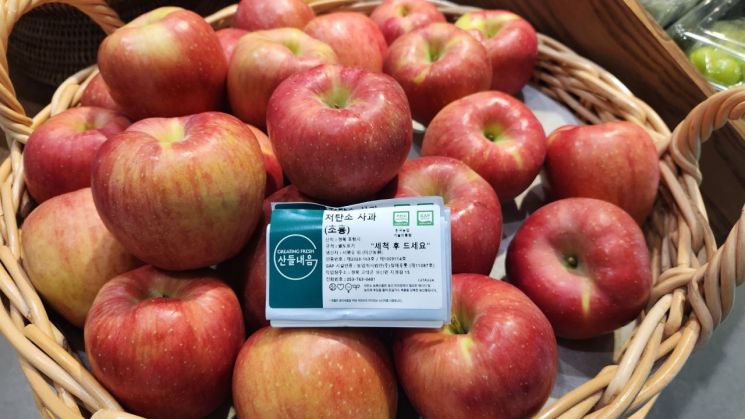 Apples certified as low-carbon agricultural products are displayed in major domestic department stores. (Photo by Ministry of Agriculture, Food and Rural Affairs)
According to the Ministry of Agriculture, Food and Rural Affairs on the 26th, the Low-Carbon Agricultural Products Certification System currently covers 65 items with 18 registered low-carbon agricultural technologies. By the end of this year, 10,500 farms are expected to receive certification.
Since its implementation, the number of participating farms, certified area, and carbon dioxide reduction volume have steadily increased. The number of certified farms, which was only 60 in 2012, rose to 90,085 last year. Accordingly, the certified area increased from 92 hectares to 10,338 hectares, and the carbon dioxide reduction volume grew significantly from 311 tons to 99,875 tons during the same period.
An official from the Ministry of Agriculture, Food and Rural Affairs stated, "With the increase in damage caused by frequent heatwaves and heavy rains due to climate change, greenhouse gas reduction is a global common challenge directly linked to national competitiveness and citizens' quality of life. The agricultural sector has set a goal to reduce carbon emissions from 22.2 million tons in 2018 to 17.2 million tons by 2030, a 22.5% reduction. Policies promoting the transition to a low-carbon agricultural structure are necessary, including the spread of low-carbon digital and green bio technologies, eco-friendly agriculture, paddy water management, fertilizer reduction, and expansion of rural renewable energy."
The Ministry of Agriculture, Food and Rural Affairs plans to completely overhaul the Low-Carbon Agricultural Products Certification System starting next year to expand low-carbon agriculture and establish a long-term operational foundation for the system. To promote the spread of the certification system, certification costs will be lowered to enable more farms to participate. The average emission standards per item, set in the early stages of the system, will be adjusted to reflect current realities. The first-come, first-served selection method will also be changed to a point-based system.
Currently, the costs for obtaining low-carbon certification are fully supported by national funds. Although there is no cost burden on farms, it is difficult to increase the number of participating farms due to limited budgets. Accordingly, the Ministry of Agriculture, Food and Rural Affairs plans to reduce the consulting cost for low-carbon certification, which previously averaged around 1.2 million KRW, to about 870,000 KRW next year to support more farmers.
The selection method for participating farms will also be improved. Until this year, applications were accepted on a first-come, first-served basis, but this method was criticized for not reflecting the farms' reduction volume or commitment. Starting next year, the ministry will award additional points to farms with stronger reduction volumes and commitments. Farms applying for the project will receive extra points if they meet any of the following criteria: ▲ applications submitted by groups of two or more ▲ participation in other agricultural greenhouse gas reduction projects within the last two years ▲ application of two or more low-carbon agricultural technologies ▲ completion of low-carbon education.
The low-carbon certification system certifies agricultural products produced using low-carbon agricultural technologies on eco-friendly or Good Agricultural Practices (GAP) certified products, where carbon dioxide emissions are lower than the average per item. The average emission standards per item, which serve as the basis for comparison, will also be adjusted. This is because the standards were set in 2012. Starting next year, the Ministry of Agriculture, Food and Rural Affairs plans to establish average emission standards per item using the Rural Development Administration's database. Farms that have already been certified and require renewal will be granted a two-year grace period before the new standards apply.
The Ministry of Agriculture, Food and Rural Affairs will conduct training sessions for farmers wishing to participate in the low-carbon certification system from January 7 to 24 next year, starting in Gyeonggi Province and continuing in eight other provinces including Gangwon, Jeonbuk and Jeonnam, Gyeongbuk and Gyeongnam, and Jeju. These sessions will provide detailed explanations of the low-carbon agricultural products certification support project and inform participants about the changes in the selection method starting next year. Farmers who attend the training will receive additional points when applying for new low-carbon agricultural product certification.
Park Jeong-hoon, Director of Animal Welfare and Environmental Policy at the Ministry of Agriculture, Food and Rural Affairs, recently visited a low-carbon certified farm and said, "With the improvement of the low-carbon certification system, we have supported more farms in obtaining low-carbon certification and established a foundation for the system's long-term operation. We hope this will serve as an opportunity to spread low-carbon farming to reduce greenhouse gas emissions in the agricultural sector."
© The Asia Business Daily(www.asiae.co.kr). All rights reserved.

















