Hongkyun Kim, US-ROK Deputy Foreign Ministers Meeting... "Schedule Normalization"
Biden Administration Supports... Also Focused on Performance Management
The South Korea-US alliance, which was shaken by the emergency martial law situation, is rapidly returning to normal. This is considered a meaningful management of the situation amid political turmoil caused by the impeachment crisis and increased uncertainty with the launch of the 'Trump 2.0' administration.
According to the Ministry of Foreign Affairs on the 24th, First Vice Foreign Minister Kim Hong-gyun held a Korea-US deputy foreign ministers' meeting with U.S. Deputy Secretary of State Kurt Campbell the day before, discussing the Korea-US alliance, trilateral cooperation among South Korea, the US, and Japan, and North Korean issues. Vice Minister Kim stated that the acting presidential system is operating stably and requested cooperation for the development of the Korea-US alliance. Earlier, Acting Prime Minister Han Duck-soo confirmed the US's trust in the Korea-US alliance during a phone call with President Joe Biden on the 15th.
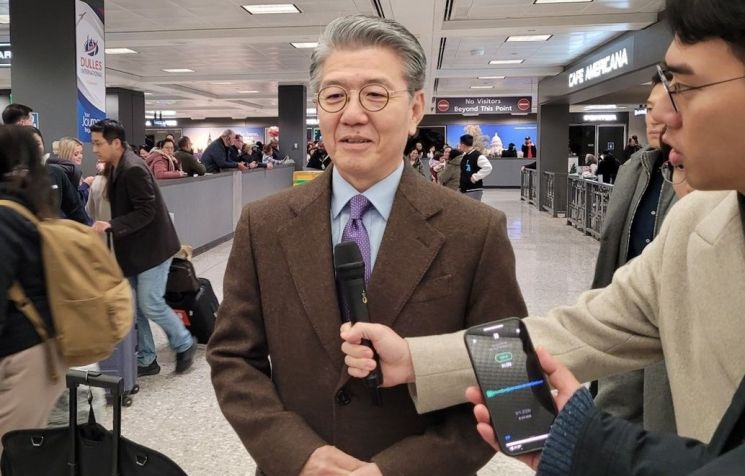 Kim Hong-kyun, First Vice Foreign Minister, is talking with correspondents on the 22nd (local time) at Dulles International Airport near Washington DC, USA. Photo by Yonhap News.
At the meeting, it was agreed to fully resume the major diplomatic and security schedules between South Korea and the US that had been postponed due to the emergency martial law situation, and to hold them as quickly as possible at mutually convenient times. Since President Yoon Suk-yeol's declaration of emergency martial law on the 3rd, the US had successively postponed the Korea-US Nuclear Consultative Group (NCG) meetings, tabletop exercises, and the visit of US Secretary of Defense Lloyd Austin, all of which are directly linked to strengthening the effectiveness of the nuclear umbrella over the Korean Peninsula.
On the surface, this was considered a reflection of South Korea's unsettled political situation due to the martial law crisis, but it was also interpreted as a 'protest' or 'warning' against President Yoon's anti-democratic declaration of martial law. In fact, the Biden administration expressed 'serious concerns' immediately after the declaration of emergency martial law, and the next day, Deputy Secretary Campbell strongly criticized President Yoon with undiplomatic remarks, saying he had made a 'serious misjudgment.'
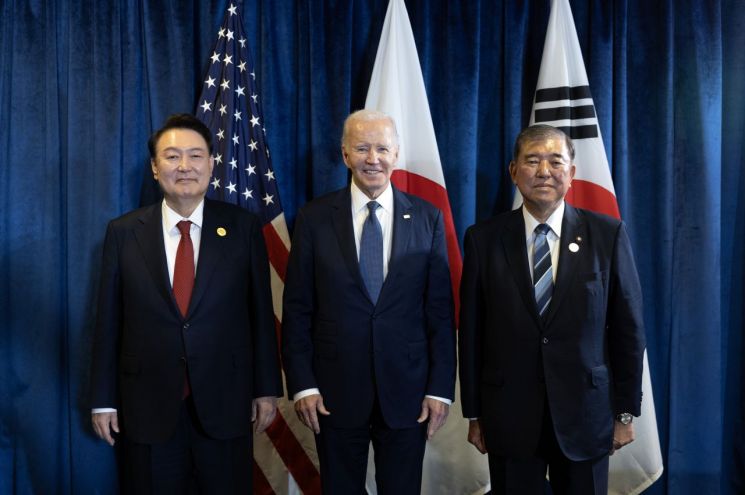 President Yoon Suk-yeol, who visited Peru in November this year to attend the Asia-Pacific Economic Cooperation (APEC) Summit, is taking a commemorative photo with U.S. President Joe Biden and Japanese Prime Minister Shigeru Ishiba at the Lima Convention Center before the Korea-U.S.-Japan summit. Photo by Yonhap News
The suspended diplomatic and security schedules reached a turning point with the activation of the Han Duck-soo acting presidential system. From the US perspective, with less than a month left in President Biden's term, it was evaluated that there was a need to support efforts to normalize the alliance's governance. Above all, since strengthening the Korea-US alliance and trilateral cooperation among South Korea, the US, and Japan are major achievements of the Biden administration, it appears that 'achievement management' toward the end of the term was also considered.
At this meeting, Deputy Secretary Campbell emphasized, "The US fully trusts Acting Prime Minister Han Duck-soo's leadership and South Korea's democratic resilience," and stated, "There is no change whatsoever in the US's firm support for the Korea-US alliance and its ironclad defense commitments to South Korea." Furthermore, both sides agreed to maintain a stronger combined defense posture to prepare for North Korea's miscalculations and to strengthen efforts to block illegal cooperation between Russia and North Korea.
© The Asia Business Daily(www.asiae.co.kr). All rights reserved.
![User Who Sold Erroneously Deposited Bitcoins to Repay Debt and Fund Entertainment... What Did the Supreme Court Decide in 2021? [Legal Issue Check]](https://cwcontent.asiae.co.kr/asiaresize/183/2026020910431234020_1770601391.png)

















