Well-preserved head and body appearance
Estimated to have lived about 50,000 years ago
A 50,000-year-old baby mammoth carcass was discovered in Yakutiya (Sakha Republic), Siberia, Russia, known for its severe cold. On the 23rd (local time), Russian local media such as Izvestia reported that the North-Eastern Federal University in Yakutsk, the capital of Yakutiya, found a well-preserved carcass of a female baby mammoth estimated to have lived 50,000 years ago.
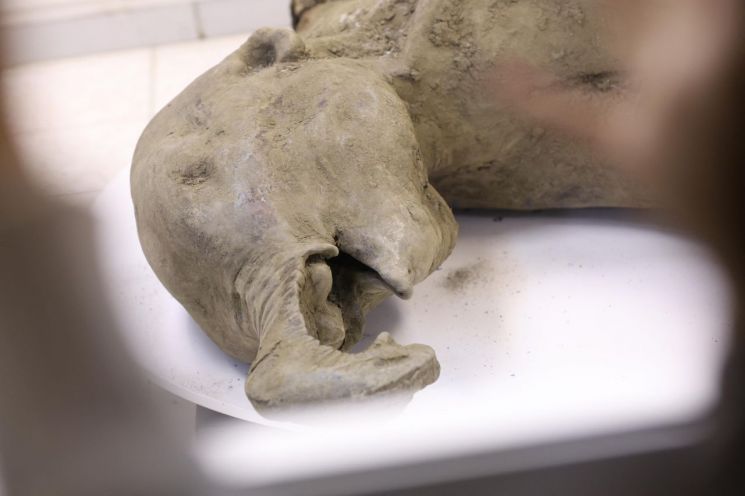 A 50,000-year-old baby mammoth carcass was discovered in Yakutia (Sakha Republic) in Siberia, Russia. On the 23rd (local time), Russian local media including Izvestiya reported that the Northeast Federal University in Yakutsk, the capital of Yakutia, found a well-preserved carcass of a female baby mammoth estimated to have lived 50,000 years ago. AFP·Yonhap News
The carcass, currently exhibited at the university museum, was found last June near the Batagaika crater in the village of Batagay in the Verkhoyansky district of northern Yakutiya. This crater is over 80 meters deep, and as the permafrost gradually melts due to climate change, the carcass was exposed. The front part of the carcass was discovered first. It is presumed that as the ice melted, the carcass split in half, and the heavier front part fell off first. The hind legs and pelvic parts remaining in the permafrost were retrieved by local residents and handed over to researchers last October. The carcass was measured to be 1.2 meters tall, 2 meters long, and weigh 180 kilograms.
Maxim Cheprasov, head of the Mammoth Museum at the North-Eastern Federal University, stated that the carcass is estimated to be a mammoth just over one year old, but more precise measurements are needed through further research. The research team plans to conduct radiocarbon dating next year to determine the exact age of this mammoth. The baby mammoth was named "Yana" after the river flowing near the discovery site. Except for the damaged back part caused by the mammoth falling, the elongated nose and facial parts were well preserved. Cheprasov, the museum director, said, "It is unusual to find a carcass with both the head and torso preserved. Usually, the parts that melt first, especially the torso, are often eaten by predators or birds, but this carcass has all organs preserved, and the head is particularly well preserved."
Meanwhile, the discovery of a mammoth carcass presumed to have lived during the Ice Age itself is a rare event. This is the seventh mammoth carcass found, with five previously discovered in Russia and one in Canada. AFP reported that the Batagaika permafrost, where this mammoth carcass was buried, "acts like a giant freezer preserving prehistoric animal carcasses," and that remains of other prehistoric animals such as horses, bison, and lemmings (migratory rodents) have also been found there.
© The Asia Business Daily(www.asiae.co.kr). All rights reserved.
![Clutching a Stolen Dior Bag, Saying "I Hate Being Poor but Real"... The Grotesque Con of a "Human Knockoff" [Slate]](https://cwcontent.asiae.co.kr/asiaresize/183/2026021902243444107_1771435474.jpg)
















