Ecological Environment Monitoring Conducted in Gimpo and Goyang Pyeonghwanuri-gil Area
Collection of Ecological Data to Promote Biodiversity and Ecological Conservation Values
Gyeonggi Province and the Gyeonggi Environment and Energy Promotion Agency announced on the 23rd that they conducted ecological environment monitoring from April to November this year in the DMZ (Demilitarized Zone) areas of Gimpo City and Goyang City along the Pyeonghwa Nuri-gil trail.
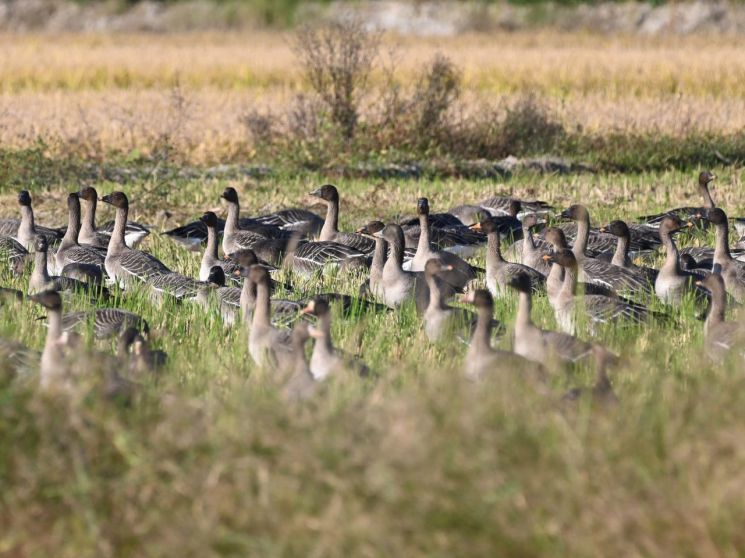
The ecological environment monitoring in the DMZ area is a project where specialized investigators in five fields?plants, vegetation, birds, mammals, and terrestrial insects?survey the distribution status of flora and fauna by region and season, identify endangered species, natural monuments, climate indicator species, and invasive species, and compare and analyze ecological environmental changes to observe the current status and changes of the ecosystem in the DMZ area.
In the areas of Gimpo Pyeonghwa Nuri-gil courses 1 to 3 and the Wild Bird Ecological Park, a total of 874 species of animals and plants were confirmed to inhabit. The habitats of three endangered wild species?Saunders's gull, greater white-fronted goose, and red-bellied falcon?six natural monuments?mandarin duck, common kestrel, Saunders's gull, falcon, red-bellied falcon, and little owl?and one Gyeonggi Province protected wild species, the long-billed plover, were confirmed. Additionally, seven bird species including the spotted sandpiper, common pochard, great cormorant, little stint, yellow-browed bunting, dipper, and Siberian tit, as well as one natural monument species (falcon), were newly discovered.
In the areas of Goyang Pyeonghwa Nuri-gil courses 4 to 5 and Janghang Wetland, a total of 644 species of animals and plants were confirmed to inhabit. The habitats of two endangered wild species?the greater white-fronted goose and leopard cat?one natural monument species, the common kestrel, and one Gyeonggi Province protected wild species, the long-billed plover, were confirmed.
In 2022, in the areas of Yeoncheon Pyeonghwa Nuri-gil courses 10 to 12, a total of 590 species of animals and plants were confirmed to inhabit. The habitats of four endangered wild species?otter, leopard cat, Eurasian hobby, and red-bellied falcon?and four natural monument species?otter, common kestrel, red-bellied falcon, and Korean taimen?were confirmed. Two natural monument species (otter and Korean taimen) that were not identified in the 2017 survey were newly discovered.
In 2023, in the areas of Paju Pyeonghwa Nuri-gil courses 6 to 9, a total of 323 species of animals and plants were confirmed to inhabit. The habitats of eight endangered wild species?leopard cat, greater white-fronted goose, spoon-billed sandpiper, white-tailed eagle, grey-faced buzzard, goshawk, and white-naped crane?and one Gyeonggi Province protected wild species, the mandarin duck, were confirmed. The grey-faced buzzard, an endangered wild species not identified in the 2017 survey, was newly discovered.
The ecological environment monitoring of the Gyeonggi Province DMZ Pyeonghwa Nuri-gil area began in 2017 and has just completed its second survey this year, aiming to serve as basic data for policy establishment to raise awareness of biodiversity and ecosystem conservation in the DMZ area.
The province plans to produce an ecological guidebook using the results of this ecological environment monitoring and place it at the Pyeonghwa Nuri-gil Eoullim Center (hub center), rest areas, and city and county tourist information centers to widely promote it to visitors. It will also be distributed to related organizations such as the Ministry of Environment, the Office of Education, the National Institute of Ecology, the National Arboretum, relevant cities and counties, and the Gyeonggi Tourism Organization to raise awareness about the ecological environment of the Gyeonggi Province DMZ Pyeonghwa Nuri-gil area.
Park Mi-jung, head of the Gyeonggi Province DMZ Policy Division, said, “Through ecological environment monitoring in the DMZ area, we will identify the wild animals and plants inhabiting the DMZ and utilize this to establish policies that can spread the importance and value of the ecological environment to more residents.”
© The Asia Business Daily(www.asiae.co.kr). All rights reserved.
![Clutching a Stolen Dior Bag, Saying "I Hate Being Poor but Real"... The Grotesque Con of a "Human Knockoff" [Slate]](https://cwcontent.asiae.co.kr/asiaresize/183/2026021902243444107_1771435474.jpg)
















