Prime Minister's Office "Rumors of Accepting Some Bills Are Not True"
Event Deadline January 1... Expectation for Bipartisan Agreement
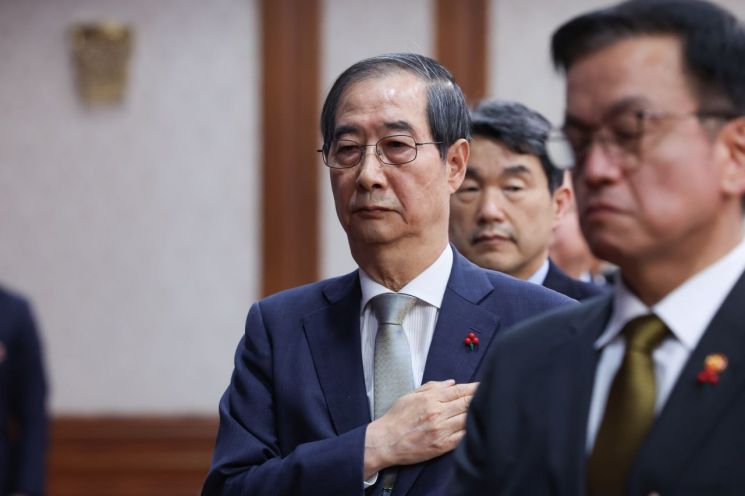 Acting President and Prime Minister Han Duck-soo salutes the national flag at the temporary Cabinet meeting held at the Government Seoul Office Building on the 19th. Photo by Yonhap News
Han Duck-soo, Acting President and Prime Minister, is deliberating over whether to exercise the re-request right regarding the so-called 'Double Special Prosecutor Law' (General Special Prosecutor Law on Treason and Special Prosecutor Law on Mrs. Kim Keon-hee). For now, Acting President Han's position is to listen carefully to the opinions of both ruling and opposition parties before making a decision, rather than immediately exercising the veto power, as the deadline for exercising the veto on the Double Special Prosecutor Law is January 1 of next year.
The Democratic Party of Korea is increasing pressure, stating that if Acting President Han does not promulgate the Double Special Prosecutor Law by the 24th of this month, they will hold him accountable. They are even considering pushing for impeachment against Acting President Han if he delays promulgation or exercises the veto power.
A key official from the Prime Minister's Office stated on the 23rd, "The Double Special Prosecutor Law will not be submitted as an agenda item at tomorrow's Cabinet meeting," adding, "Acting President Han plans to make a decision after thoroughly listening to the opinions of both ruling and opposition parties based on the Constitution, laws, and the future of the nation."
The Double Special Prosecutor Law was passed in the National Assembly plenary session led by the opposition parties on the 12th and was sent to the government on the 17th. Currently, there is a strong possibility that either the promulgation bill or the re-request bill will be submitted and resolved at the regular Cabinet meeting scheduled for the 31st.
A senior official from the Prime Minister's Office told Asia Economy in a phone interview, "There are suggestions that some parts of the Double Special Prosecutor Law might be accepted, but nothing has been decided yet," and added, "We hope that a consensus will be reached through sufficient consultation and procedures in the ruling-opposition-government consultative body."
Opposition: "Impeachment of Acting President Han Willing"... Controversy Over National Assembly Quorum
The opposition parties have stated that if Acting President Han exercises the veto on the Double Special Prosecutor Law, they are prepared to proceed with impeachment against him. However, controversy has resurfaced due to clear differences in opinion between the ruling and opposition parties regarding the quorum required in the National Assembly for impeachment proceedings against the Acting President.
The Democratic Party of Korea holds the view that impeachment of Acting President Han requires the approval of a majority of the total members of the National Assembly (151 members), which is the standard for impeaching the Prime Minister. On the other hand, the People Power Party insists that approval by two-thirds (200 members) of the total members, which is the standard for impeaching the President, is necessary.
Experts' opinions are also divided. Professor Jang Young-soo of Korea University Law School said, "The impeachment standard for the Prime Minister should be applied, not that for the President," explaining, "The special quorum for the President is recognized because of the democratic legitimacy directly elected by the people, and since the Acting President has not been newly granted legitimacy, a majority of the total members is sufficient." Conversely, Kim Sang-soo, Senior Specialist of the National Assembly Steering Committee, stated in an October review report on the 'Special Act to Prevent Abuse of Impeachment Prosecution' that "It seems appropriate to apply the heightened (impeachment prosecution) requirements for the President equally to the Acting President."
Moreover, the ruling and opposition parties are sharply divided over whether Acting President Han has the authority to appoint Constitutional Court justices. The Democratic Party said, "Since it is a National Assembly-recommended position, the Prime Minister has no justification to refuse or delay the formal appointment procedure," while the People Power Party argued, "Acting President Han does not have the authority to appoint Constitutional Court justices. If the Democratic Party forcibly proceeds with the appointment process, we will immediately file a jurisdictional dispute petition with the Constitutional Court."
However, many constitutional scholars lean toward the view that Acting President Han can appoint Constitutional Court justices. Professor Jang explained, "From the perspective of maintaining the status quo authority, while the three justices appointed by the President may be excluded, the other six can be appointed," adding, "There is also precedent in March 2017 when Acting President Hwang Kyo-ahn appointed Justice Lee Sun-ae, who was recommended by Chief Justice Yang Sung-tae."
© The Asia Business Daily(www.asiae.co.kr). All rights reserved.
![Clutching a Stolen Dior Bag, Saying "I Hate Being Poor but Real"... The Grotesque Con of a "Human Knockoff" [Slate]](https://cwcontent.asiae.co.kr/asiaresize/183/2026021902243444107_1771435474.jpg)
















