Musk, 6 Weeks After Announcing Appointment as Head of Government Efficiency Department
Posts Survey on SNS Asking About Abolishing National Tax Service
Expresses Critical Views on Fed and Regulatory Agencies
It has been six weeks since Elon Musk, CEO of six companies including Tesla, was appointed head of the Department of Government Efficiency (DOGE) in Donald Trump's upcoming administration. With less than a month remaining until the administration's launch, the true nature of DOGE has yet to be revealed. However, Musk, who wields immense power as Trump's 'first buddy,' is sparking movement by pouring out his thoughts through his social networking service (SNS), 'X.'
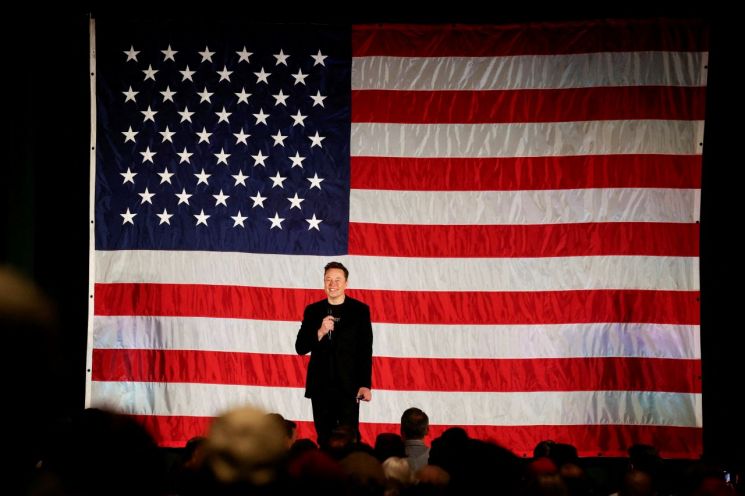 Elon Musk, CEO of Tesla and nominee for the Department of Government Efficiency (DOGE), standing in front of the U.S. flag Photo by Reuters Yonhap News
The Washington Post (WP) recently reported that DOGE is not an official government agency, and its structure and functions have not yet been decided. Nevertheless, it has outlined priorities for government efficiency by mentioning various issues, big and small. Musk has stated that through DOGE, he plans to cut the federal government budget by more than $2 trillion (approximately 2,900 trillion won) and aims to accelerate efficiency within this organization, which will operate temporarily until July 4, 2026.
The Internal Revenue Service (IRS) has become a target of Musk. On the 27th of last month (local time), Musk posted a poll on his X account asking whether the IRS, which requires a budget of $20 billion, should be maintained. Over 200,000 followers responded, and with a 60.6% response rate, the result was that the budget should be eliminated. Six out of ten respondents answered that the IRS should be abolished. Supporters of Trump have long argued for the need to reform the IRS.
Of course, not all of Musk's ideas expressed on SNS will come to fruition. WP explained, "Abolishing the IRS would be a very radical move. The IRS's tax collection is a major source of revenue for the federal government," adding, "Without the IRS, the federal government would need to secure other sources of revenue. Like other ideas from Musk, this would require congressional approval."
Musk has also not hidden his critical view of the Federal Reserve (Fed), which controls the global economy. Recently, he commented "Yes" on a post by former Congressman Ron Paul, an Army physician, who wrote on his SNS that "just as we have freed ourselves from mainstream media, we must also free ourselves from the Fed." Last month, Musk also expressed support for the hashtag '#EndTheFed,' revealing his critical stance.
Attacks on the Fed's independence have existed long before Musk. During his first term, Trump also clashed publicly several times with Fed Chair Jerome Powell. However, Trump has stated that he has no intention of replacing Powell before his term ends in 2026.
In addition, last month Musk emphasized improving the efficiency of defense spending. At the same time, he stated that federal employees should not work remotely and that the number of employees is larger than necessary, so he plans to carry out large-scale cuts. To this end, he said he would work to identify the minimum number of employees required for the federal government to perform essential functions.
Musk is also raising issues about federal government support and donations. On the 7th, he posted a chart on SNS showing that humanitarian donations by Americans amount to $9.48904 billion, more than four times that of the European Union (EU) at $2.11421 billion, and voiced that this should be reduced. Citing media reports that federal agencies such as the National Institutes of Health (NIH) are providing grants for inappropriate projects, he wrote that "there seem to be many opportunities for DOGE."
Having frequently clashed with regulatory agencies in his business, Musk has also called for the abolition of agencies such as the Consumer Financial Protection Bureau (CFPB). On the 27th of last month, he mentioned on X that there are too many overlapping regulatory agencies, citing the CFPB, which was established after the 2008 global financial crisis to protect consumers. The Wall Street Journal (WSJ) also reported that Trump's transition team has begun reviewing whether the Federal Deposit Insurance Corporation (FDIC) can be abolished.
© The Asia Business Daily(www.asiae.co.kr). All rights reserved.

















