Bank of Korea's 'December Regional Economic Report'
Clear Differentiation in Regional Exports This Year... Metropolitan Area Share Expected to Expand Further
Regional Export Companies "Concerned About Intensified Competition with China... Export Growth Rate to Slow Next Year"
Although South Korea's exports maintained an upward trend this year, there were clear regional disparities. Exports from the Seoul Capital Area and Chungcheong region, which have a high proportion of semiconductor exports, showed double-digit growth rates, while exports from the Daegu-Gyeongbuk and Honam regions continued to decline. As a result, the share of the Seoul Capital Area in South Korea's exports during the fourth quarter of this year reached an all-time high.
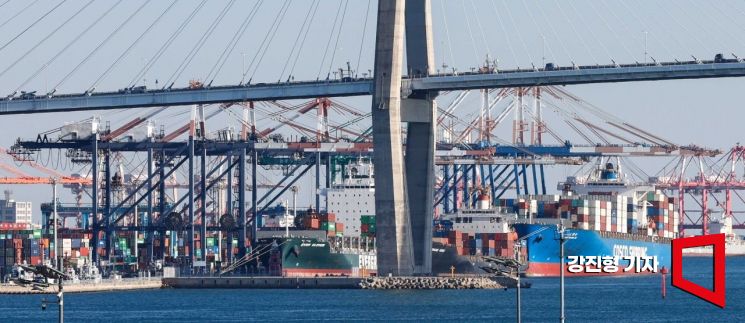 Export containers are being loaded onto a ship at Busan North Port. Photo by Jinhyung Kang aymsdream@
According to the 'Regional Economic Report Issue Analysis: 2024 Regional Export Fluctuation Factors and 2025 Export Outlook Survey' released by the Bank of Korea on the 23rd, nationwide customs-cleared exports from January to November this year increased by 8.3% compared to the same period last year, shifting from a decline to growth.
However, as exports recovered mainly in IT items such as semiconductors, regional differentiation became pronounced. Exports from the Seoul Capital Area (16.4%) and Chungcheong region (10.4%), where semiconductor exports account for a high proportion, recorded double-digit growth rates compared to the same period last year. The Southeast region (4.2%) also saw export growth centered on ships. In contrast, exports from the Daegu-Gyeongbuk region (-5.9%) and Honam region (-4.6%), which have a large share of steel and chemical products facing intense competition with China, continued to decline.
Accordingly, the export share of the Seoul Capital Area in the fourth quarter of this year expanded to an all-time high. The Seoul Capital Area's export share began to rebound after the fourth quarter of 2022 (37.6%) and reached 43.6% in the fourth quarter (October to November) of this year. This figure surpasses the previous peak of 42% in the second quarter of 2018. If this trend continues, the perceived export economy between the Seoul Capital Area and non-capital regions is expected to diverge significantly.
Export growth rates showed clear differentiation depending on the industrial structure of each region. From January to November this year, exports from the Seoul Capital Area recorded the highest growth rate nationwide (16.4%), centered on high-bandwidth memory (HBM). The Southeast region increased by 4.4% despite the absence of an IT industry, supported by strong ship exports along with chemical products and weapons exports. In contrast, the Honam region saw a 4.6% decrease as exports of key items such as petrochemicals and steel, excluding ships, all declined, and the Chungcheong region decreased by 8.3% excluding semiconductors.
This year's nationwide export growth was mainly attributed to increased market share due to enhanced competitiveness of companies. Regionally, the Seoul Capital Area saw growth as global demand for key export products increased and local companies strengthened their competitiveness. The Southeast region overcame global demand decline through market share expansion, while the Honam region improved market share centered on ships but not to the extent of the Southeast region. Conversely, the Daegu-Gyeongbuk region was significantly affected by the decline in global demand.
Regional Export Companies Concerned About 'Intensified Competition with China' Next Year... Need to Expand Dominance in High Value-Added Products
According to a survey of 200 regional export companies, they expect exports to increase next year compared to this year, but the growth rate is expected to shrink. Although the external environment may deteriorate somewhat, they anticipate maintaining export growth through strengthening export competitiveness. In particular, the Seoul Capital Area views the export outlook more positively than other regions, suggesting that its export share will further increase.
Regarding external conditions, regional companies expressed the greatest concern about "intensified competition due to China's overproduction and low-priced exports." They expect this impact to worsen next year. The technological competitiveness of Chinese companies was found to be similar to or at a concerning level compared to domestic firms, especially in secondary batteries, machinery, and steel sectors. Perceptions of U.S. tariff policies, including a general tariff of 10% and a 60% tariff on Chinese goods, varied by industry and company. Among industries, steel and automobiles expressed the greatest concerns.
Jeong Hee-wan, head of the Regional Economic Survey Team at the Bank of Korea's Research Department, who authored the report, emphasized, "Since the external environment is expected to be unfavorable in the future, it is crucial to expand market dominance with differentiated high value-added products through research and development to compete with China." He added, "It is also an important time to strengthen cooperation between the government and companies to effectively respond to uncertainties surrounding global trade policies."
Regional Economy Maintains Previous Quarter Level in Q4... Downside Risks Increase Due to Political Situation
Meanwhile, the regional economy maintained the previous quarter's level in the fourth quarter. By region, the Seoul Capital Area, Chungcheong, and Gangwon regions remained stable, the Daegu-Gyeongbuk region slightly improved, while the Southeast, Honam, and Jeju regions slightly deteriorated. The regional economy is expected to maintain the fourth quarter level with stable production in both manufacturing and services sectors. However, downside risks due to domestic political situations appear to have increased.
Manufacturing production increased mainly due to high-performance semiconductors but decreased in petrochemical refining, chemicals, and steel due to weak global demand, resulting in an overall stable trend. Service production remained at the previous quarter's level, with increased freight volume offset by a contraction in housing transactions and sustained high dining prices.
Private consumption showed a slight increase in service consumption but remained stable overall as goods consumption maintained the previous quarter's level. Going forward, private consumption is expected to increase slightly due to easing inflation and improved household consumption capacity from relaxed financial conditions. However, uncertainties related to this remain elevated.
Facility investment slightly increased, centered on semiconductors, as investments to expand HBM production capacity rose. Future facility investments are expected to continue in advanced semiconductor processes and eco-friendly vehicle production facilities but are likely to remain stable due to high domestic and international uncertainties.
Construction investment slightly decreased due to accumulated poor construction starts and sustained high levels of unsold housing inventory. This trend is expected to continue with the impact of reduced new construction starts and orders, along with cuts in SOC (Social Overhead Capital) budgets.
Daily average exports remained at the previous quarter's level overall, with semiconductors maintaining high levels and increases in ships and automobiles, while petrochemical refining and chemicals declined. Exports are expected to show a stable trend going forward, with increases in semiconductors and ships but decreases in automobiles.
© The Asia Business Daily(www.asiae.co.kr). All rights reserved.

















