Yoon's Treason Act and Kim Geon-hee Special Prosecutor Demand
South Korea Reviews Ministry of Justice and Listens to Various Opinions
The Democratic Party of Korea has pulled out the impeachment card against Han Deok-soo, the Acting President and Prime Minister. This move comes as Han threatens to suspend his duties early if he continues to reject opposition party demands such as President Yoon Seok-yeol's appointment of a permanent special prosecutor for the insurrection and the special prosecutor law concerning First Lady Kim Geon-hee. The deadline is set for the end of this month. There are concerns that if both President Yoon and Acting President Han are impeached, the resulting political turmoil could lead to uncontrollable economic uncertainty.
The Democratic Party's demands to Acting President Han are mainly threefold. First, they urged him to promulgate the 'Kim Geon-hee Special Prosecutor Law,' which targets 15 allegations including the Deutsche Motors case involving the First Lady, and the 'General Insurrection Special Prosecutor Law' concerning President Yoon's emergency martial law insurrection acts by the 24th of this month. Although the deadline for promulgation and reconsideration requests for these two special prosecutor laws is the 1st of next month, the Democratic Party plans to immediately initiate impeachment proceedings against Han if he does not promulgate them within this week. The opposition party is also considering a plan following the impeachment push. After impeaching Acting President Han, they plan to have Choi Sang-mok, Deputy Prime Minister and Minister of Economy and Finance, serve as the acting acting president?a first in constitutional history.
The Democratic Party also pressured for the recommendation of candidates for the 'Permanent Insurrection Special Prosecutor.' The permanent special prosecutor investigation request passed the National Assembly on the 11th, led by the opposition. Unlike the general special prosecutor, the permanent special prosecutor cannot be vetoed by the president, allowing investigations to begin immediately after a 20-day preparation period following the appointment. However, the special prosecutor must be appointed by the acting president after National Assembly approval. The Democratic Party stated, "The permanent special prosecutor investigation request passed the plenary session of the National Assembly ten days ago, and the candidate recommendation committee has been formed," urging, "Hurry up and request the recommendation of special prosecutor candidates." The party has also set the 24th as the deadline for the permanent special prosecutor.
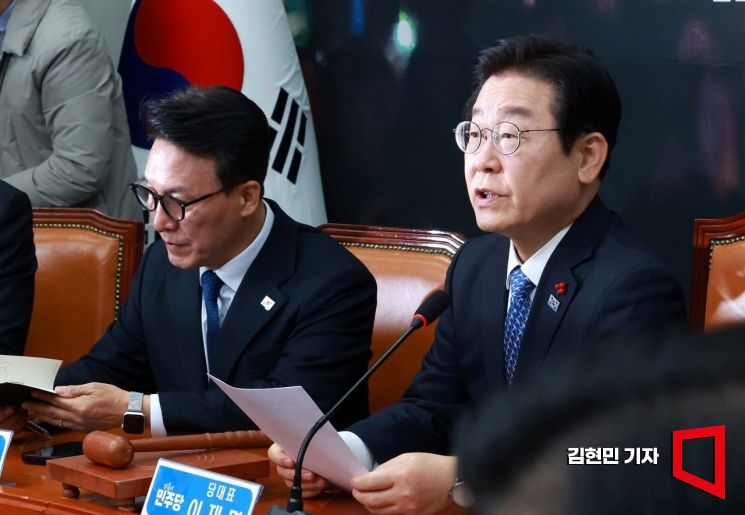 Lee Jae-myung, leader of the Democratic Party of Korea, is speaking at the Supreme Council meeting held at the National Assembly on the 20th. Photo by Kim Hyun-min
They also urged the swift appointment of constitutional court justices who will decide on President Yoon's impeachment. The Democratic Party plans to hold confirmation hearings for three constitutional court justice candidates on the 23rd and 24th and to process the appointment consent bill in the plenary session on the 27th. However, the ruling party has announced it will boycott the hearings and has entered a 'stalling' strategy. The ruling party's strategy is to delay the 'impeachment trial' as much as possible to highlight the judicial risks of Democratic Party leader Lee Jae-myung.
In response to the Democratic Party's pressure, Acting President Han repeatedly cited three criteria: the constitution, the law, and the nation's future. He previously pointed out fiscal issues regarding six laws, including the Grain Management Act, but said the two special prosecutor laws require consideration of both legal and political factors. The insurrection special prosecutor law includes Han himself as a major suspect, raising suspicions that exercising the veto could be an attempt to evade investigation. While the Kim Geon-hee special prosecutor law was previously opposed on grounds of unconstitutionality, the justification for vetoing it has somewhat weakened after the emergency martial law.
Acting President Han spent last weekend without official schedules but reportedly continued to review points of conflict between the ruling and opposition parties at the official residence. The Ministry of Justice is reviewing the two special prosecutor laws, and various opinions are being gathered. The government appears to be seeking a breakthrough through a ruling-opposition-government consultative body while delaying a final decision as much as possible. A government official said regarding whether the issue would be raised at the regular Cabinet meeting on the 24th, "We will carefully deliberate within the given time." Before the veto deadline (January 1 next year), there is one more regular Cabinet meeting scheduled for the 31st.
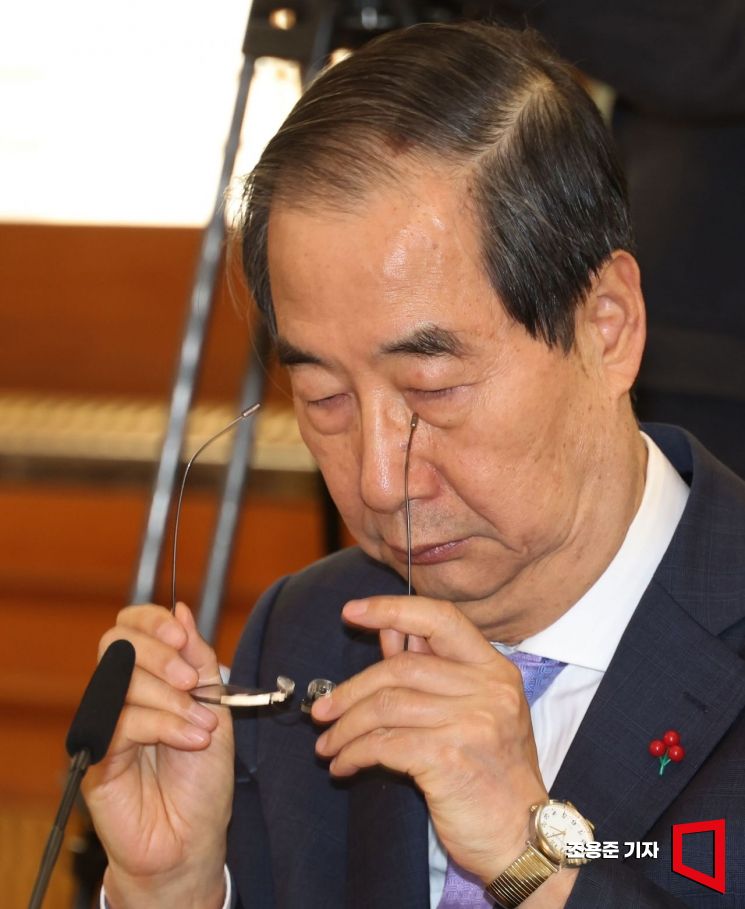 Prime Minister Han Duck-soo is adjusting his glasses while attending the National Intellectual Property Committee held at the Government Seoul Office in Jongno-gu, Seoul on the 12th. Photo by Jo Yong-jun
© The Asia Business Daily(www.asiae.co.kr). All rights reserved.


















