Habitat Confirmed for Saegitajaebi and Hansanjarigong
The National Honam Biological Resources Center, under the Ministry of Environment, announced on the 23rd that it has identified numerous new habitats for various rare plants, including endangered wild plants, through this year's survey of island plant life.
This survey was conducted as part of the "Survey and Discovery of Native Organisms in Island Regions" project, targeting 21 islands. As a result, the center confirmed the presence of approximately 1,500 native plant species, including four endangered wild plants (Saegitajaebi, Maehwamareum, Kkeunkeunigwigae, Jineballan) and many other rare plants.
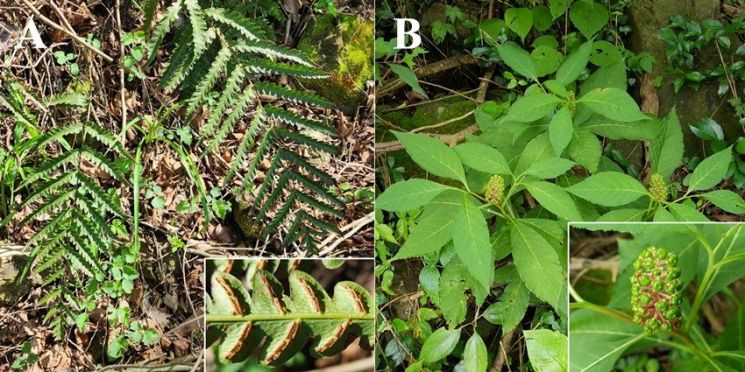 The "Saegitajaebi," designated as a Class II endangered wild species, and the "Hansanjaligong," were discovered for the first time on Gageodo Island. Provided by the National Honam Biological Resources Center
In particular, the native habitat of Saegitajaebi, which was designated as a Class II endangered wild species by the Ministry of Environment in 2017, was identified for the first time on Gogeumdo in Wando-gun. Saegitajaebi is a type of fern that mainly grows in tropical regions, and two individuals were discovered during this survey.
Additionally, Hansanjarigong, previously known to be distributed only on Jeju Island, was found for the first time with about ten individuals on the outermost Gageodo in Jeollanam-do. This species is a rare plant with only a few individuals even on Jeju Island and has a unique characteristic in which the carpels are fused rather than separated, unlike other Phytolaccaceae species.
The habitats of Saegitajaebi and Hansanjarigong identified in this survey consist of only small populations, highlighting the urgent need for research and systematic management for habitat conservation and restoration.
Kim Changgyun, head of the Island Biological Resources Research Laboratory, stated, "Through this discovery, we have confirmed that many undiscovered rare organisms still exist in Korea's island regions. We will continue to survey biological resources in island and coastal areas to contribute to biodiversity conservation and help establish national biological sovereignty."
© The Asia Business Daily(www.asiae.co.kr). All rights reserved.

















