UNIST Professor Choi Won-young's Team Develops Kirigami Pattern-Based Porous Metal-Organic Framework
Smart Adsorbent Applied to Energy Storage and Separation... Published in Angew. Chem. Int. Ed.
A foldable porous nano solid resembling the pattern of Kirigami, a type of paper folding, has been developed.
The research team of Professors Choi Won-young and Oh Hyun-chul from the Department of Chemistry at UNIST (President Park Jong-rae), in collaboration with Professor Moon Hwe-ri's team from TU Dresden, TU Dortmund, and Ewha Womans University, developed a foldable Metal Organic Framework (MOF).
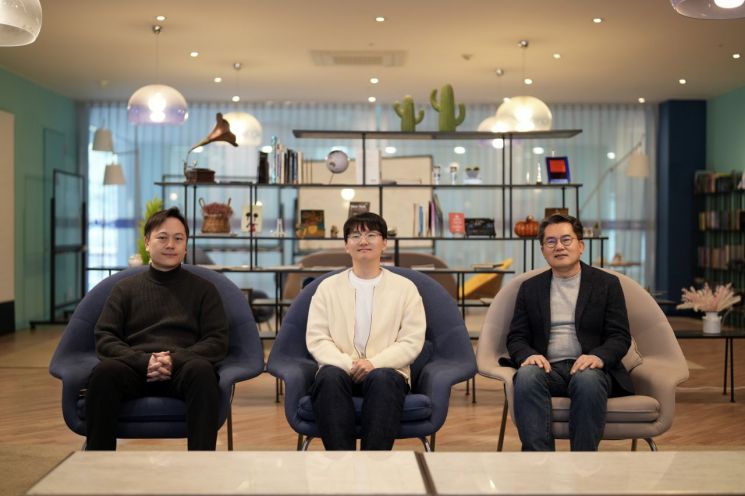 (From left) Professor Oh Hyun-chul, Researcher Nam Joo-han, Professor Choi Won-young. Provided by UNIST
The developed MOF consists of molecular tunnels with diameters of 1 to 2 nanometers, chemically bonded between metal and organic components, connected in three dimensions. The connected structure resembles a Kirigami pattern, allowing the folding and unfolding of molecular tunnels in specific directions such as horizontal and vertical. Kirigami is a craft technique that creates complex three-dimensional structures by cutting and folding paper, commonly seen in pop-up books and 3D cards.
The research team selected metals and organic materials suitable for creating Kirigami patterns and synthesized them. They then analyzed the internal structure of the synthesized MOF through X-ray diffraction experiments. The results revealed that the size, direction, and dimension of the molecular tunnels connected by the Kirigami pattern can be precisely controlled by external stimuli such as temperature, pressure, and molecules.
In particular, they discovered that by folding and unfolding the molecular tunnels, it is possible to block or selectively open fluid flow in specific directions, similar to manifolds used in boiler distributors and water supply and drainage pipes. They also identified the region of the molecular tunnel that functions as a check valve in the manifold. In this MOF structure, the rotation of the metal-organic tile area acts like turning a check valve.
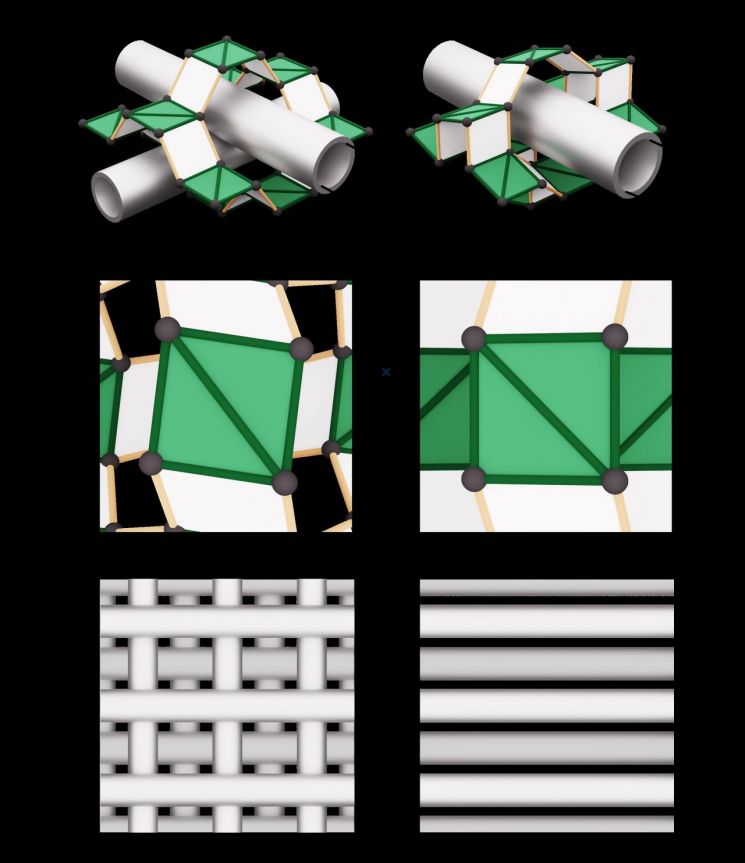
The joint research team explained, “This study confirmed the implementation of a folding mechanism inspired by paper folding at the molecular level, presenting a new direction for designing metamaterials with properties not found in nature.”
The team added, “The characteristics of the developed foldable MOF can be applied to the development of smart adsorbents, energy storage, and separation materials.”
This research was conducted jointly with Dr. Andreas Schneemann’s team at TU Dresden, Professor Sebastian Henke’s team at TU Dortmund, with participation from researcher Nam Joo-han of UNIST and researcher Lee Hong-gyu of Ewha Womans University.
The research results were published online on November 21 in Angewandte Chemie International Edition, a prestigious journal in the field of chemistry. The research was supported by the National Research Foundation of Korea (NRF) under the Ministry of Science and ICT and by Ulsan National Institute of Science and Technology (UNIST).
© The Asia Business Daily(www.asiae.co.kr). All rights reserved.


















