A next-generation lithium-sulfur battery for use in urban air mobility has been developed in South Korea. The battery industry is focusing on the urban air mobility market, which connects air transportation following the electric vehicle market. However, existing commercial lithium-ion batteries have low energy density per weight, limiting their use as an energy source for air mobility. The newly developed lithium-sulfur battery overcomes these limitations and is expected to be utilized as a next-generation energy source for urban air mobility.
KAIST announced on the 23rd that a research team led by Professor Kim Hee-tak from the Department of Biological and Chemical Engineering and a research team from LG Energy Solution collaborated to identify the causes of performance degradation in lithium-sulfur batteries under conditions of reduced electrolyte usage and developed technology to improve performance based on these findings.
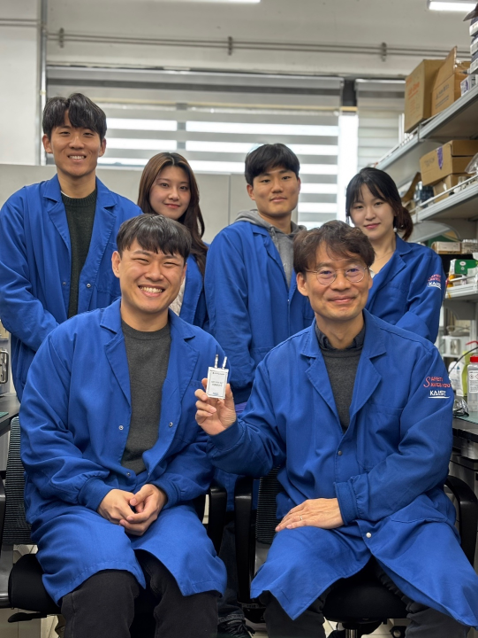 (Front row from left) Ilju Kim, PhD candidate; Heetak Kim, Professor (Back row from left) Sejin Kim, PhD candidate; Yewon Shin, Master's candidate; Dongwoo Kim, Master's candidate; Hyena Cho, Master's candidate. Provided by KAIST
Earlier, China’s CATL announced its ‘Condensed battery’ technology last year, officially signaling its preparation for the aviation battery market. This is an example demonstrating the battery industry’s attention to lithium-sulfur batteries as next-generation technology beyond existing lithium-ion batteries. In fact, the industry regards lithium-sulfur batteries as a game changer in the urban air mobility market due to their energy density per weight being more than twice that of conventional lithium-ion batteries.
However, existing lithium-sulfur battery technology required a large amount of electrolyte for stable battery operation, which increased battery weight and consequently reduced energy density.
Additionally, in dilute electrolyte environments where electrolyte usage is reduced, performance degradation accelerates, and the degradation mechanisms were not clearly understood, making it difficult to develop lithium-sulfur batteries for practical application in urban air mobility.
The joint research team overcame these limitations by developing a lithium-sulfur battery that reduces electrolyte usage by more than 60% compared to conventional levels while achieving an energy density of over 400 Wh/kg.
This is evaluated as overcoming the biggest obstacle for batteries in the urban air mobility market by securing stable lifespan characteristics with an energy density more than 60% higher than commercial lithium-ion batteries.
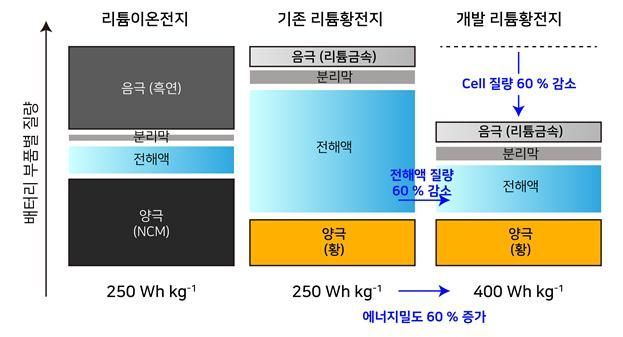
During experiments with various electrolyte environments, the joint research team discovered that electrolyte depletion caused by electrode corrosion was the main factor reducing battery performance. To address this, they introduced fluorinated ether solvents, which enhanced the stability and reversibility of the lithium metal anode and successfully reduced electrolyte decomposition.
The research, with PhD student Kim Il-ju from KAIST’s Department of Biological and Chemical Engineering as the first author, was published in the prestigious energy journal Advanced Energy Materials.
Professor Kim Hee-tak said, “This study is significant in revealing the importance of electrode interface control through electrolyte design in lithium-sulfur batteries. Above all, it is a representative successful case of collaboration between academia and industry, and we expect it to advance the commercialization of batteries for next-generation mobility such as urban air mobility.”
Meanwhile, KAIST and LG Energy Solution plan to continue strengthening their collaboration on battery technology for next-generation mobility to lead the new battery market.
© The Asia Business Daily(www.asiae.co.kr). All rights reserved.
![Clutching a Stolen Dior Bag, Saying "I Hate Being Poor but Real"... The Grotesque Con of a "Human Knockoff" [Slate]](https://cwcontent.asiae.co.kr/asiaresize/183/2026021902243444107_1771435474.jpg)

















