Slight Decrease from April's Original 9.2 Trillion Won
Samsung's Investment Plan Change Seems to Have Impact
Investment Scale Revised to 'Over $37 Billion'
Reflects Mid- to Long-Term Plans Including Global Investment 'Optimization'
Accelerating Preparation for Taylor Plant Operation Using Subsidies
Likely to Focus on Advanced Process Development and Customer Attraction
The U.S. government has finalized subsidies to be paid to Samsung Electronics, which is building a large-scale semiconductor production facility in the United States, at $4.745 billion (approximately 6.9 trillion KRW). This is about a 26% reduction compared to the $6.4 billion (approximately 9.2 trillion KRW) announced when both parties signed the preliminary memorandum of transaction (PMT) last April.
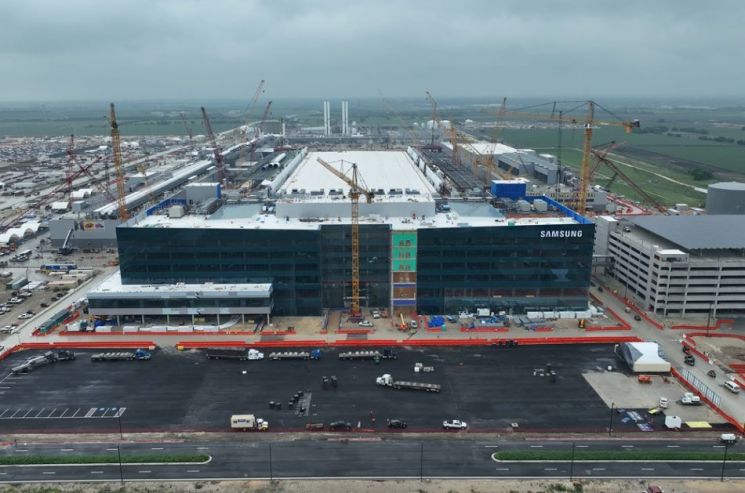
Although the amount is somewhat lower than the original plan, the finalization of the long-awaited subsidy payment holds great significance. Accordingly, Samsung Electronics is expected to gain momentum in constructing the Taylor plant, which is targeted to begin operations in 2026.
The U.S. Department of Commerce announced on the 20th (local time) that following the signing of the preliminary memorandum of transaction and the completion of department-level due diligence, it will directly pay approximately 6.9 trillion KRW in subsidies to Samsung Electronics under the Semiconductor Act.
The Commerce Department explained that this will support Samsung’s investment of more than $37 billion (approximately 53 trillion KRW) over the coming years to transform its current semiconductor production facility located in central Texas into a comprehensive ecosystem for advanced semiconductor development and production within the United States.
Gina Raimondo, U.S. Secretary of Commerce, stated in a press release, "With this investment in Samsung, the United States has become the only country where all five of the world’s top advanced semiconductor manufacturers have established operations." She added, "This will ensure a stable domestic supply of cutting-edge semiconductors essential for artificial intelligence (AI) and national security, while also creating tens of thousands of high-quality jobs."
Samsung Electronics’ subsidy amount is less than that of Intel ($7.865 billion), TSMC ($6.6 billion), and Micron ($6.165 billion). However, when considering the subsidy-to-investment ratio by company, Samsung’s subsidy remains at a high level. Samsung’s subsidy-to-investment ratio is 12.7%, higher than that of U.S. companies Micron (12.3%) and Intel (8.7%). SK Hynix, which signed a direct subsidy payment contract with the U.S. on the 19th, has a subsidy-to-investment ratio of 11.8%, and Taiwan’s TSMC is at 10.3%.
The reduction in subsidies is reportedly due to some changes in Samsung Electronics’ investment plans. Initially, Samsung had agreed to invest a total of $44 billion in the U.S. by 2030 and signed a preliminary memorandum of transaction to receive $6.4 billion in subsidies, negotiating with the U.S. government accordingly. However, during negotiations, the final investment scale was reportedly lowered to "more than $37 billion."
This appears to reflect some adjustments in the mid- to long-term investment plans for more efficient global investment execution. Samsung Electronics recently secured sufficient production capacity (capability) for foundry (semiconductor contract manufacturing) and advanced packaging research and development (R&D) fabs, including the Pyeongtaek Campus and Giheung NRD-K.
In particular, the Giheung NRD-K, which held its equipment installation ceremony on the 18th of last month, is a state-of-the-art integrated R&D complex that Samsung is building to lead future semiconductor technologies. It conducts technology research and product development across all semiconductor fields, including memory, system, and foundry. It is scheduled to begin full operations by mid-next year, with a total investment scale of 20 trillion KRW by 2030. Additionally, Samsung aims to operate an advanced system semiconductor line in the Yongin National Industrial Complex starting in 2030.
The sluggishness in the foundry business also seems to have had an impact. Samsung Electronics’ foundry business is estimated to have incurred losses exceeding 2 trillion KRW last year due to poor orders and is expected to post losses of several trillion KRW this year as well. As a result, Samsung has begun adjusting operating rates by suspending some foundry equipment operations. The Taylor plant, which began construction in 2022, was originally scheduled to start operations in the second half of this year, but the timeline has been pushed back to 2026 due to a slowdown.
Based on the negotiations with the U.S. Department of Commerce, Samsung Electronics plans to accelerate advanced fine process development, Taylor plant construction, and customer acquisition to ensure there are no setbacks in preparing for the Taylor plant’s operation in 2026. Samsung plans to build state-of-the-art logic production lines and R&D lines at the Taylor plant, aiming to develop it into a hub for advanced fine process implementation and research and development within the United States.
© The Asia Business Daily(www.asiae.co.kr). All rights reserved.

















