US Launch Tonight in Korean Time
Swarm Operation Possible... Strengthening 'North Korea Surveillance'
Our military's third reconnaissance satellite is set to launch into space. The third reconnaissance satellite to be launched this time is the second Synthetic Aperture Radar (SAR) satellite, which is expected to enable cluster operation of reconnaissance satellites.
The Ministry of National Defense announced that at around 8:34 PM Korean time on the 21st, the military reconnaissance satellite No. 3 will be launched aboard SpaceX's Falcon 9 rocket from the Vandenberg Space Force Base in California, USA. At 136 seconds after launch, the first stage engine will separate, and at 195 seconds, the fairing (satellite protective cover) will separate. After 3,099 seconds, it will enter the target orbit. If it successfully reaches orbit, it will deploy solar panels and antenna reflectors, then undergo an initial operation period and operational test evaluation to verify various functions and communications before being commissioned.
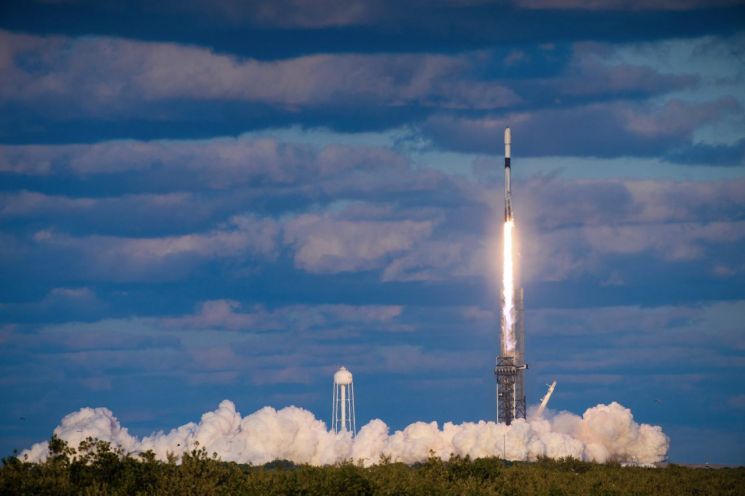 Launch scene of the second military reconnaissance satellite in April this year. Provided by the Ministry of National Defense
This satellite is the third satellite launched under the '425 Project' to secure medium-to-large reconnaissance satellites. The project involves deploying five reconnaissance satellites: one electro-optical/infrared (EO/IR) satellite (No. 1) and four SAR satellites (Nos. 2 to 5). The name 425 (Saio) comes from combining the Korean pronunciations of SAR ('Sa') and EO ('Io').
Previously, the No. 1 EO/IR satellite was launched in December last year and was commissioned in August this year. The No. 2 SAR satellite was launched in April this year and is currently undergoing operational test evaluation, with mission commencement expected around February next year.
The No. 3 satellite to be launched this day is the second SAR satellite, and with the number of identical SAR satellites increasing to two, cluster operation of reconnaissance satellites becomes possible. This means multiple satellites operate together to perform the same mission. This increases opportunities for information acquisition, diversifies observation angles, and enables flexible response to situations.
 Images acquired from left to right by SAR, EO, and IR sensors. Provided by the Ministry of National Defense.
The 425 Project diversified satellite sensors into electro-optical, infrared, and SAR types. Electro-optical sensors use visible light like a camera to directly capture images of the ground, providing excellent image visibility and readability. However, they have limitations depending on weather conditions such as nighttime or clouds. Infrared sensors visualize detected information through temperature differences and can acquire images even at night. SAR satellites emit radio waves to the ground and generate images by receiving reflected signals. They are unaffected by weather but require expert analysis.
The military plans to continue real-time surveillance of North Korean areas by utilizing these complementary sensors and multiple satellites. Once all five satellites under the 425 Project are commissioned, it is expected to be possible to monitor and reconnoiter specific targets within North Korea every two hours. Seok Jong-geon, Director of the Launch Management Team and head of the Defense Acquisition Program Administration overseeing the launch of the No. 3 satellite, stated, "Through Korea's first cluster operation of reconnaissance satellites, increased opportunities for image acquisition and sensor utilization tailored to target characteristics will enable three-dimensional identification of North Korea's provocation signs in the future."
© The Asia Business Daily(www.asiae.co.kr). All rights reserved.
![Clutching a Stolen Dior Bag, Saying "I Hate Being Poor but Real"... The Grotesque Con of a "Human Knockoff" [Slate]](https://cwcontent.asiae.co.kr/asiaresize/183/2026021902243444107_1771435474.jpg)

















