Energy Economics Institute Research Achievements Presentation
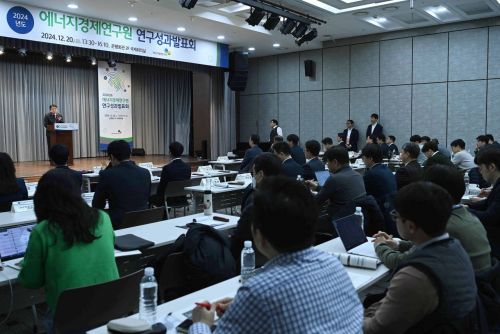 On the 20th, Choi Nam-ho, the 2nd Vice Minister of the Ministry of Trade, Industry and Energy, delivered a congratulatory speech at the 2024 Research Performance Presentation held by the Korea Energy Economics Institute at the Eunhaenggwe-gwan in Seoul. December 20, 2024. Photo by the Ministry of Trade, Industry and Energy
A study has found that when renewable energy, energy storage systems (ESS), and small modular reactors (SMR) are used together, greenhouse gas emissions are reduced by half compared to using 100% renewable energy alone. Additionally, combining renewable energy with SMR is analyzed to reduce power procurement costs by up to 90% compared to using only renewable energy.
According to data presented by Research Fellow Kim Jong-woo at the ‘2024 Research Performance Presentation’ hosted by the Korea Energy Economics Institute on the 20th, using ESS alongside renewable energy reduces the annual power grid usage share to between 21.9% and 37.4%, significantly alleviating the time-of-use power supply imbalance for companies.
In contrast, without ESS, even if 100% renewable energy is procured, reliance on grid power ranges from 32.2% to 69% depending on the time of day.
Furthermore, simultaneous use of renewable energy and the innovative small modular reactors (iSMR, three units with 680MW capacity) being developed by Korea Hydro & Nuclear Power is analyzed to substantially mitigate the annual power shortage (3TWh).
Especially when ESS facilities are used together with renewable energy and iSMR (based on industrial use), the annual indirect greenhouse gas emissions are analyzed at 1,448,000 tCO2eq (tons of CO2 equivalent), which is a 49.6% reduction compared to the 2,871,000 tons when procuring 100% renewable energy alone.
Based on electricity for general use, combining ESS, renewable energy, and iSMR results in carbon emissions of 1,840,000 tons, a 42.6% decrease compared to 3,208,000 tons when using 100% renewable energy alone.
Moreover, the study shows that procuring clean power by combining renewable energy and iSMR can reduce procurement costs by 70.7% to 90.9% based on the levelized cost of electricity (LCOE) compared to using 100% renewable energy. Research Fellow Kim Jong-woo explained, “Adding ESS will further reduce procurement costs.”
Based on these research results, Research Fellow Kim Jong-woo stated, “In addition to large nuclear power plants, financial investment and support policies are needed to secure technologies for various carbon-free power sources early, such as SMR, carbon capture and storage (CCS), and clean hydrogen, as well as to promote ESS technology and dissemination.”
Meanwhile, Google, having achieved RE100 in 2017, is promoting the ‘24/7 CFE Compact’ aiming for 24/7 carbon-free energy (CFE) supply by 2030. South Korea has been leading the CFE initiative since 2023. The Climate Group, which promotes the RE100 campaign, announced in September its intention to collaborate with 24/7 CFE.
On the same day, Research Fellow Jang Yeon-jae presented the results of the ‘Study on Enhancing Cost Efficiency of Solar Power Supply through Analysis of Site Selection Factors.’
Research Fellow Jang said, “Relaxing solar power setback distance regulations is expected to contribute to the expansion of cost-effective solar power deployment,” but also explained, “To ensure the effectiveness of deployment expansion following the removal of setback regulations, it is necessary to concurrently plan to secure grid capacity in areas with high grid congestion.”
Research Fellow Jang added, “Policies that guide power generation facilities to specific regions through price signals such as regional differential tariffs may have limited effectiveness,” and emphasized, “Careful institutional design is needed, including combining with other policies.”
The solar power setback distance regulation restricts the installation of solar power facilities within a certain radius from houses or roads. Since the regulation was introduced in 2015, the potential area for solar power sites has been continuously decreasing.
Grid congestion refers to the phenomenon where solar power facilities concentrate in areas with relatively low land prices and high solar irradiance. In Jeollanam-do and Jeollabuk-do provinces, grid congestion has intensified, causing delays in grid connection, which has become an obstacle to solar power deployment.
© The Asia Business Daily(www.asiae.co.kr). All rights reserved.
![Clutching a Stolen Dior Bag, Saying "I Hate Being Poor but Real"... The Grotesque Con of a "Human Knockoff" [Slate]](https://cwcontent.asiae.co.kr/asiaresize/183/2026021902243444107_1771435474.jpg)
















